I haven’t done this in awhile, but
the topic came up in my brain. My current car is a 2009 Dodge
Charger R/T, with the 370 HP 5.7L HEMI V8. I’ve already covered that
in the past, and in any case haven’t drag raced the Charger, so I’ll stick with
the story.
In 1992 I fell in love with the
Pontiac Firebird Formula, in particular the model with the tuned port injected
5.7L V8, the L98, commonly known as a Formula 350 to distinguish it from most
’87-92 Formulas, which had the 5.0L (305) V8. The 350 was born in
1967, amidst the performance age, first offered in the brand new 1967 Camaro
SS, whereas the 305 came on the scene in 1977. Both have the same
stroke, 3.48, but the 350 enjoys a 4.0 inch bore, whereas the 305 has a 3.74
inch bore. Sadly, this effort to make the V8 more fuel-efficient
also severely compromises its performance potential, as that smaller bore
prevents the engine from breathing properly, no matter what kind of intake,
camshaft, or cylinder heads you’ve got. Bottom line is that if you have
a 305, you’re best off replacing it with a 350, as they’re the same size
externally with far more parts available for the 350. Since the
advent of the LS series engines in the late ‘90s, the 350 is no longer sold in
any vehicle you can buy at a dealer, but Chevrolet certainly still sells the
engine in crate form.
Anyhow.
By June 1995 I finally scored my
much-desired Formula 350, and eventually took it to the local dragstrips. I
went to Maryland International Raceway (MIR) in south eastern Maryland one
especially hot day in the summer. I was there practically alone. I
learned to drop the tire pressure in the rear tires to hook up at the starting
line. My times were in the mid 14s.
Soon after, I learned of another
dragstrip, just south of Frederick, Maryland, 75/80. I took
the Formula there several times. Mostly I did Test & Tune (i.e.
not actually racing). On one date I decided to do a competitive race
just to get one more run in. The other driver redlighted – lost by
default – so I was told to continue to the next round. The next
driver redlighted as well! Back for another run. This
time, I redlighted. D’oh! The winner (driving a 327 powered ’68
Camaro) went on to win the final race, meaning I essentially came in third
place simply by joining one race.
Part of the fun of drag racing is
that you can bring your street car to the dragstrip, then when you do a run,
you get a quarter mile time and a MPH time, which corresponds apples to apples
to the professionals in NHRA. Granted, you’re running 14s and
they’re well below 10, depending on whether they’re Pro Stock or Top Fuel, but
the same standard applies. Is there any NASCAR track that
allows you to run your street car around the track? Is there any
NASCAR track that allows ordinary drivers to race their street cars against
each other? Somehow I doubt it.
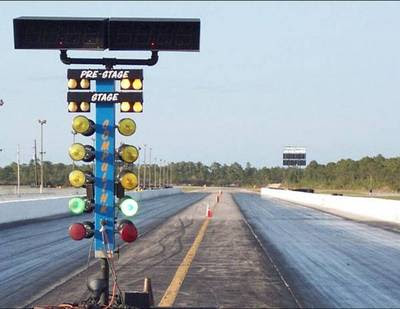
The Tree. You
get three yellows then a GREEN. You leave at the green. If
you leave before the green you redlight, and lose automatically. It’s
fairly simple. Your time from the last yellow to launching on green
is your reaction time. Ideal, quickest, is a half second (.50). Us
slowpokes will start off over a second and work our way down to maybe .60. I
don’t think I ever reached a perfect .50.
Times. A
slow car might do the quarter mile in 20 seconds. Most stock
Firebirds, Camaros and Mustangs will run 16s. A fast street car will
be in the 14s, and a very fast street car, something like a Viper or a ZR1
Corvette, in the 12s. Anything in the 10s or lower is almost certainly
a non-street legal drag racing car.
It helps if you’re running slicks,
which can cut over a second off your time. Traction is often an
issue with street cars, their treaded tires compromising their quarter mile
times but saving them from flying off the road when it rains. A
comrade of mine, driving a 1969 Plymouth Barracuda hardtop, would actually
unmount his street tires, mount slicks, and run with the slicks. This
‘Cuda had no mufflers, a balanced and blueprinted Mopar 360, and a twin turbo
setup going through a QuadraJet (???). He had a roll cage and
the doors bolted shut, so he’d have to climb in, Dukes of Hazzard style. It
was blue with 01 painted on the doors. The thing was extremely loud. I
believe he was running 10s.
Bracket Racing. It’s
no fun losing to a faster car, so to keep things interesting for those not
running actual race cars (“heads up” racing is the standard format where both
cars leave at the same time), they developed this. You pick a
dial-in time, e.g. 14.5 seconds. Your opponent in the other lane
does the same, e.g. 15 seconds. Whoever has the slower dial-in will
get a green light faster, by the difference in dial-ins. If you run
faster than your dial-in (break out), you lose automatically unless your opponent
did the same by a higher margin. Ideally they match up cars with
similar dial-ins, but occasionally you’d see a 16 second car take off, and four
seconds later his 12 second opponent launches and might even come from behind
to catch up. Whoever crosses the finish line first without breaking
out, wins.
My 14 second Formula had a
modified 350 rated nominally around 300 horsepower. Although I
replaced the torque converter with a 2800 stall model, put a shift kit in the
700R4, and upgraded the rear gears from 3.23 to 3.73, I don’t think I ever took
the car to the track after making those upgrades. Incidentally, the
original owner, after giving the car the SLP upgrades which pushed the HP from
240 (stock) to 290, had the car running high 13s. To my recollection,
my best time was 14.28 at 99 mph.
The Charger is rated at 370 HP, so
I suppose it should run faster than the Formula. Oddly, it’s a 2009
but the 2019 Charger R/T is still rated at the same power – though now there’s
the SRT8 at 420 HP and the supercharged Charger Hellcat – for a mere $70,000 –
putting out 700 HP; the engine itself available from Mopar Performance as a
crate engine… for $20,000 [https://www.motortrend.com/news/dodge-hellcat-crate-engine/]. According
to the Interweb, the ’09 Charger R/T is supposed to be able to do the quarter
mile in 13.9 seconds. Actually not that great
considering the original owner of my Formula, rated at 300, was able to get
that car to do the quarter in 13.8 seconds, as noted above.

