Friday, March 25, 2022

Cover Albums


The March 2022 issue of Classic Rock Magazine has its cover story on … covers.  “Covers” are when one musician plays a song by another musician.  Oddly, although Garage, Inc. (Metallica’s double covers album) is mentioned, there’s really no discussion of cover albums per se.  And as I can show you below, there are now plenty of them to talk about.

Morning and Evening.  When bands are starting out, they have to rely on covers until they hone the skills necessary to write acceptable quality material of their own, obviously drawing upon the inspiration of those covers.  The Beatles had gone to 100% originals by the third album, A Hard Day’s Night, but even Please Please Me (#1) and With The Beatles (#2) were less than 50% covers.  The Stones didn’t make it to 100% originals until Aftermath, their fourth album, and the first album had only one original.

Likewise, when the bands get older and run out of gas, rather than put out an album of substandard originals, it’s much easier just to do an album of covers.  Of course, it’s intriguing to hear how they put their mark on other bands’ music.  What I noticed, though, was most of these covers predate the band’s own material and – as Saxon explicitly acknowledge with the album title – were their inspirations.  What I rarely hear are any of these bands playing covers of their own peers and competitors.  Thus no Beatles covers on Blue & Lonesome, no Black Sabbath (and just a snippet of “Dazed and Confused” in a medley) on Turning to Crime, no Megadeth, Slayer or Anthrax on Garage, Inc. 

Here they are, listing the songs and the original artists.

Deep Purple, Turning To Crime.  The most recent of these.  Half are fairly obscure 50s tunes, the rest are more famous 60s tunes.

7 and 7 Is (Love); Rockin’ Pneumonia and the Boogie Woogie Flu (Huey “Piano” Smith); Oh Well (Fleetwood Mac); Jenny Take A Ride (Mitch Ryder & the Detroit Wheels); Watching The River Flow (Bob Dylan); Let The Good Times Roll (Louis Jordan & the Tympany Five); Dixie Chicken (Little Feat); Shapes of Things (Yardbirds); The Battle of New Orleans (Johnny Horton); Lucifer (Bob Seger); White Room (Cream); Caught in the Act (medley including “Dazed and Confused” (Led Zeppelin), “Hot ‘Lanta” (Allman Brothers))

Ace Frehley, Origins Vols 1 & 2.  The original lead guitarist for KISS.  These were released separately in 2016 and 2020.  He claims he’ll do a Vol. 3, but the story quoting him saying so isn’t dated.

Vol #1.  White Room (Cream); Street Fighting Man (Rolling Stones); Spanish Castle Magic (Jimi Hendrix); Fire And Water (Free); Emerald (Thin Lizzy); Bring It On Home (Led Zeppelin); Wild Thing (Troggs); Parasite (KISS – really a cover?); Magic Carpet Ride (Steppenwolf); Cold Gin (KISS); Till The End of the Day (Kinks); Rock and Roll Hell (KISS)

Vol #2.  Good Times Bad Times (Led Zeppelin); Never In My Life (Mountain); Space Truckin’ (Deep Purple); I’m Down (Beatles); Jumpin’ Jack Flash (Rolling Stones); Politician (Cream); Lola (Kinks); 30 Days In The Hole (Humble Pie); Manic Depression (Jimi Hendrix); Kicks (Paul Revere & the Raiders); We’ve Gotta Get Out of This Place (Animals); She (KISS)

Fu Manchu, The Covers.  I have this on vinyl, and have never seen it on CD.  It doesn’t show up on Amazon or eBay in either format, nor does their Wikipedia discography even mention it.  Apparently it was a limited release of 700 copies by the band itself.  As stoner rock bands go, FM have shorter, snappier, high tempo songs, often about skateboarding, so the punk influence is definitely front center, as the cover choices make clear. 

Who Are You (Void); Nothing Done (SSD); D.O.A. (Van Halen, not Bloodrock); When The Shit Hits The Fan (The Circle Jerks); Moving in Stereo (The Cars); Beach Blanket Bongout (JFA); Freedom of Choice (Devo); Godzilla (Blue Oyster Cult); Things Start Moving (Adolescents); Ride To Live (Live To Ride) (Twisted Sister); Six Pack (Black Flag); Words To Live By (Penance); Jailbreak (Thin Lizzy); Chevy Van (Sammy Johns).

Yngwie Malmsteen, Inspiration.  A few years back before the Saxon album.  YM plays large headstock Stratocasters with scalloped fretboards and took classical music into overdrive, blending it with obvious influences of Ritchie Blackmore, Uli Roth, and Jimi Hendrix, which makes their inclusion on this covers album a no-brainer.  Although he’s obviously talented and practiced those oddball scales rigorously, somehow he doesn’t seem to pull off more bluesier solos that well.  My recollection is that I got the UK album after hearing this one, the only track on the album I wasn’t already familiar with. That’s a prog super group with Allan Holdsworth (guitar), John Wetton (bass & vocals), Bill Bruford (drums), and Eddie Jobson (keyboards).

Carry On Wayward Son (Kansas); Pictures of Home (Deep Purple); Gates of Babylon (Rainbow); Manic Depression (Jimi Hendrix); In the Dead of Night (UK); Mistreated (Deep Purple); The Sails of Charon (Scorpions); Demon’s Eye (Deep Purple); Anthem (Rush); Child in Time (Deep Purple); Spanish Castle Magic (Jimi Hendrix)

Metallica, Garage, Inc.  Before this, they had “broken in” Jason Newsted with the $5.98 EP, Garage Days Re-Revisited (1987), before his bass was ignored on …And Justice For All.  Fast forward to 1998, when the band released Garage, Inc., which included the EP on disc 2 along with other previously released covers – including “Am I Evil” (Diamond Head) and “Blitzkrieg” (Blitzkrieg) which had been the b-sides of “Creeping Death” and tacked on to the Elektra version of their first album, Kill ‘Em All.  Then they went into the studio and recorded a whole CD worth of new covers, for a two disc set.  I like that they pick more obscure tunes instead of big hits.

Disc 1 (Freshly recorded):  Free Speech For the Deaf (Discharge); It’s Electric (Diamond Head); Sabbra Cadabra (Black Sabbath); Turn The Page (Bob Seger); Die, Die My Darling (Misfits); Loverman (Nick Cave); Mercyful Fate (Mercyful Fate); Astronomy (Blue Oyster Cult); Whiskey In the Jar (traditional, played by Thin Lizzy); Tuesday’s Gone (Lynyrd Skynyrd); The More I See (Discharge)

Disc 2 (previously released):  Helpless (Diamond Head); The Small Hours (Holocaust); The Wait (Killing Joke); Crash Course in Brain Surgery (Budgie); Last Caress/Green Hell (Misfits); Am I Evil? (Diamond Head); Blitzkrieg (Blitzkrieg); Breadfan (Budgie); The Prince (Diamond Head); Stone Cold Crazy (Queen); So What (Anti-Nowhere League); Killing Time (Sweet Savage); Overkill (Motorhead); Damage Case (Motorhead); Stone Dead Forever (Motorhead); Too Late Too Late (Motorhead) 

Monster Magnet, A Better Dystopia.  New Jersey's premiere stoner rock band.  Dave Wyndorf gave us this collection of mostly obscure tunes.  I would have preferred an entire album of Hawkwind covers – or least add in their earlier covers of “Brainstorm” and “The Right Stuff” – but at least he gives us the distinction of the only Hawkwind cover on any of these albums.

The Diamond Mine (spoken word intro); Born To Go (Hawkwind); Epitaph For A Head (Blackfoot); Solid Gold Hell (Scientists); Be Forwarned (Pentagram); Mr. Destroyer (Poobah); When The Wolf Sits (Jerusalem); Death (Pretty Things); Situation (Josefus); It’s Trash (Cavemen); Motorcycle (Straight To Hell) (Table Scraps); Learning To Die (Dust); Welcome To The Void (Morgen)

Motorhead, Under Cover.  Given that the man himself, Lemmy, already did “Motorhead”, “Lost Johnny” and “The Watcher” on both On Parole and Motorhead, I suppose Hawkwind songs weren’t going to show up here, though “Silver Machine” would have been cool. 

Breaking The Law (Judas Priest); God Save The Queen (Sex Pistols); Heroes (Bowie & Fripp); Starstruck (Rainbow); Cat Scratch Fever (Ted Nugent); Jumpin’ Jack Flash (Rolling Stones); Sympathy For The Devil (Rolling Stones); Hellraiser (Ozzy Osbourne); Rockaway Beach (Ramones); Shoot ‘Em Down (Twisted Sister); Whiplash (Metallica)

Ozzy Osbourne, Under Cover.  Yes, the same title as Lemmy’s.  Instead of Zakk Wylde, his guitarist on this is Jerry Cantrell of Alice In Chains.  Mike Bordin of Faith No More (who also played drums with Ozzy’s solo band, and Black Sabbath on the 1997 Ozzfest tour) is here on drums.  Ozzy gives us lots of hits from left field: a Beatles song, two John Lennon songs, King Crimson, and the hit the Moody Blues had before Justin Hayward and John Lodge joined and they became a prog band with Days of Future Passed, “Go Now”. 

Rocky Mountain Way (Joe Walsh); In My Life (Beatles); Mississippi Queen (Mountain); Go Now (The Moody Blues); Woman (John Lennon); 21st Century Schizoid Man (King Crimson); All The Young Dudes (Mott the Hoople); For What It’s Worth (Buffalo Springfield); Good Times (The Animals); Sunshine of Your Love (Cream); Fire (Arthur Brown); Working Class Hero (John Lennon); Sympathy For The Devil (Rolling Stones); Changes (Black Sabbath – yes, like Ace, covering a song he was originally on)

The Rolling Stones, Blue & Lonesome.  Eleven years after their last album of original material, A Bigger Bang (9/5/05), the Stones come back with an album of exclusively blues covers.

Just Your Fool (Little Walter); Commit A Crime (Howlin’ Wolf); Blue and Lonesome (Little Walter); All of Your Love (Magic Sam); I Gotta Go (Little Walter); Everybody Knows About My Good Thing (Miles Grayson & Lermon Horton); Ride ‘Em On Down (Eddie Taylor); Hate To See You Go (Little Walter); Hoo Doo Blues (Otis Hicks & Jerry West); Little Rain (Ewart G. Abner Jr & Jimmy Reed); Just Like It Treat You (Willie Dixon); I Can’t Quit You Baby (Willie Dixon)

Rush, Feedback.  Back in 2007, fairly short – just an EP.  They did a tour for this album, which we saw, and for which some of the concert t-shirts were tie-dyes, with the 2112 Naked Man (who may or may not be the same naked guy from the Hemispheres cover) is now afraid of a peace symbol instead of a red star.

Summertime Blues (Eddie Cochran, but homage to The Who version, not the Blue Cheer version); Heart Full of Soul (Yardbirds); For What It’s Worth (Buffalo Springfield); The Seeker (The Who); Mr Soul (Buffalo Springfield); Seven and Seven Is (Love); Shapes of Things (Yardbirds); Crossroads (Robert Johnson/Cream).

Saxon, Inspirations.  Along with Iron Maiden and Def Leppard, among the trio of most successful New Wave of British Heavy Metal (NWOBHM) bands to emerge from the early 1980s and not merely survive but prosper, even if they aren't quite as famous or successful as the other two.  Biff & his comrades came out with this relatively recently.

Paint It Black (Rolling Stones); Immigrant Song (Led Zeppelin); Paperback Writer (Beatles); Evil Woman (Crow); Stone Free (Jimi Hendrix); Bomber (Motorhead); Speed King (Deep Purple); The Rocker (Thin Lizzy); Hold The Line (Toto); Problem Child (AC/DC); See My Friends (Kinks)

Tesla, Real to Reel (Discs 1 & 2).  Often lumped together with Motley Crue and Skid Row as a "hair metal" band, Tesla were less about image than about the music itself, with a sincerity that was sometimes borderline naive.  Disc 1 was sold outright in CD packaging allowing for two.  The second disc was given at the shows for that tour, which I saw at the Ram’s Head Live in Baltimore.  Frank Hannon himself was at the merch booth and give me the disc – and signed the insert.

Reel 1.  Space Truckin’ (Deep Purple); Walk Away (James Gang); Hand Me Down World (Guess Who); Bad Reputation (Thin Lizzy); Thank You (Led Zeppelin); I’ve Got A Feeling (Beatles); Day of the Eagle (Robin Trower); Ball of Confusion (Temptations); Rock Bottom (UFO); Stealin’ (Uriah Heep); Bell Bottom Blues (Derek & the Dominos); Honky Tonk Woman (Rolling Stones); Dear Mr. Fantasy (Traffic)

Reel 2.  All The Young Dudes (Mott the Hoople); Make It Last (Montrose); Shooting Star (Bad Company); Not Fragile (BTO); Street Fighting Man (Rolling Stones); It’s My Body (Alice Cooper); I Want To Take You Higher (Sly and the Family Stone); Do You Feel Like We Do (Peter Frampton); Beer Drinkers and Hell Raisers (ZZTop); Seasons of Wither (Aerosmith); Saturday Night Special (Lynyrd Skynrd); War Pigs (Black Sabbath)

UFO, The Salentino Cuts.  They started off with Mick Bolton on guitar for two space jam-type albums, then found Michael Schenker for five major seventies albums and a later trio of reunion albums; Vinnie Moore has been the guitarist for the last several albums.  The only constant member has been vocalist Phil Mogg, and they give us a rare gem: a LATER song, “River of Deceit” from Mad Season. 

Heartful of Soul (Yardbirds); Break on Through (The Doors); River of Deceit (Mad Season); The Pusher (Steppenwolf); Paper In Fire (John Mellencamp); Rock Candy (Montrose); Mississippi Queen (Mountain); Ain’t No Sunshine (Bill Withers); Honey-Bee (Tom Petty); Too Rolling Stoned (Robin Trower); Just Got Paid (ZZTop); It’s My Life (Animals).

As these are all experienced professionals, I didn’t hear any songs butchered, though I didn’t hear any where I felt they had improved on the originals.  In about 20% of the cases I was unfamiliar with the source material to make any kind of comparison anyway.  As a Monster Magnet fan, though, I was dissatisfied with Wyndorf’s choices; it seems he deliberately picked extremely obscure tracks to continue cultivating his “aren’t I cool?  I wear sunglasses at night” persona. 

Tribute Albums.  I suppose the opposite of a covers album, where one band covers all sorts of different bands’ songs, is a tribute album, in which all different bands cover one band’s songs.  The most recent was Blacklist, where Metallica’s 1991 self-titled, so-called Black Album, gets cover treatment by a host of bands outside their own genre.  The sad apart about it is that almost all of them make the original versions sound that much better.  It’s almost as if the band was thinking, “well, everyone seems to think we sold out on this album, but here are versions of our songs which are far more commercial than our own.  See how you like those.” 

Sunday, March 13, 2022

Red Dawns


Finally something to write about which I haven’t covered before.   With Russia becoming the Bad Guys once again, thanks to their tourism extravaganza in Ukraine, revisiting this movie, and watching its 2012 remake, became appropriate and amusing again.

Red Dawn (1984).  A small town in Colorado is abruptly attacked by Communist bloc army of Russians, Afghans and Sandinistas.  The local high school students take to the hills and continue the fight.  A USAF pilot, Tanner (Powers Boothe) is shot down but manages to join their group.  Casualties are to be expected, but a few survive to make their way to US lines and freedom.  The big two here are Jed Eckert and his brother Matty (Patrick Swayze and Charlie Sheen – the first major role for each of them).  The female contribution is Jennifer Grey – before her hookup with Swayze in “Dirty Dancing” – and Lea Thompson, briefly before she fell in love with Marty McFly, her own son gone back in time before his parents even hooked up (Grey and Sheen "hook up" briefly in "Ferris Bueller's Day Off"). Ron “Superfly” O’Neal is one of the Red leaders, evidently a former Sandinista.

Released in August 1984, we saw this when it came out.  It was right in the Reagan years, when patriotism was running high, to put it mildly.   Grenada was two years earlier, and I even managed to visit the USSR – Kiev, Moscow and Leningrad – in March 1983.  All the boxes are checked off here: AK47s, MI24 Hinds (actually French helicopters modified to look like them), and plenty of anti-communist and pro-American propaganda, either cringeworthy or amusing depending on your viewpoint.  Too bad these days, the types most likely to identify with the Wolverines tried to take over the government on January sixth and actually support Putin, because their beloved leader seems to have a tiny hard-on for the Russian dictator.  That’s the cue for the rest of us to stock up on AR15s and AK47s (plus the 5.56mm and 7.62x39mm ammunition they fire).  Oddly, some of the Comm-Bloc soldiers were actually firing FALs - not aware of any communist country which adopted it.

I like it, even if I can recognize the “check the boxes” deal of immersing in contemporary uber-patriotic propaganda which this film indulges in.  The extra features were amusing to watch.  Although the movie takes place in Colorado, it was filmed in a small town in New Mexico, with the familiar name of Las Vegas, although this one doesn’t seem to have any casinos, and its fanciest hotel is supposedly haunted.  The town is not far east from Santa Fe.  The film crew hired experts to teach the cast about weapons training, as none of them (except C. Thomas Howell) had any relevant experience.  Lea Thompson said that was immensely fun.  She also shared the common knowledge that Patrick Swayze and Jennifer Grey did not get along with each other.  Well, three years later they could dance together without shooting at anyone, or each other. 

Red Dawn (2012).  I suppose if you remake a movie that was never particularly popular in the first place, there’s no wonder the remake won’t be a whole lot more popular (though I suppose “The Thing” is a counterexample).  Instead of a small town in Colorado, it’s Spokane, Washington (a decent sized city).  Instead of a Comm-bloc alliance army, it’s the North Koreans (!!) with a Russian Spetsnaz advisor.  Chris “Thor” Hemsworth takes over the Patrick Swayze (Jed Eckert) role, and Jeffrey Dean Morgan takes the Colonel Tanner role, now USMC instead of USAF.  Unlike the prior Jed Eckert, who was just a former football player, this one was in Iraq with the USMC and has combat experience.  Josh Hutcherson is the only other major actor here, dwarfed by Hemsworth. 

As we’re talking about North Koreans and not Sandinistas, Colonel Bella (O’Neal’s) comment about the guerillas turning into policemen is now switched with Jed Eckert talking about “policemen who are now guerillas”.  Other plot angles are switched as well, almost as a matter of principle.  Instead of a group gradually wound down in numbers (1984) this time they have a specific target, a black box (olive drab suitcase) which contains the North Koreans' anti-EMP device.   

Part of what makes this one a little stranger, is that as implausible as the “Russians invade us through Mexico” scenario of the first movie was, an invasion by North Korea is far more implausible than that.  If they can’t even roll back into Seoul and down to Pusan, it’s unclear which navy they have which can take an invasion force to Washington State.  Same deal with having higher military technology than we do.  As an actual threat, I’d say the Russians have returned to being our most likely adversary, though the Chinese seem to be moving in that direction as well – both far more so than North Korea. 

Either way, it’s the same type of story:  high school students defend their home against a foreign invader.  Ten years later, we’re cheering the Ukrainians as they do the same thing – against Russians, for that matter. 

As Americans we love this business of, "we didn't start this war, but we'll finish it!"  Whether we're avenging Fort Sumpter, the USS Maine, the Lusitania, Pearl Harbor, the USS Maddox, or the 9/11, we love this business of fighting back.  Otto Skorzeny, the black ops specialist of Nazi Germany - who arranged Mussolini's rescue and the behind-the-lines chaos of the Battle of the Bulge, gave SS Leader Heinrich Himmler advice when asked if the Germans could fire a V1 rocket off a U-boat into Manhattan.  "Don't underestimate the Anglo-Saxon strain in the Americans; their morale jumps sky-high when directly threatened."

However, there's no plausible scenario in which we would be faced with enemy ground forces on US soil.  Far more likely, unfortunately, is for Russia, China or North Korea to land on US soil in the form of nuclear assault, and none of our weapons training is of any use against an H bomb.  

Oh, and no sign of Hugh Jackman in either film.  Too bad. 

Friday, February 25, 2022

FN FAL


Back to guns.  I got a book on these for Christmas [The FN FAL Battle Rifle, by Ron Cashner], and briefly entertained the idea of purchasing one, but then realized that their scarcity and cost ($1500-2000) put them out of my budget for the immediate future.  I have yet to fire one in person.  Most are semiautomatic, but I saw a select-fire (full auto capable) model for sale at the recent Dulles Gun Show for $12,000.  As Class III weapons go, that’s a bargain.  DS Arms is still making new ones, based off the Austrian variant, the STG58, generally considered the best version of the FAL. 

Oddly, I have fired the gun, but in a slightly different form.  When we were living in Paris, the nearest US PX was in Belgium, right over the border from France, a three hour drive.  The closest bases in Germany, Kaiserslautern & Ramstein, were 5 hours away.  Initially we would make day trips, until my parents discovered a hotel in Mons, Belgium, the Raymond, which catered to US personnel, mainly people transferring to Brussels and waiting for their sea shipments to come or go.  It had AFN TV and a unique mozzarella pizza I’d never tasted anywhere else.

We’d go out looking around local Mons, and found a toy store which sold plastic guns which fired little plastic bullets.  The muzzle velocity was well short of allowing these bullets to pierce skin, so they were OK.  One was a Thompson SMG – semi auto, of course – and the other was an FAL.  I have no idea where they went, but we enjoyed them for awhile.  I still have my replica MP40, which actually looks exactly like a real one, but you can see the gun is nowhere close to being capable of converted to actually fire bullets, much less full auto.  Anyhow.

While the US upgraded to a semiautomatic rifle, the M1 Garand, slightly before WWII, the UK went through WWII with the Mark 4 Lee Enfield, a bolt-action rifle, as its main weapon.  By the time WWII ended, it was obvious that an upgrade to a better weapon was a good idea.  After some flirting with the idea of a smaller round (in .276 caliber) was done, eventually the US bludgeoned everyone into accepting .308/7.62x51 as the “main round” for NATO.  Fabrique National, the famous Belgian gun company, had been working on a weapon which morphed into the FAL, chambered in 7.62x51.  Oddly, despite insisting that its allies adopt 7.62x51, the US then went ahead and adopted its own intermediate round, the 5.56mm cartridge.  D’oh!

While the US adopted the M14 (in 7.62x51), then the M16 (in 5.56mm), the UK and its Buddies – Canada, Australia, New Zealand, South Africa, etc. – adopted the FAL.  In its main form, the gun has a 21” barrel and is fairly long.  Later, shorter versions came out, including a folding stock “paratrooper” model.  There is an inch pattern which only the British use, and a metric pattern which everyone else uses.  The inch version is semi-auto only, whereas the metric version is select fire (capable of both semi-auto and full-auto fire).  The Israelis and Australians made small changes to their models.  The Indians actually combined elements of the inch and metric pattern versions to make their own. 

Brazil has also been a big fan of the FAL and used it for a long time.  West Germany wanted to use it for the Bundeswehr (West German Army) and asked to produce it in Germany under license.  But the Belgians, who didn’t forget German misconduct during WWII – which included looting and destroying the FN factory at Herstal (northeast of Liege, east of Brussels) on their way out as the Allies pushed them back into Germany – gave them a hard NO.  So the Germans developed the H&K G3. 

Major Conflicts with the FAL. Despite the absence of a World War III, the world has not been completely at peace since August 1945.  Various low-level wars and guerilla conflicts have absorbed the resources of numerous countries which adopted the FAL as their main weapon, pretty much everyone except the Soviet Bloc (who use the AK47 and its variants) and the US, which loves its M16. 

Jadotville, Zaire.  A recent film which features the weapon prominently, even in the promotional photos.  A battle broke out on southeast Zaire in 1961, and a unit of Irish soldiers – with no combat experience – was sent down there, ending up in a siege.  In addition to the FAL, they also used Lee Enfield rifles, Bren guns, and a Vickers heavy machine gun.  Remarkably, none of the soldiers were killed. 

Malayan Emergency, Oman, Aden, Northern Ireland.  During these brief conflicts involving British forces, the weapon of choice was the FAL.   Of these Malaya was a jungle scene, Oman and Aden were desert, and Northern Ireland was urban – Belfast, mainly.  “The Troubles” had the distinction wherein the IRA would lurk among the heavily populated civilian areas, effectively using the locals as shields.  All well and fine when guerillas wear civilian clothes in the jungle or rural areas, but in the middle of the city the challenge is for troops not to shoot civilians who can’t help being caught in the crossfire.    

Suez Canal (1956), Six Day War (1967), and Yom Kippur War (1973).  Leaving aside the original war of liberation in 1948, in which the Israelis were mainly armed with surplus guns from Nazi Germany – now there’s an irony – these three major Middle Eastern conflicts between Israel and its Muslim neighbors saw the IDF using the FAL.  Although there was some discussion of the gun’s reliability in desert conditions, overall the Israelis were pleased with it.

Vietnam War.  Although Harold Wilson’s Labour Government in the UK was against the war in Vietnam – as was John Lennon – the Australians sent troops to fight.  They were issued FALs, which performed well in the jungles of Vietnam.  Generally the troops found the weapon worked best on semiautomatic fire. 

Falkland Islands War (1982).  What’s amusing about this brief war is that not only were the Brits using the FAL, but so were the Argentinians.  Both sides enjoyed the weapon.  The Argentinians were also well equipped with Dassault Mirages and anti-ship missiles.  Merci, mes amis Français.  

It’s on my list of guns to get, but not sure when I’ll have an opportunity to acquire one: ideally a 21” full size model from DS Arms. 

Friday, February 11, 2022

The American School of Paris


Whoa!  A subject I can discuss which I didn’t cover already:  my high school.

Basics.  Established in 1946, after the Germans finally left.  The current campus dates from around the 1960s, supposedly at the former SHAPE facilities, vacant once DeGaulle took France out of NATO – and SHAPE moved up to Belgium.  The school actually has a Lower School (elementary school), a Middle School (junior high), and Upper School (high school).  I went to Marymount, a Catholic school in Neuilly, for fifth through eighth grade, but since Marymount stopped at eighth grade, I had to go somewhere else for high school.

Alternatives.  Georgetown Prep was the outlier, effectively a boarding school had I gone.  My father indicated Good Counsel in Wheaton, MD, would have been where I went had we stayed in Maryland instead of moving to Paris as we did.  Had I gone to Georgetown Prep, I would have been a freshman when Neil Gorsuch was a sophomore and Brett Cavanaugh was a senior.  Maybe going to ASP negatively impacted my legal career, as I’m not a judge, much less a Supreme Court justice.

#2 was the Lycee International in St Germain-en-Laye.  With all classes in French except for English and history, that was a non-starter.  I could barely handle French as it was.  So nope.

ASP was the closest thing to an American high school in Paris, even though it’s actually a private school.  So that was an easy choice for me.

IB.  Instead of Advanced Placement (AP), I took the International Baccalaureate program, despite having no intention of attending college anywhere other than the US.  As it was, I went to the University of Maryland, College Park, my home state university at its flagship campus in College Park. 

IB means three Sub-level courses – for me, those were French, Math, and Psychology (there is no High Psychology) – and three High level courses – and for me, English, Biology and History.  The exams are rated from 1-7, 4 being passing and 7 being an A+.  I got 4 in French, 4 in Math (though got a 6 on the mock exam), and 6 in Psychology.  On the High classes I got 5 on English and Biology and a SEVEN on History.  This is why I went to law school and not medical school.  If I recall correctly, my IB thesis was on Western European volunteers in the German armed forces in WWII.

Sports.  I wasn’t particularly athletically inclined.  The only sport I played was rugby, which for our school in Europe was the equivalent of football.  As mid-height and stocky, I played forward:  at some point I played most positions except hooker or eight man, but as a practical matter I was usually flanker or second row.  I went on one trip to Brussels – Chris Bren bought me my first beer (probably a Stella Artois).  But I wasn’t among the varsity elite and not invited to their parties.  I’m not even listed as a member of the team in the yearbook, although I show up in the pictures.  And I did get a letter (P) on my letter jacket... which I still have.  (It barely fits.)

I tried rugby at UMCP, but the school was so huge, with a top level football team which effectively excluded most of the male student body, that the rugby team was overstocked relative to other schools.  That being the case, the Terp team could be extremely selective.  After banging up my finger, I gave up.  I suppose that finger injury was lucky, as I didn’t screw up my anterior cruciate ligament. 

Other Extracurricular Activities.  Mainly AD&D & RuneQuest with my brother and our gamer buddies Myles & Eoin, Jean, Sean, Sean & Phil. 

Roscoe’s.  I only started going to Roscoe’s, the bar in downtown Paris where the ASP alumni hang out, when I was back in Paris on semester break during college in Maryland.   The drinking age in Paris is 14, compared to 21 in the US, so most high school students and all college students are old enough to drink.  I’d stick with Heineken, whereas the draft beer was Stella Artois.  I could usually count on meeting ASP comrades at Roscoe’s.  After we moved back to the US in 1990, I didn’t have an opportunity to visit Paris again until October 2017, but that short stay was too short to swing by Roscoe’s – the Marine House on Boetie and the Champs Elysees were as close as I got.  If it’s still an ASP-friendly bar, I’d be happy to know.

Favorite Teachers.  Mr. Kite, for freshman English, Mr. Ferguson for psychology, Mr. Mimmack for history, and Fraulein Delacroix for German, were my favorites.  I was not a trouble maker, didn’t smoke, drink, or sample the local hashish, and generally got along well with most teachers and students. 

Late Bus & SNCF.  When I first started at ASP, we were living at the Embassy Compound at Neuilly.  For those of you less familiar with Paris, that’s a suburb right next to Paris (“banlieu”), to the northwest.  That compound is two four-story buildings, a few blocks away from the Bois de Boulogne.  There’s a Boulogne Compound as well, three three-story buildings – down to the southwest of Paris.  I recall the first time we drove past it – I had no clue it existed.  But the buildings are the same architecture and style as the Neuilly Compound, just three stories instead of four.  Wait, is that ours?  It can’t be, those buildings only have three floors, and there were three, not two, of them. MIND.  BLOWN.  Our Embassy Fourth of July parties & fireworks (courtesy of the Marines) were there.  That and Halloween (trick or treating, a tradition unknown amongst the French at that time, i.e. 1979-82) were our occasions to visit the Boulogne Compound.  I later learned my ASP buddy Phil, with whom I’m still friends today, lived there at some time, so we may have been in the same place at the same time and not even known it.  Just like we were in the same Webelos den in Paris without even realizing it.  Weren’t we amazing?  I know, right?

Anyhow.  With lots of Compound Kids going to ASP, the school bus wasn’t a problem.  There were the usual buses after classes ended, and then a later bus, aka The Late Bus, which took us home if we had extracurricular activities like rugby. 

In May or so of 1984, we moved from the Neuilly Compound to an apartment in Paris itself, the upper Eighth Arrondisement, on Boulevard Malesherbes.  The bus route for school was such that we – my brother and I - were the only ones at that stop.  So the bus driver wasn’t too diligent about picking us up. 

We soon learned that the local train station, Gare St. Lazare, was about the same distance from our apartment, in the opposite direction, as the bus stop.  Not only that, the train ran directly to St. Cloud & Garches, the commuter train stops nearest ASP itself.  A direct route!  More mind blowing.  And if we got a Carte Orange – “orange card” – this gave us unlimited access to the trains AND the Paris Metro, a flat rate for all public transportation for a full month. Awesome. 

There were three daily trains:  8:00 (only as far as St. Cloud, needed a bus to get to school), 8:15, and 8:30.  The 8:15 train got us to Garches at 8:40, plenty of time to walk to school and get there before first period at 8:50 a.m.  The 8:30 train would get you to class late.  If you missed the 8:15 train, you could get the 8:30 train.  If you missed the 8:30 train, the next train wasn’t until 9:15 or so.   Good luck with that: you’d miss the first two periods, assuming you actually cared. 

All well and fine for that.  But here’s the kicker.  That aforementioned “late bus”, which came all the way to the Compound, did NOT come all the way to Blvd. Malesherbes.  Nope, it went as close as the E-TOILE and then went off somewhere else.  So I’d have to take the Metro from the E-TOILE to Villiers, our closest stop.  Since FNAC-Wagram was right there, I simply stopped there, with my Walkman, and walked all the way home from Wagram, past Parc Monceau (where the Communards were executed in May 1871).  Don’t you love history?

This meant, instead of worrying about catching a late bus which still meant a Metro trip, just taking whichever train came by after school - which would take us to Gare St. Lazare - was the better deal.  Well, I’d hit FNAC or Virgin on some other day.  Switching to the train was the best deal overall.  Thank you, SNCF!

Bottom line….

Spending 4 years at Georgetown Prep and being on the Supreme Court?  Or 4 more years in Paris and just being another attorney in Virginia?  I think I’ll take 4 more years of Paris.

Saturday, February 5, 2022

Who Wants To Live Forever?


First off, two nuggets of weirdness I’d like to share with my beloved readers, whoever you might be.

I went to buy beer at the Safeway, a regional supermarket.  Beer is an “age-restricted item”, which requires a Safeway Authority Figure to verify my State-Issued Vehicle Operation ID to make sure a child is not purchasing low-potency alcoholic beverages.  In her casual haste to fulfil her duties, the SAF entered my year of birth as 1169, prompting the Cashier Computer to go into “WTF” mode, meaning I would have to bring my purchase from the self-checkout register to the Actual Flesh & Blood Store Cashier register.  Once the Cashier verified I was 52 years old, instead of 852 years old, my beer purchase was finally consummated.  And there was much rejoicing.

Then, the weather report.  As my hearing is well below milspec (which is why I’m an attorney and not an Army-trained killing machine) I have the TV thing set with captions.  And in the wintery time, in a place such as Northern former Confederate State Virginia which sometimes sees that snow stuff, obviously that possibility was germane to weather reporting.  However, the captioning indicated that because the temperature would be rising above freezing, the snow would transition to “eyes”.  Raining eyes?  Really?  Now that’s a form of precipitation I’ve never seen.   Imagine that.  We’re all Mortys living in Rick’s world. 

I’ve been plowing through Westworld, Season 3.  Whereas season 1 & 2 took place in the “park” area, somewhere in Utah, season 3 takes us out to the real world, as the Hosts (Androids) manage to determine how to survive on their own.  Aaron Paul, aka Jesse Pinkman from “Breaking Bad”, is here as veteran with PTSD who ends up working with Dolores (Evan Rachel Wood).  Of course, the #1 issue is always, who is a guest (human) and who is a host (android)?

Biological Functions.  This came up during “Blade Runner”, the early 80s sci-fi film based on PKD’s book, Do Androids Dream of Electric Sheep, with Harrison Ford as Deckard, an assassin who takes out rogue replicants (androids), the main one being Roy Batty (Rutger Hauer).  Replicants are hardwired with a two year lifespan, which Batty is trying to fix, only to find that it can’t be fixed.  Then the faux-clever question is, “is Deckard himself a replicant”?  First off, if he was doing it for more than 2 years, then no.  But here’s another big issue.

Humans have these things called biological functions.  We eat, drink, poop, pee, sleep, get sick, age, and die.  Androids need at least some power source, but beyond that there’s no reason to program them with all those biological functions.  Why do so??? That would be like retro-engineering a modern car with the same features as a Model T.  Best to keep androids the way they are and not worry about making them replicate humans.

The really stupid thing is that aside from plot reasons, there’s no reason to show people in movies or TVs shows peeing or pooing, or getting sick.  So those occur off-camera, presumably, for any character who is human.  If you’re uncertain if you’re a human or a robot, the simple deal is:  do you get hungry and have to eat?  If you eat, do you poo?  Do you get older and sick?  The narrative of “Westworld” occurs over 20-30 years, and we see at least one human character age so much he’s played by two completely different actors at those different times.  But all the hosts – the most notable being Dolores (Evan Rachel Wood) and Meave (Thandie Newton) look exactly the same.  Well, of course:  an advantage of androids is that they don’t age and are theoretically immortal.

The catch is, how does a HUMAN get to enjoy that immortality?  How do you transfer your consciousness from your meatbag, aging, peeing and pooing shell, into that sleek, non-aging host body?  So far as I can tell, none of the guests from Westworld made that transition.  They can make host copies of guests, but while the copies might have memories of the guest, there is no continuity of consciousness; the host is just a copy, the original person eventually dies.  The best they can do is reduce all the hosts’ personalities and memories to a small globe which can be removed and inserted into any other host body.  They can also make copies of these globes and inhabit multiple host bodies simultaneously.  Think of how the narrative might change with that possibility.  Anyhow, none of us are androids and unlikely to be one anytime soon, or ever.

Robocop.  One scenario where it did happen, albeit under somewhat suboptimal circumstances.  In the first movie, Detroit, facing an unruly police union, decides to avoid the issue by making robot cops: a robo-cop made from somewhat deceased cop, Murphy (Peter Weller).  Robocop starts off as a robot, but Murphy’s prior memories leach back in.  In Robocop 2, they pull the brain, eyes and spinal cord of the subject (truly evil bad guy) into a second generation robot.  They had to use the bad guy, Cain; the good guys they tried it with first immediately killed themselves.  Is this a truly practical solution?  Probably not.

In any case, the insanely rich and well funded Delos Corp never seemed to manage to figure out how to transplant an original guest consciousness into a host body:  the best they could do was somehow copy the humans into a very convincing android who supposedly had the original’s personality and memories.  But if the original human simply died at some point, what’s the point of all these android copies?  It doesn’t do the original human any good, and doesn’t solve the ultimate problem.

The other issue is that our brains have limited memory capacity.  Once we reach that limit, new memories are only acquired at the expense of old ones.  So if you could live to be 1000, but your brain can only reliably store 100 years worth of memories, which of those do you retain? That would be 10%.  Then if you live to be 2,000, we’re talking 5%, and so on.  This sounds like a problem which will never be fixed no matter how brilliant the scientists are.  Let’s talk to Dr. Strange…

Saturday, January 22, 2022

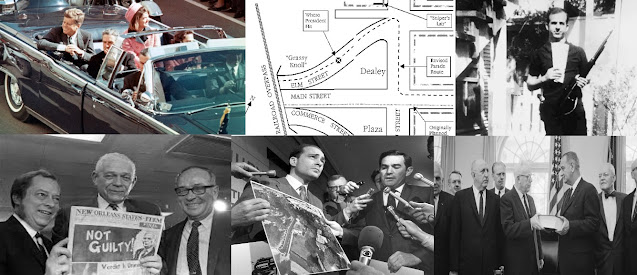
JFK Assassination


Having reach the point of consistent writer’s block, combined with having blogged so many subjects that I repeatedly hit the “I blogged about it already and have nothing new to add”, I’ll throttle back to every other Friday.  Moreover, I couldn’t get this one done in time and didn’t want such an important topic to be half-assed.  And it’s three months since the anniversary.  So here you go.

We came and passed November 22, the anniversary of John F. Kennedy’s assassination in 1963.  Recently I’ve been reading Vincent Bugliosi’s huge volume, Reclaiming History, in which he debunks countless conspiracy theories behind the event and comes to the conclusion that Lee Harvey Oswald did in fact act alone to assassinate President Kennedy on that day.  As an aside, Reclaiming History is a HUGE book.  It’s 1648 pages, and although I’ve started it, I haven’t quite finished it.  The initial 688 pages was also released as a separate book, Four Days In November, which simply described the assassination itself and the subsequent killing of Oswald by Jack Ruby (two days later).  I read Four Days and then began reading Reclaiming History.  Four Days was also made into a movie, “Parkland”, named after the hospital where both Kennedy and Oswald were taken after their gunshots.

FYI:  two other celebrities died on November 22, 1963 as well.  The author of The Lion, The Witch and the Wardrobe, C.S. Lewis, died of natural causes on that day.  And the author of Brave New World and The Doors of Perception. Aldous Huxley, also died - of natural causes - on the same day.  Both deaths were, as you might imagine, ignored in the hoopla surrounding Kennedy's.  

Let’s start with the basics.  On Friday, November 22, 1963, JFK and his wife Jackie Kennedy were riding in an open limo with Texas Governor Connally through downtown Dallas, starting westbound on Main Street.  The limo then made a right turn (90 degrees) due north onto Houston Street, then a left turn (90 degrees) onto Elm, westbound to the freeway.  As the limo turned left onto Elm Street from Houston St, it passed underneath the Texas Book Depository, and then down Elm Street, when a gunman shot both Kennedy and the governor.  The governor survived his wounds, but Kennedy did not.  Shortly after, a lone gunman, Lee Harvey Oswald, was picked up in a movie theater several blocks away to the south, and arrested – after having shot Dallas police officer Tippits who had approached him on his way from the downtown area where the assassination had occurred.  Two days later, a nightclub owner, Jack Ruby, came into the basement garage of the city hall and shot Oswald, fatally, as he was about to be transported to the main jail pending a criminal trial. 

Without a formal trial of Oswald, because he was shot by Ruby, the Warren Commission was set up to investigate the matter and determine if anyone else besides Oswald was involved.  The Commission was a seven member panel:  Chief Justice Warren, Richard Russell, Jr. (Senator, D-GA), John Sherman Cooper (Senator, R-KY), Hale Boggs (US Rep, D-LA), Gerald Ford (US Rep, R-MI), Allen Dulles (CIA), and John J. McCloy (World Bank).   Future PA Senator Arlen Spector was an assistant counsel.  The Warren Commission, after studying the issue, concluded that Oswald did act alone.  In the 1970s, a second investigation, the House Select Committee on Assassinations (HSCA), also decided that he acted alone.  However, conspiracy theories persisted, and in 1991, Oliver Stone put out a movie, “JFK”, largely focusing on a criminal trial in the late 60s, done by New Orleans district attorney Jim Garrison, which attempted to implicate Clay Shaw as being in conspiracy with Oswald – by proxy, to prove a conspiracy through Shaw.  Despite this, Shaw was acquitted. 

First off, who is Vincent Bugliosi?  He was the L.A. district attorney who prosecuted Charles Manson and his “family” for killing Sharon Tate, Jay Sebring, and friends, on August 8, 1969, then the Labianca couple two nights later.  Since Manson himself did not get out of the car on those nights and pull the trigger, Bugliosi needed to prove a conspiracy.  If not, Manson would walk free and corral another group of stupid teenage girls into killing more people.  Bugliosi succeeded at getting Manson convicted – and Manson died in prison serving a life sentence.  This gave Bugliosi a critical background in criminal forensics AND the nature of conspiracy, a skill set he used to evaluate the plethora of conspiracy theories surrounding the JFK assassination. 

By now, there are countless books on the topic.  However, as a practical matter, the most important contributor to the whole conspiracy movement in terms of bringing all of this to public attention – those of us who can spare 3+ hours to watch a movie but not the time and attention necessary to read all the books on the topic – is the Oliver Stone movie, JFK.  It had an all-star cast, not the least of which was Kevin Costner as Garrison, Tommy Lee Jones as Shaw, Gary Oldman as Oswald, and Donald Sutherland as the fictitious “Mr X” who advises Garrison, amidst various Washington DC monuments, of the vast conspiracy allegedly behind the assassination.  That movie takes as its focus the Clay Shaw trial in Louisiana in the late 60s.  Jim Garrison was a New Orleans prosecutor who was convinced that Oswald was part of a larger conspiracy, including Clay Shaw, so he prosecuted Shaw for conspiracy to kill Kennedy.   The trial served as de facto conspiracy trial, but Shaw was acquitted.  Stone saw fit to use the trial as a similar proxy for his own Kennedy assassination conspiracy theory.  The “Mr X” is a fictitious character who Garrison meets (in a meeting which never actually happened, by Stone’s own admission) in Washington DC.  Basically Garrison and Stone shared a firm conviction that, absence of evidence of a conspiracy to the contrary notwithstanding, there WAS such a conspiracy, mostly likely by a shadowy cabal of CIA, generals, etc. who were upset that Kennedy would not be escalating the war in Vietnam.  Garrison and Stone felt they had to fill in the blanks, as it were, to draw the picture and prove the case, out of whole cloth.  Bugliosi considered the Shaw prosecution an egregious miscarriage of justice and the verdict correct – as a fellow D.A. he had choice words for Garrison.  The bigger problem is that the movie serves as most Americans’ source of information on the assassination, as a work of fiction masquerading as the truth, serving to deliberately mislead the American public as to existence of a non-existent conspiracy.  Having an A-list cast makes the matter even worse, lending the stars’ reputation to an undeserved implication of credibility.  It’s garbage – 3.5 hours of fiction.    

Parkland.  This is a much simpler movie, echoing Bugliosi’s shorter book and simply giving us the basics of the assassination:  the motorcade, the assassination, the efforts of the Parkland ER dept to try to save Kennedy, the subsequent similar effort at the same hospital to save Oswald, and a very limited analysis of everything else.  Jeremy Strong plays Oswald, Paul Giamatti plays Zapruder, and Ron Livingston plays FBI Agent Hosty, who briefly interrogated Oswald before the assassination.  By the way, not only did Kennedy and Oswald wind up in Parkland, so did Ruby.  After being convicted of Oswald’s killing, he was sentenced to death.  That sentence was overturned and a new trial ordered, but while he was waiting on that, he had a stroke and was taken to Parkland, where he died.  I suppose any pilgrimage or assassination tour of Dallas would have to include this hospital.  The Book Depository actually has a museum on the sixth floor.  You’ll have to bring your own Carcano rifle – and good luck buying it in the mail for $12. 

Clearly, Bugliosi did his homework, not only reading all of the conspiracy theory literature out there, but actually talking in person with many of the doctors and major witnesses who supposedly support the theories, mainly indirectly.  And he devoted an entire, enormous chapter of his book to discredit – rightfully so – the Oliver Stone film.  I have to confess that as of writing this blog, I have not finished reading the book, but have digested the initial chapters on the assassination itself, the chapter on the autopsies – which form much of the core of the conspiracy, as most allege the fatal shots come from the grassy knoll, not the book depository – and the huge chapter devoted to critiquing the “JFK” film itself.  The remainder of the book, which I have not read, focuses on Oswald’s motives and the likely motives of would-be actors behind the conspiracy, e.g. the Soviets, Cubans, CIA, or the Mob. 

Zapruder Film.   26 seconds of home movie camera shot by Zapruder.   Since it was a primitive movie camera, the quality was very low, but the kicker is that it’s SILENT.   The vantage point is from the north, looking at the limo from the right side as it passed by on Elm Street.  There’s a brief obscuration of the highway sign.  The second shot is not obvious, except that Connally is twisting back and Kennedy and Jackie are confused and upset.  The third shot – the one through Kennedy’s head that blows his brains out – is obvious.

Gimme Three Shots & Single Bullet & Magic Bullet.   Oswald fired three times.  The first shot, as the limo turned left onto Elm right below the Book Depository, missed; the bullet was never found.  The second shot went through Kennedy’s back and then into Connally, who survived.  The third shot went through Kennedy’s head and blew his brains out, all over Jackie’s dress. 

“Single bullet” is the premise – correct, as it is, but disputed – that the same bullet which injured Connally first went through Kennedy, i.e. it wasn’t two separate bullets and thus a separate gunman from Oswald.  “Magic bullet” refers to the conspiracy theory laugh that somehow, for that bullet to leave Kennedy and hit Connally, it had to make a 90 degree right turn, then a 90 degree left turn.  The limo had three rows of seats.  The driver was in the front row, Connally was in the middle row, and the Kennedy and his wife were in the back row, with Kennedy himself to the far right back corner.  However, Connally was not directly in front of Kennedy, but actually further to the middle and below.  Further line of sight analysis of the Book Depository and the relative positions of Kennedy and Connally show that the bullet’s trajectory, far from an implausible zigzag, was actually straight.  Moreover, the entrance wound to Connally is oval/elliptical, but the range from the Book Depository was too close for the 2000 fps rifle round to yaw or tumble on its own.  At that range, a direct hit to Connally would have been a neat, circular entrance wound.  Thus the bullet which hit Connally did go through Kennedy first, thus the “single bullet”, which did not have to be “magic”. 

Motives for Conspiracy.  Assuming Oswald did not act alone, and was part of a larger conspiracy, who else was behind the assassionation?

Mob.  The “October Surprise” theory says that George H.W. Bush, in October 1980, swiftly went from the Imperial War Museum in London to a secret meeting in Paris to meet with Iranians to persuade them not to release the US hostages seized from the embassy in Teheran until after the November 1980 election, in order make Jimmy Carter look bad and improve Ronald Reagan’s chances.  The sole support for this theory is a Mossad (Israeli intelligence) agent who also echoed Mossad’s belief that the US Mob was behind Kennedy’s assassination.  The motive?  Supposedly the Mob helped Kennedy get elected in 1960 (those “dead votes” in Chicago) but were upset when JFK put his brother RFK as Attorney General, who then set out to aggressively prosecute the Mob.  This upset the Mob as an act of betrayal.

The catch is that the Mob generally did NOT target politicians, least of all popular, elected officials, much less the US President.  Generally the mob focuses its violence on competing mobsters and potential adverse witnesses.  Some allege that Jack Ruby had mob ties, but his ties to the Dallas PD were far more substantial.  Moreover, Lee Harvey Oswald had zero ties to the Mob.  Really, the Mob theory is a non-starter. 

Soviets.  The CIA had been monitoring East Bloc communications at the time, and from what they overheard, the Russians and their comrades were as shocked as anyone else by the assassination.  Although LHO had spent time in Minsk, the Russians really had no use for him, which is why he returned to the US with his Russian wife.  The Soviets had narrowly missed a nuclear war with the US over the Cuban Missile Crisis, so they would be equally averse to providing the US with a legitimate ground for war, which is what assassinating our President would have been.  So there was no motive on their part.

CIA/Military.  An old friend of mine who worked for the CIA felt blaming the agency was strange, as Kennedy was very popular with the CIA.  Perhaps the agency was a bit upset about Kennedy pulling the plug on the Bay of Pigs operation, but that came nowhere close to the hostility necessary to take out the President.  Moreover, LHO had no connection with the CIA. 

The military angle, as suggested by “JFK”, is that the top brass wanted a war in Vietnam, whereas JFK was about to remove the US advisors in there, and would certainly not be sending in troops.  Yet as Bugliosi notes, there was no guarantee that Lyndon Johnson, who would take over as President after JFK was killed, would be any more inclined or cooperative in sending troops to Vietnam.  As it was, he did, but then he refused to run for re-election in 1968.  For that matter, Nixon would have had a huge target on his back, as not only did he oversee the withdrawal of US forces from Vietnam, but he also cozied up to Mao.  If the military was willing to have Kennedy – a very popular president – assassinated, surely it would not hesitate to do the same with Nixon. 

Oswald had been in the US Marines, but had no connections with the military at the time of the assassination.  Obviously he burned his bridges when he defected to the Soviet Union. 

Oswald as Patsy.  One reason for suspicions of a conspiracy is that Oswald himself was very eccentric, unpredictable, and not particularly bright.  In the two days between his arrest on Friday and death on Sunday, he was interrogated several times, and each person who talked to him was frustrated by his obtuseness.  He talked about “not saying anything without an attorney” but refused to accept any legal representation.  Neither the Marines nor the Russians had any use for him.  So how could this guy, all by himself, take out the President?

Oddly, the prior assassins were mostly lone wolves.  Charles Guiteau (Garfield, 1880), acted alone, as did Leon Czolgoz (McKinley, 1901).   Oswald simply needed to perch himself on the sixth floor, take three shots down at the limousine, and then leave.  He was picked up in a movie theater after walking from the Depository and killing a Dallas police officer.

The primary conspiracy concept is that there was another gunman at the grassy knoll ahead of the limousine who actually fired the shots which killed Kennedy.  Of course, Bugliosi managed to determine that both bullet wounds to Kennedy – his neck and his head – came from behind, i.e. from the book depository.  He devotes an entire chapter to determining that the majority of the pathologists concluded that both wounds came from behind, and what minor discrepancies may have existed – and were blown out of proportion by conspiracy theorists – can be reconciled and explained fairly simply.  When the dust clears, so to speak, we’re left with conclusive evidence that both shots came from behind.    

Assuming there was another gunman at the grassy knoll, what was Oswald’s role?  To be a patsy, a decoy in the Book Depository to hide the existence of the second gunman at the grassy knoll.  Well then, WHY would Oswald agree to put himself in the position of being the scapegoat for the assassination?  Leaving aside Ruby’s intervention, assuming he wasn’t killed leaving the Depository, or being arrested after leaving, he’d still be on the hook for the death penalty after a criminal trial.  Why would he agree to do so?  Moreover, as Bugliosi points out, if it’s implausible to believe the man was capable of killing the President by himself, it’s equally implausible that whoever did plan the assassination would rely upon him to be the patsy – to go to the Book Depository at that date and time and carry out the fake assassination as requested.  And then to be left to leave the Depository by himself and picked up all by himself at the movie theater. 

And as a UNWILLING patsy, acting completely independently of the second gunman?  Completely unbelievable.  If Oswald would be an unreliable willing participant in this whole thing, why would anyone set up an entire operation hoping that Oswald would carry out his own attempt without any coordination or agreement?  That’s just too bizarre. 

No Leaks, Garrison, and Stone.   A conspiracy of this magnitude would have resulted in some leaks at some point, but nothing happened.  If the answer is, “all potential leakers were ‘taken care of’,”, that begs the question of why Jim Garrison wasn’t “taken care of”, or Oliver Stone.  The bigger picture is that whether we want to believe or accept it or not, Oswald acted alone. 

Friday, January 7, 2022

Dreams


And by that I mean the thing which happens when we sleep, not the figurative sense of unfulfilled plans or ambitions, e.g. “Dreams I’ll Never See”…

My most recent memorable dream kind of melted the Pentagon with NYC for a strong 9/11 flavor, the Pentagon leading out to the ground/swamp underneath the New Jersey Turnpike – you know where it splits up just south of NYC and rises over the swamps by Meadowlands.  It was like the dream was playing fast and loose with NYC and Northern Virginia.  I can’t remember the plot, except the Turnpike somehow morphed into a two lane road.  Too bad we can’t record our dreams.

I’ve been blessed with a decent sleeping ability; I rarely get insomnia.  In fact, I rarely get jet lag, as my last few foreign trips were Rio de Janeiro, Brazil (EST + 2) and Bucharest, Romania (EST + 7) – which I conquered by simply staying up until bedtime local time.  As for insomnia, somehow I don’t have trouble sleeping when stressed out, even before a big trial, but every now and then it happens.  A shot of Jagermeister almost always gets the job done. 

When I was a kid, with a far more active imagination than I have now, I had nightmares.  Not all the time, but far more common than now, which is almost never.  The most recent nightmare I can recall, a few years ago, was that somehow I pushed my brother off a high ledge on a building, by accident, and he fell directly on his head, killing him instantly.  That was so messed up I woke up immediately.  My childhood nightmares usually involved ghosts and other supernatural creatures.  Axe murderers and such were not even on my radar of apprehension.  As an adult, my nightmares, rare as they are and noticeable by their rarity, generally involve close friends and relatives dying.  Back in school, the most common topic was missing or failing exams, and as a practicing lawyer it was missing deadlines or trials (“I know I’m supposed to be somewhere today….OOPS!”).

To make matters worse, on at least one occasion – when I was very young - I had a high fever and went delirious, which means hallucinating while wide awake – a nightmare you can’t escape just by waking up.  Thus the classic Universal logo from the 50s or 60s still hits me when I see it, as it had something to do with that unforgettable experience.  Bar none, that was the worst experience in that regard, because unlike a nightmare while you’re sleeping, you’re wide awake.  Years later, experiencing LSD and mushrooms voluntarily were a way of confronting this, and I’d describe the psychedelic experiences as effectively dreaming while you’re wide awake.  On lower doses you can simply close your eyes and vanish into a vast fantasy world which seems to last for years, and if you don’t like it, just open your eyes and you’re back in reality – although with some seriously distorted visual effects to liven things up. 

I’ve had a few erotically charged dreams, but not nearly as many as I might prefer.  A more recent one involved a former GF, so finally I had a dream about one of them.   “The names have been changed…to protect the guilty.”

When people I do know appear in my dreams, it’s like a random appearance, and they don’t necessarily act in character. In one particular dream, someone was injured, and my father (deceased for almost 20 years now but making a guest appearance in my dream) undertook to drive the victim to the hospital, but couldn’t find the place and just gave up, dumping the injured party on the sidewalk with the advice, “good luck”.  Highly out of character for my Dad, who would have called 911 at the very least, but most likely would have successfully delivered the patient to the ER.  This dream alone convinced me that the appearance of people we know is not meaningful or prophetic, but merely random. 

As such, I dream every night, most being fairly nonmemorable.  These dreams never come true, and I can imagine why.  That brings me to my theory, which I’ve yet to hear echoed by any doctor or psychiatrist.

If dreams seem random and nonsensical, it’s because they are nothing more than the brain’s way of washing itself while we sleep, clearing its cache of short term memory. after a day of stress, work, and having to think clearly from waking to sleeping.  It jumbles around our memories at random, concocting a series of events which have no plot or reason and bear superficial resemblance to our actual experiences.  None of this is even remotely prophetic or supernatural, nor is there any reason to believe it would be. – aside from wishful thinking.  I don’t relive past encounters, or see the future.  Most of the women I meet in dreams are women I’ve never met before, although some ex-GFs do make guest appearances from time to time as noted above, mostly at random.  Again, dreams are the mind’s way of washing itself.  If you can’t sleep, you can’t dream, and your mind starts to deteriorate.

There was an experiment done years ago, in which they kept the subjects awake for several days straight.  Before the experiment they tested the subjects on mental skills – adding and subtracting – and motor skills, shooting baskets.  This initial test acted as the baseline, the subjects were repeatedly tested over the next few days without sleep, and then given a full night’s rest, and tested again.  They found the motor skills didn’t suffer appreciably during the days without sleep, but the math test results showed a strong downturn.  And after the subjects could sleep again – 8 hours – they were back up to normal again.

Getting back to the LSD issue.  Albert Hofmann, who invented LSD, noticed after his first trip, that the day after, he had immense peace of mind and clarity of thought.  LSD effectively acts not only as “dreaming while wide awake”, but also several nights’ worth of dreaming all at once, depending on the dosage.  The connection between the two is much stronger than I believe is realized.   Note this this also applies to psilocybin, the active ingredient of psychedelic mushrooms, e.g. psilocybe cubensis.

Well, we study the subject every night, don’t we?