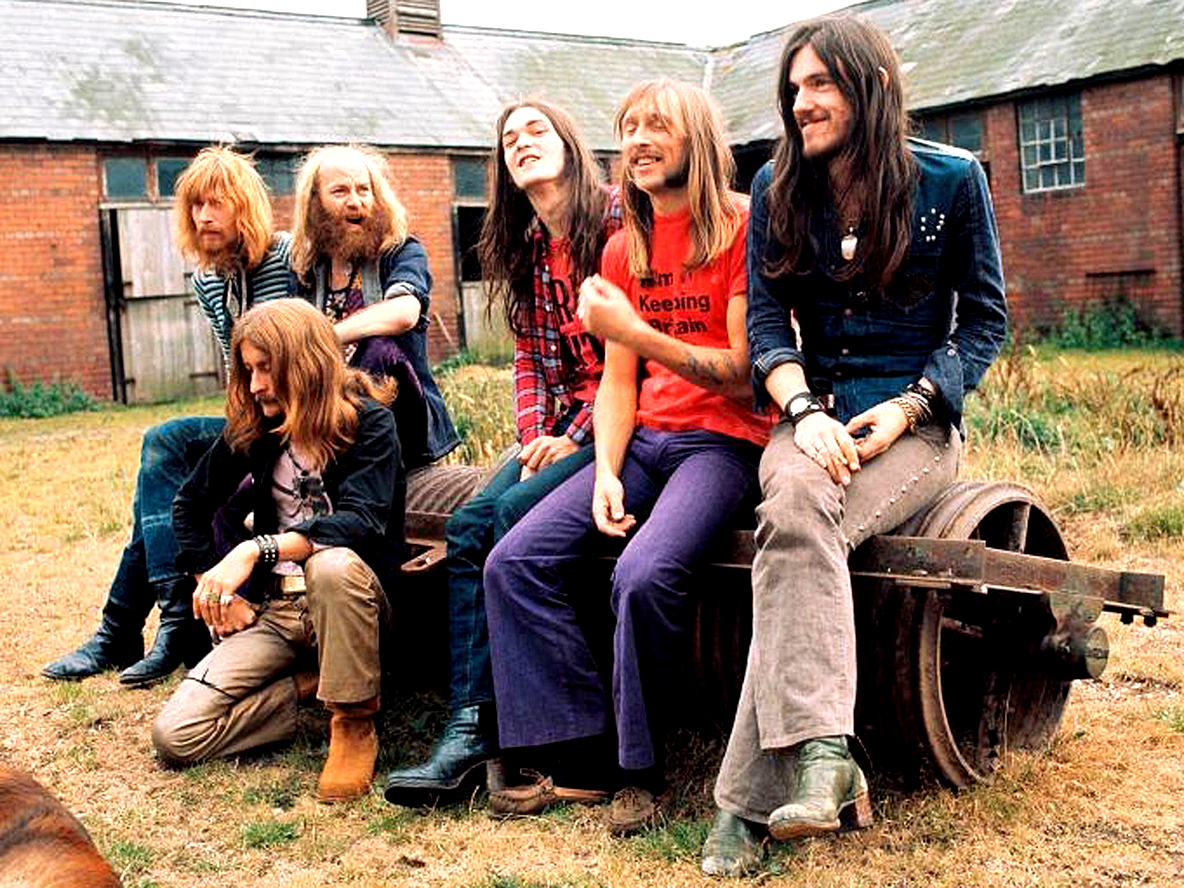
Neil (Nigel Planer): "Why don't they ever play Hawkwind or Marillion??"
Band. They started out in London in 1969 and are in
still in existence, though with only one consistent member, Dave Brock. The “classic era” was in the 1970s, but
despite declining popularity and publicity Brock has maintained the band. Of course, there have been numerous lineup
changes over the years.
At this time my recollection is that I got into Hawkwind
from two sources. First, in August 1985
my brother started taking guitar lessons from a very cool guy, Joel, and I
began doing so the week after. I almost immediately
caught the fever to buy a Fender Stratocaster, but at this stage, neither my
talent nor budget merited a full US-made ($$$) version, so I took a temporary
job at the US Embassy, Office of American Services, making tourist
passports. The French guy running things
was Bernard, who turned me on to Hawkwind.
About this time the band came out with Chronicle of the Black Sword,
their Elric of Melnibone concept album, and the two together induced me to
start listening.
Discography. Hawkwind (1970); In Search of Space
(1971); Doremi Fasol Latido (1972); Hall of the Mountain Grill
(1974); Warrior at the Edge of Time (1975); Astounding Sounds, Amazing
Music (1976); Quark, Strangeness & Charm (1977); 25 Years On
aka Hawklords (1978); PXR5 (1979); Levitation (1980); Sonic
Attack (1981); Church of Hawkwind (1982); Choose Your Masques
(1982); The Chronicle of the Black Sword (1985); The Xenon Codex
(1988); Space Bandits (1990); Electric Tepee (1992); It Is The
Business of the Future to Be Dangerous (1993) White Zone (1995); Alien
4 (1995); Distant Horizons (1997); In Your Area (1999);
Spacebrock (2000); Take Me To Your Leader (2005); Take Me To Your
Future (2006); Blood of the Earth (2010); Onward (2012); Stellar
Variations (2012); The Machine Stops (2016); Into the Woods
(2017); Road to Utopia (2018); All Aboard the Skylark (2019); Carnivorous
(2020). As you can see, they’ve been continuously
releasing material for 50 years, and will probably continue to do so until Dave
Brock retires or passes away.
Plus their VERY famous, Lemmy-era live album (recorded on the
Doremi Fasol Latido tour), Space Ritual.
Stacia. Back in the 70s they had this tall,
well-proportioned stage dancer on tour with them, sometimes even nude. It certainly made the experience more fun,
though I can’t say I’ve had the pleasure of seeing any shows with her on
stage.
Nik Turner. Right up there with Dave Brock in
contribution in the 70s, mostly playing flute.
Jimi Hendrix made a reference to him at Isle of Wight. Although long since gone from the band, he
still puts out albums and tours periodically, and his live sets are far more
focused – as you might imagine – on the 70s material. In that regard his shows were better for
someone like me who was more familiar with that material.
Bob Calvert. Another eccentric contribution to the band,
and like Turner, only in the 70s. He has
a solo album, Captain Lockheed and the Starfighters, about the ill-fated jet plane
which had a bad reputation for disintegrating in midair.
Lemmy. By far their most famous member, on Doremi,
Hall, and Warrior, kicked out of the band on that tour after being arrested by
Canadian authorities. In his autobiography,
he says he was very happy in the band and would not have left had he not been
fired. Thereafter he formed Motorhead. “Motorhead”, “Lost Johnny”, and “The Watcher”,
plus “Silver Machine”, were Lemmy’s contributions, and Motorhead fans could
occasionally hear his band play them. My
understanding is that they reconciled fairly soon. Sadly, he was never in the band with HLL (see
below) except for a handful of one-off appearances.
Huw Lloyd Langton. Their excellent guitarist, appearing on the
first, self-titled album, then on Levitation through The Xenon Codex – i.e. throughout
the 1980s. He gave the band a good dose
of blues-oriented solos, and remains by far my favorite Hawkwind guitarist.
I get Del Dettmar and Dik Mik mixed up, plus
Simon House and Simon King.
Alan Davey and Harvey Bainbridge were more recent band
members. Ginger Baker, the
drummer for Cream, was on Levitation.
Michael Moorcock. The sci-fi author had a close relationship
with the band, not merely inspiring the Chronicle album but actually writing a
few songs.
Concerts. Sadly, they don’t seem to the tour the US
very often, and the only concert I was able to see in London – I believe we
visited in 1981, 1983, and 1985, the odd-numbered years when we didn’t go back
to the US – was Donington in 1985. My
two shows are December 1990 and April 1995, both in the Washington, DC area,
plus a show by Nik Turner.
Drugs. With the opening track on Electric Tepee
named “LSD”, it’s no secret or surprise what the band’s drug of choice is. Put the band up with Pink Floyd and the Grateful
Dead in terms of being “drug-orientated band, you can trust us…” Having said that, I can still enjoy much of their
material even without any chemical enhancement.

