Showing posts with label hawkwind. Show all posts

Friday, February 5, 2021

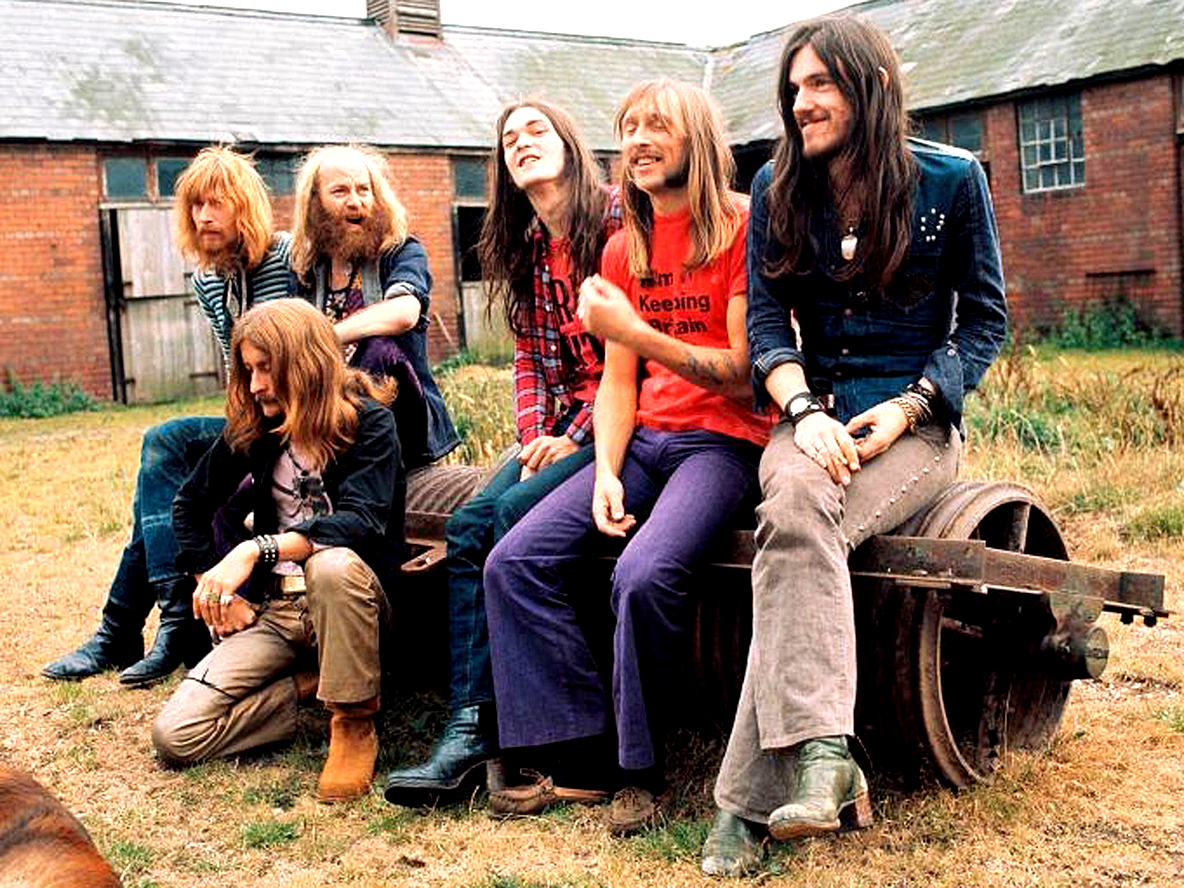
Hawkwind


Neil (Nigel Planer): "Why don't they ever play Hawkwind or Marillion??"

 I had reviewed this band in the past, but mostly in passing.  I felt a more comprehensive discussion was appropriate.

Band.  They started out in London in 1969 and are in still in existence, though with only one consistent member, Dave Brock.  The “classic era” was in the 1970s, but despite declining popularity and publicity Brock has maintained the band.  Of course, there have been numerous lineup changes over the years.

At this time my recollection is that I got into Hawkwind from two sources.  First, in August 1985 my brother started taking guitar lessons from a very cool guy, Joel, and I began doing so the week after.  I almost immediately caught the fever to buy a Fender Stratocaster, but at this stage, neither my talent nor budget merited a full US-made ($$$) version, so I took a temporary job at the US Embassy, Office of American Services, making tourist passports.  The French guy running things was Bernard, who turned me on to Hawkwind.  About this time the band came out with Chronicle of the Black Sword, their Elric of Melnibone concept album, and the two together induced me to start listening. 

DiscographyHawkwind (1970); In Search of Space (1971); Doremi Fasol Latido (1972); Hall of the Mountain Grill (1974); Warrior at the Edge of Time (1975); Astounding Sounds, Amazing Music (1976); Quark, Strangeness & Charm (1977); 25 Years On aka Hawklords (1978); PXR5 (1979); Levitation (1980); Sonic Attack (1981); Church of Hawkwind (1982); Choose Your Masques (1982); The Chronicle of the Black Sword (1985); The Xenon Codex (1988); Space Bandits (1990); Electric Tepee (1992); It Is The Business of the Future to Be Dangerous (1993) White Zone (1995); Alien 4 (1995); Distant Horizons (1997); In Your Area (1999); Spacebrock (2000); Take Me To Your Leader (2005); Take Me To Your Future (2006); Blood of the Earth (2010); Onward (2012); Stellar Variations (2012); The Machine Stops (2016); Into the Woods (2017); Road to Utopia (2018); All Aboard the Skylark (2019); Carnivorous (2020).    As you can see, they’ve been continuously releasing material for 50 years, and will probably continue to do so until Dave Brock retires or passes away.

Plus their VERY famous, Lemmy-era live album (recorded on the Doremi Fasol Latido tour), Space Ritual

Stacia.  Back in the 70s they had this tall, well-proportioned stage dancer on tour with them, sometimes even nude.  It certainly made the experience more fun, though I can’t say I’ve had the pleasure of seeing any shows with her on stage. 

Nik Turner.  Right up there with Dave Brock in contribution in the 70s, mostly playing flute.  Jimi Hendrix made a reference to him at Isle of Wight.  Although long since gone from the band, he still puts out albums and tours periodically, and his live sets are far more focused – as you might imagine – on the 70s material.  In that regard his shows were better for someone like me who was more familiar with that material.

Bob Calvert.  Another eccentric contribution to the band, and like Turner, only in the 70s.  He has a solo album, Captain Lockheed and the Starfighters, about the ill-fated jet plane which had a bad reputation for disintegrating in midair. 

Lemmy.  By far their most famous member, on Doremi, Hall, and Warrior, kicked out of the band on that tour after being arrested by Canadian authorities.  In his autobiography, he says he was very happy in the band and would not have left had he not been fired.  Thereafter he formed Motorhead.  “Motorhead”, “Lost Johnny”, and “The Watcher”, plus “Silver Machine”, were Lemmy’s contributions, and Motorhead fans could occasionally hear his band play them.  My understanding is that they reconciled fairly soon.  Sadly, he was never in the band with HLL (see below) except for a handful of one-off appearances. 

Huw Lloyd Langton.  Their excellent guitarist, appearing on the first, self-titled album, then on Levitation through The Xenon Codex – i.e. throughout the 1980s.  He gave the band a good dose of blues-oriented solos, and remains by far my favorite Hawkwind guitarist.

I get Del Dettmar and Dik Mik mixed up, plus Simon House and Simon KingAlan Davey and Harvey Bainbridge were more recent band members.  Ginger Baker, the drummer for Cream, was on Levitation.

Michael Moorcock.  The sci-fi author had a close relationship with the band, not merely inspiring the Chronicle album but actually writing a few songs.

Concerts.  Sadly, they don’t seem to the tour the US very often, and the only concert I was able to see in London – I believe we visited in 1981, 1983, and 1985, the odd-numbered years when we didn’t go back to the US – was Donington in 1985.  My two shows are December 1990 and April 1995, both in the Washington, DC area, plus a show by Nik Turner. 

Drugs.  With the opening track on Electric Tepee named “LSD”, it’s no secret or surprise what the band’s drug of choice is.  Put the band up with Pink Floyd and the Grateful Dead in terms of being “drug-orientated band, you can trust us…”  Having said that, I can still enjoy much of their material even without any chemical enhancement. 

Influences.  Monster Magnet have covered “Brainstorm” and “The Right Stuff”, and I saw a recent pic of Mikael Akerfeldt – the charismatic frontman for Swedish prog-metallers, Opeth – wearing an In Search of Space t-shirt.  Maybe they deserve more credit, relative to Black Sabbath, for the stoner rock genre.  

Thursday, December 31, 2015

Lemmy, Hawkwind, and Motorhead

Tuesday night’s Clutch concert at Terminal 5 in NYC featured exclusively Motorhead songs on the PA leading up to the band’s stage appearance and a call-out by singer Neil Fallon.

With Ian “Lemmy” Kilminster’s recent death and intense and widespread outpouring of regret, sympathy and fond remembrance, I checked my blogs and realized I hadn’t done one on this subject, although I did cover Time of the Hawklords, Michael Moorcock’s Hawkwind sci-fi book, back in March 2014.

White Line Fever.  His autobiography.  If you haven’t already, check it out.  I did so because of the Hawkwind angle, which he does cover briefly – though enough to make it worth checking out for Hawkwind fans.  Required reading for ALL Motorhead fans.
His more recent DVD documentary, “Lemmy”, is also fun to watch.  He gives a tour of his rent-controlled, Nazi-memorabilia filled apartment in L.A., and the cubbyhole of the Rainbow Bar & Grill where he hangs out.  I liked Scott Ian ragging on him for his Daisy Dukes (very short jean shorts). 

Sam Gopal.  Before Hawkwind, Lemmy was in Sam Gopal’s band, and he’s on Escalator.  He plays lead guitar and sings.  This is a bit more Indian toned than Hawkwind, so maybe not that great for Motorhead fans. 

Hawkwind.  I’ve seen Hawkwind twice, but both times was in the 1990s well after Lemmy left.  He’s on Doremi Fasol Latido (1972),  Hall of the Mountain Grill (1974), and Warrior on the Edge of Time (1975), plus their must-have live album, Space Ritual (1973), which oddly does NOT have “Silver Machine”.  It was on the Warrior tour that he was busted in Canada and effectively kicked out of the band.  Sadly, Lemmy was never in the band at the same time as Huw Lloyd Langton (HLL) [except ONE live show] – that would have been killer.  
            Compared to Motorhead, Hawkwind are a completely different animal.  Amazingly psychedelic, but with a strong core of strength – thanks to Lemmy – it was weird, but fun.  Those albums with Lemmy are arguably the best ones, though Levitation and Xenon Codex – both with HLL – are also awesome. 
            “Motorhead”, “Lost Johnny”, “The Watcher”, and “Silver Machine” are Lemmy’s contributions to Hawkwind, really where any Motorhead fan should start.  I prefer the Hawkwind version of “Motorhead”, though it doesn’t have Lemmy singing, plus it has a slower lope to it than the Motorhead version.

Motorhead.  I’ve seen them a few times, including one major show at the Bayou (DC) in January 1996, headlining, plus opening for Black Sabbath (1994) and Iron Maiden (2003).   Ace of Spades is, of course, the definitive album, but I prefer Another Perfect Day, the one-off album with Brian Robertson – better known as half of Thin Lizzy’s guitar attack with Scott Gorham – and Phil Taylor (RIP recently as well). 

            In more recent years Lemmy tended to switch up and ease the throttle a bit on some songs.  “1916” is an excellent example of this.  He couldn’t do this for more than a song or two per album, but an entire album of such songs – like Opeth’s Damnation – would have been great.  F**k Motorhead fans if they can’t deal with it.  Part of what kept me from being a stronger Motorhead fan was that too many of his songs sounded exactly the same, and the same attitude was endlessly repeated to the point of boredom.  He complained that fans always mention Ace of Spades and tried to remind people that he’s made 18 albums since that one.  Dude, all those 18 albums sound the same!  If he’d done that prog album I’d asked for, maybe it would be different.  

Friday, March 7, 2014

The Time of the Hawklords

Music and science fiction meet in this semi-fun 70s novel by Michael Moorcock and Michael Butterworth.  Moorcock seems to disavow his role writing this book – perhaps out of embarrassment – but if it was Butterworth’s writing, he did an excellent job of copying Moorcock’s style.

The “classic” lineup of Hawkwind from the mid-70s is here, albeit with slightly alternate identities: Baron Brock (Dave Brock), Thunder Rider (Nik Turner), Count Motorhead (Lemmy, generally referred to as Lemmy anyway), Lord Rudolph the Black (Paul Rudolph), The Hound Master (Sandor Clegane….er… Simon King, drummer), The Sonic Prince (Simon House, keyboardist), Earth Mother (Stacia, though generally simply referred to as Stacia), Astral Al (Alan Powell), Liquid Len (Jonathan Smeeton), Captain Calvert (Bob Calvert), The Acid Sorceror (Moorcock), and Actonium Doug (Doug Smith).  Remarkably, they all have fairly equal roles, though Calvert is a late arrival to the story.  All are portrayed fairly sympathetically.   Sorry to disappoint, but Stacia does not have sex with anyone.

A mysterious death ray is weakening and killing the remaining population of London and the rest of the planet, which appears to be in a state of post-capitalist decay, though no signs of nuclear holocaust, more like simply the inevitable cumulative effect of decades of wanton abuse of the planet by the usual neglect by the thoughtless modern society.  Hawkwind’s music, when played live, has the effect of countering the ray’s effects, but only temporarily, and the band can’t play continuously – even with the usual expected array of chemical assistance.  

The “straights” and establishment authority figures are immune to the death ray and adversely affected by Hawkwind’s music – so much so that the band develops “music guns” to protect themselves.  The forces of evil, such as they are, are led by Mephis; uncertain as to whether he’s simply the most powerful “straight” or an actual devil or demon.  Moreover, it turns out that the band members are in fact reincarnations of previous champions from ancient times – does this sound familiar, Elric readers? – with special powers, i.e. Hawklords, even Stacia herself.   For his part, Mephis does seem to have similar powers, so maybe he was a “devil.”  Anyhow.

Ultimately the story winds down to a climactic battle between the Hawklords and their lesser allies vs. Mephis and his legions of soldiers and straights.  It’s 60% “classic Moorcock” and 40% Hawkwind, so I’d say the mix is fairly well done.  However, I can’t say the story is compelling enough to appeal to anyone who isn’t a Hawkwind fan.  On the other hand, if you’re a Hawkwind fan AND a fan of Moorcock, I can’t see any compelling reason NOT to read this story.  It’s not very long, it’s fairly easy to read, and as moderately enjoyable as any of Moorcock’s other fiction.

Friday, November 14, 2008

Jam Bands


I’ve been listening to Man alot lately, especially the expanded edition of the studio album Back Into The Future, which includes the full 1973 show at the Roundhouse, not to be confused with the 1972 show, included in the Greasy Truckers album (with Brinzley Schwartz and Hawkwind), or the 1975 show which was immortalized on Maximum Darkness with John Cippolina of Quicksilver Messenger Service. The Greasy Truckers set was fantastic, practically nonstop jamming – which led me to decide on this entry.


What is a “jam band”? To me, a jam is an extended improvisation involving the entire band. From this I have to disqualify various guitar-oriented bands which set aside a portion of the live set for the guitarist to go off on his own, alone on stage, e.g. Black Sabbath, AC/DC, or Blue Oyster Cult. Oddly, BOC could have been considered a jam band back when they were Stalk-Forrest Group, because “St. Cecilia” and “A Fact About Sneakers” have extended jams, whereas “Buck’s Boogie” and “Then Came The Last Days of May” simply feature Buck Dharma soloing on his own. Similar to Van Halen, their current live setup gives the drummer a drum solo and the bassist a bass solo – even Cliff Burton did that. Sorry, “jam” involves the whole band, not this “taking turns in the spotlight” deal. And “Freebird” does not make Lynyrd Skynyrd a jam band.


Grateful Dead. Probably the top jam band in reputation alone. Oddly, their top album American Beauty has no jamming on it. Having two drummers, Mickey Hart and Bill Kreutzman, truly complicates things, but the overall effect is mesmerizing. Every set, on every tour, was a complete surprise, even if certain songs tended to follow one another. The vast volume of bootlegs, openly recorded and traded among fans, greatly expands the variety of songs in their repertoire, well beyond the studio albums. Moreover, the same song could be dramatically extended or played in various different “moods”. To the Dead themselves I’ll tack on the derivative bands Ratdog (Bobby Weir), Phil Lesh & Friends, and even Phish and Widespread Panic.


Allman Brothers. Sounding similar to the Dead but with a more rock attitude. Warren Haynes played with the Dead on the 2004 tour. To be honest, though, I’ve only heard At The Fillmore East, and can’t comment on their live performances without Duane Allman.


King Crimson. After listening to the studio albums to get the bare minimum basis, listen to the live material, and prepare to be amazed. The live stuff takes off to a completely different dimension, including lots of material, e.g. Holst’s “Mars” and “All That Glitters Is Not Gold”, which don’t appear on any studio albums. Even more so than the Dead, Crimson truly expand in the live context, like a caterpillar blossoming into a butterfly (“WHO-ARE-YOU??”). Hell, some of the live tracks are simply called “Improv”.


Pink Floyd. With Floyd, it’s less of a vast distance between the albums and the live material the way it is with the Dead and Crimson, but they do jam.


Hawkwind. They add a heavy dose of electronica and psychedelia into the mix. Stiff competition with the Dead for this type of noise, but Hawkwind are much heavier and have less of a country angle. A Hawkwind crowd has a nastier, biker type of element to it than the harmless hippie stock at a Dead show. Both bands cater to LSD and marijuana, but Hawkwind is more skewed towards the raging aggressive psychosis of LSD than the Dead, who are much more mellow and less intense. Hawkwind tends to pull you into the psychosis as a participant, whereas the Dead are content to leave you as a mere spectator.


Deep Purple. They qualify based on the 20 minute “Space Truckin’” on Made in Japan alone (which took up an entire side on the original vinyl), but I find that Purple don’t do very well at maintaining momentum throughout the jam the way many others of these bands do. Moreover, Purple do tend to stratify the jams into guitar (Blackmore), keyboards (Lord) and drums (Paice) rather than a true jam, a chemical “suspension” rather than a “solution”. I also noticed that the extended jams which you could expect from Marks II-IV no longer occur with the post-1984 lineups.


Man. Easily the most heavily guitar-oriented of the jam bands, without being heavy metal. True distortion and not the annoying bright distortion-less treble sound of Jerry Garcia’s guitar, but also without the “wayyyyyyyyy off into space” electronica of Hawkwind. The Greasy Truckers’ set was practically a nonstop guitar solo, yet it never got dull or lost its momentum. The more I hear, the more I like. Plus they have a refreshingly irreverent talent for odd song names (shared with Budgie, BOC, and Frank Zappa), my favorite being “Many Are Called, But Few Get Up”.


Particle. By far the newest of these, injecting a heavy dose of funk and techno into the equation. But the guitarist, wailing on a Les Paul with thick distortion, gives it the balls that the Dead often lack. This was another band I listened to nonstop – thanks Diane!

Frank Zappa.  Usually known for his humor, Zappa was all over the place musically.  On Hot Rats, he's well into jam band territory.

Tuesday, July 15, 2008

Hawkwind-Motorhead


I always prefer the original Hawkwind version of this song - and this slideshow is pretty damn well done (especially the acid effects).

Danava Where Beauty And Terror Dance Music Video


Very interesting: imagine Hawkwind turned into a NWOBHM band.. and covered "Stranglehold". ????

Thursday, January 24, 2008

Stoner Rock 101

I suppose it started with Hawkwind…Pink Floyd….Blue Cheer…maybe even Captain Beyond. Up until the early 90s, heavy metal was alive and well, as we could see in “Heavy Metal Parking Lot”. Then Nirvana came around and ruined it all with grunge (see my grunge blog). Now we have “nu-metal”, Good Charlotte, A Simple Plan, Disturbed, etc. all the dazzlingly brilliant and original (ha!) bands on the Ozzfest. Hold on, where’s the real metal? And I don’t mean Manowar….


I’m talking about bands that know, understand, and live for riffs, guitars, guitar solos, old-school, old-style banging around like …Black Sabbath, who are probably the most important influence to many of these bands. But despite the name, you don’t have to smoke dope, or get stoned, to listen to this or enjoy it, although obviously many of these bands are probably chemically inspired in different ways, to various degrees. For some reason many of the bands come from California. Oddly, there’s little jamming and not much psychedelic (except for Gas Giant) – just straightforward heavy guitars and good fun.


So what passes for real metal these days is best known as “stoner rock” and will not be found opening for Ozzy or Black Sabbath. Maybe just as well, because it means we can see these bands at local clubs for $20 a ticket and maybe even meet the band members after the show. Who are these bands? Here are a few of the most important (i.e. these are not only the ones I’m most familiar with, but who are also the most popular and tour the most – with the exception of sHEavy, mentioned below - and the list is by no means exhaustive):


Kyuss. They are considered the first stoner rock band, if you leave out Hawkwind and Black Sabbath (precursor bands). I actually saw them in concert years ago and can’t remember a thing. D’oh!


Queens of the Stone Age. Derivative of Kyuss thanks to Josh Homme. Despite the name, none of the band members are female. This is one of these more original bands with its own sound that’s hard to describe, but it’s definitely heavy and definitely different. My favorite album is Rated R. I’ve been able to see them a few times, including with Dave Grohl of Nirvana on drums (Songs for the Deaf tour).


Fu Manchu. If Black Sabbath were surfers and into vans, cars, etc. you’d have Fu Manchu. Scott Hill is a bit smarter, and has a better voice, than Ozzy. IMHO, their best album is King of the Road. This is the band of these that I’ve probably seen the most.


Nebula. A three-piece that used to be ¾ of Fu Manchu, with Scott Hill being the 4th who remained the core of Fu Manchu. Nebula sound almost the same, though with a more spacey riffing and losing the vans & surfing themes.


Monster Magnet. From New Jersey, and led by Dave Wyndorf, the closest thing to a rock personality that stoner rock has. They have several albums and are heavily influenced by Hawkwind – they even covered “Brainstorm” and “The Right Stuff.”


Atomic Bitchwax. This started out as a side project of Monster Magnet guitarist Ed Mundell, but now has a life of its own with replacement guitarist Finn Ryan, who looks like a blond version of Jason Lee. More riff-oriented than Monster Magnet; my favorite song is (surprise, surprise) “Black Trans Am.” They even cover Deep Purple’s “Maybe I’m A Leo.” I got to meet the band in Baltimore and talk to Chris Koznik, the bassist/singer.


Electric Wizard. From England, EW tune the guitars down to C and really, really drone on. Their album Dopethrone should be a dead giveaway (wizard w/bong) as to their inclinations. Imagine Black Sabbath slowed down half speed…and you have Electric Wizard.


Acid King. Now…substitute a female singer in EW and you have….Acid King. Pretty much the same deal. They do an excellent cover of BTO’s “Not Fragile.”


sHeavy. Of all these bands, sHeavy have by far the closest sound to Black Sabbath, thanks to the singer, Steve Hennessy, who does a dead on Ozzy impression. For some reason, this Canadian band doesn’t tour. I finally saw the DVD that comes with their latest album, The Machine That Won The War, and could see why: half the band (aside from Hennessy, who looks like he belongs in a band) look like they have day jobs, wife & kids, etc. and can’t go off on a money-losing tour of Canada or the US. Too bad, as they are damn good.


Fireball Ministry. These guys sound like 70’s Black Sabbath with 90’s-era Ozzy singing.


Pentagram. The DC area’s Black Sabbath. Remarkably, they’ve been around since the 70s yet only put out an album until the 80s. The only consistent member is singer Bobby Liebling, though their drummer, Joey Hasselvander, recently played drums for Blue Cheer, and I found out that Liebling was at the Blue Cheer show I saw at Krug’s Place in Frederick, Maryland (see the shot of me and Dickie Peterson on my Yahoo 360 album).


The Suplecs. A trio from New Orleans. Fortunately they’ve survived Katrina, but I haven’t seen them tour around this area yet. “Cities of the Dead” is my favorite song, and they do a knockout cover of the Beatles’ “She’s So Heavy.”


Gas Giant. These guys are from Denmark, not to be confused with an Arizona band called the Gas Giants. They have two albums, Mana and Pleasant Journey in Heavy Tunes, both of which are fantastic. They actually have some pretty psychedelic stuff going on, more so than even Hawkwind these days.


Orange Goblin. This was one of the first of these bands I heard, and I got to see them play in Baltimore. Pretty damn good. They are one of the more Sabbath-oriented groups, though the earlier material from the first three albums, Frequencies from Planet Ten, Time Travelling Blues, and The Big Black, are the trippiest.


Lowrider. Teleport Orange Goblin from England to Sweden and you have…Lowrider.


Valkyrie &The Sword. For some reason I put these two together and can’t pull them apart in my mind. They both sound the same. I suppose it’s because The Sword evoke a lot of Norse mythology, which matches up with the name of Valkyrie. They should definitely tour together.


Wolfmother. This new band from Australia gets lumped in with these other bands. They’ve been compared to Black Sabbath and Led Zeppelin, but I hear more Grand Funk Railroad – but I seem to be the only one making that connection.


Even within this narrowly limited genre of rock music, there is much variety, but in addition to cool riffs, they share a remarkable talent for cool album covers, as you can see.

Thursday, November 15, 2007

Lysergic Acid Diethylamide (LSD)


Despite what happened with Marge in the kitchen, Shelbyville cannot lace Springfield’s (or anyone else’s) water supply with LSD: the drug is too unstable and complicated, and gets broken down immediately by the chlorine and other chemicals in the water treatment plants.  This is the same reason the water supplies are essentially immune to potential biological terrorist attack, as these chemicals attack bacteria as well.  In any case, the effects would take an hour or two to really get going, not instantaneous as happened to Marge.  


 In the Beginning, there was Sandoz.  Working on ergot alkaloids for Sandoz Laboratories in Switzerland, Albert Hofmann (one f, two n’s) invented lysergic acid diethylamide in 1938.  They marketed it as Delysid.  Can you imagine the ads today?  “Delysid is not for everyone…consult your doctor about Delysid.  Side effects may include…”.   Having successfully developed several other (non-hallucinogenic) ergot compounds which became commercially successful for Sandoz, he put LSD aside for the time being.  In 1943, he dusted off the LSD and began working on it again, and accidentally ingested it through his skin, becoming the first person to trip on it.  Soon after he took another trip, resulting in a horrifying bicycle ride (wartime restrictions limiting gasoline engine vehicles).  The rest is history.  His book, LSD: My Problem Child is remarkable, although only half of it is really about LSD itself.  The drug definitely changed him, although he remained the efficient, normal-looking Swiss chemist with the analytical mind we expect from Germans/Swiss.   

 Eventually Sandoz was embarrassed by the publicity surrounding LSD and stopped making it.  The premier LSD source of the 60’s, Augustus Owsley Stanley, III, better known as "Bear", claimed to be able to make purer LSD than Sandoz itself; his variety “Blue Cheer” became the name of a SF metal band, and his poetry graces the inside covers of their albums, but he is usually associated with the Grateful Dead and claims he was never very impressed by Blue Cheer.

 Effects. LSD is the most powerful drug known to man, as noted in the Guinness Book of World Records.   Doses are measured in micrograms, not milligrams.  Although it’s been produced in tablet and liquid form, blotter paper (as shown second left) is probably the most popular and well known, and certainly uniquely open to artistic interpretation, something that can't be said about a drug which is injected, snorted or smoked….LSD doesn’t have to be injected, snorted, or smoked.

Low doses.  The spaced out feeling like a mild fever, or Darvocet/Percocet.  Something isn’t quite right, but that’s not necessarily a bad thing.  Still able to have something close to a normal conversation.

            Medium doses.  The visuals show up – trails, colors are brighter, glow, and begin to melt into each other.  Patterns, like wallpaper and oriental carpets, begin to shift, swerve, or scroll; lines on a flannel shirt will dance, woodgrain breathes.  Grass grows before your very eyes.  Album covers breathe and begin to act up, like the living portraits in Harry Potter.  Speech becomes more difficult as the brainwaves no longer directly connect thoughts to spoken words – someone inside (who?) has to translate from the brain to the mouth. 

            Higher doses.  Totally out to lunch, on another planet.  More intense visuals, and the mindf**k goes into overdrive.  The self dissolves into the universe at the molecular level, the ego disappears and nothing has any true meaning anymore.   You’ve shifted into a completely different dimension.  Welcome to “where the hell am I now???”

There is no “cure” for a trip, but thorazine will calm down a bad trip somewhat. Theoretically, a bad trip can happen to even the most experienced tripper, but it's most likely when LSD is taken carelessly  in the wrong set or setting - or if it's given to someone without their knowledge ("Somebody Put Something In My Drink", as the Ramones might  say); the Dead were notorious for doing so, so much so that it was common knowledge to avoid eating or drinking anything in their presence.  Syd Barrett's friends would constantly dose him, thinking they were doing him a favor by keeping him tripping 24/7, ultimately not helping him. 

 The CIA.  It experimented with the drug in the 1950s in the MK-Ultra program, as fully described in Acid Dreams, by Martin Lee & Bruce Shlain.  It turned out to be a lousy truth drug: the subject was as likely to spout complete nonsense as the “truth” (however that could possibly be defined under the influence of the drug), with the interrogator scarcely able to tell one from the other.  It was also useless as a mind control drug, because its effects were so unpredictable and (as noted above) it breaks down in the water supply.  The CIA finally gave up on it altogether, about the same time certain anti-establishment elements discovered it.  This is the twisted part about LSD: it started out within the darkest depths of the establishment, the CIA, and then went to the counterculture.  Before Leary (mentioned below) there was Captain Alfred M. Hubbard, one of the CIA’s biggest fans of LSD.

 Merry Pranksters.  Yes, these are the anti-establishment elements, led by Ken Kesey (author of One Flew Over The Cuckoo’s Nest) – they ran out of the Beatles’ 1964 tour screaming as they couldn’t handle “I Wanna Hold Your Hand” on acid.  Kesey & crew, with a plentiful supply of still-legal LSD, painted a school bus (“Furthur”) dayglow colors and toured the country in summer 1964, freaking out unsuspecting locals who had yet to experience LSD or hippies.  Eventually the Acid Tests evolved, group parties in California where a warehouse would be rented, a vat of electric Kool-Aid (laced with LSD) was there for communal drinking, and a house band, the Grateful Dead, would play – all in safe, nonthreatening environment where you were surrounded by like-minded (?) people and not thrust out into a hostile outside world of squares and pigs.  In London the same experience was imitated, the house band being Syd Barrett-era Pink Floyd.  Kesey’s antics are best described in Tom Wolfe’s The Electric Kool-Aid Acid Test.

 Timothy Leary. The all-time ultimate LSD guru.  After a mushroom trip in 1960, he discovered LSD and proceeded to lose his job at Harvard.  From then he preached the LSD gospel to everyone, convinced that LSD could solve all the world’s problems.  Hofmann met him a few times in Switzerland but felt that Leary was responsible for attracting too much unwelcome attention to LSD and encouraging its use among people who really should NOT be tripping.  Eventually Leary got off his acid trip (after a vacation in exile in Algeria, Switzerland, and finally picked up by the FBI in Afghanistan) and turned his attention to space travel and the ultimate final trip, death itself.  Before he died he engaged in a series of public debates with G. Gordon Liddy, his erstwhile nemesis as a NY prosecutor in the late 60s.

 Change the world?  The hippies, including Leary, felt that if LBJ or Nixon could just be dosed, they would wise up and stop the war in Vietnam.  Highly unlilkely. The effects are unpredictable even for the same person tripping more than once – each trip is completely different, like a snowflake – much less predicting how it would affect the President.  For all we know, Nixon might have decided to nuke North Vietnam.  Not good. 

 Acid Casualties.  Charles Manson & Syd Barrett, who I’ve mentioned in earlier blogs, are the most notorious.  Hofmann, though, notes that no one has ever died of an LSD overdose, which can’t be said for heroin.  Much of the anecdotes about people flying off rooftops because of an LSD trip gone wrong usually turn out to be urban legends (remember Pop Rocks?).  The rumors that LSD damaged chromosomes turned out to be complete nonsense, as Generation X has ably demonstrated (these kids are normal, right?).  And the top ranks of corporate America are full of baby boomers who consumed vast quantities of acid in the 60s and eventually rejoined the mainstream rat race like everyone else, none the worse for the whole “experience.”

 It’s the music, man.  Of course, far beyond Timothy Leary or Charles Manson, the ultimate legacy of LSD is in the music we listen to today.  Although much of the LSD-influenced music was psychedelic with little appeal to those not already disposed to take LSD, marijuana, mushrooms, etc. – notably Pink Floyd, the Grateful Dead, and Hawkwind – a substantial amount was, and is, accessible to those of us who would never dream of tasting the temporary madness of LSD, but who can nonetheless enjoy the music made by those who did dare to “turn off their minds, relax and float downstream”, the biggest example being the Beatles and their masterpiece, Sgt Pepper’s Lonely Hearts Club Band.  Very little of Sgt Pepper is psychedelic in the sense of “Interstellar Overdrive” (Pink Floyd), “Dark Star” (Grateful Dead) or anything by Hawkwind or King Crimson.  The LSD effect is more subtle than that: it’s the whole concept of the album and how it all fits together; “Lucy in the Sky with Diamonds” is just the ambassador of LSD within the album itself, to those not in tune enough to recognize it in the whole, the big picture.
            But that’s not all.  To the extent a second wave, an “equal and opposite reaction” in the Newtonian sense, of 70s rock developed, mainly Black Sabbath and punk rock (remember that “Pink Floyd Sucks!” t-shirt?), in defiance of the hippies and California sound, we have a secondary ripple from LSD.  From there, you get the bands Black Sabbath influenced, i.e. Metallica and the whole dark heavy metal genre, and its offshoots such as grunge, meaning that LSD’s impact on music is far beyond the Beatles, Hawkwind, Pink Floyd or the Grateful Dead.  Again, even if some metalheads wouldn’t dream of doing LSD, they still listen to, bang their heads to, and enjoy, music which was indirectly caused by the very drug they shun.  There's also a whole newer genre of heavy metal, which developed in the mid 1990s and continues today, called stoner rock, a genre which deserves its own blog entry in its own right.
             Finally, that brings us to Blue Cheer – not only named after LSD, not only having Owsley’s poetry on their albums, but merging both the San Francisco sound with the darker noise of Black Sabbath and proto-metal...arguably the first stoner rock band.
Friday, November 17, 2006

Unknown Guitar Heroes


Yet another installment on musical subjects, in this case, unknown guitar heroes. In this case, Huw Lloyd Langton and Andy Powell.

 Langton is best associated with the space-rock band Hawkwind. By now Hawkwind are most known, if at all, for being the band Lemmy – Motorhead bassist/singer and another of these Ozzy-like godfathers of metal – was in before forming Motorhead. Hawkwind made one of the most collossal mistakes of the history of mankind in dumping him following a drug bust in Canada on the Warrior on the Edge of Time tour in 1975. In addition to Lemmy, Hawkwind was also "home" to a curvacious stage dancer Stacia, the eccentric Bob Calvert, and British science fiction/fantasy author Michael Moorcock. They still record, still tour England, and remain on good terms with Lemmy. Hardly a Motorhead interview fails to mention Hawkwind.

 Anyhow, back to Langton. He played on several Hawkwind albums scatttered over their career, but the highlights are: the first album (simply titled Hawkwind) from 1969, Levitation (a fantastic comeback album of 1980 with, of all people, Cream’s Ginger Baker on drums), The Chronicle of the Black Sword concept album (1985), and lastly, a fantastic trip called The Xenon Codex (1989) – before returning to the same obscurity he enjoyed from 1969-79. (Unfortunately he’s not on any of the same albums as Lemmy).

 Langton has a heavy sound, but melodic – somewhat like Don Felder, Dave Murray, and David Gilmour. Like Gilmour does in Pink Floyd, he serves as a solid rock base amidst a chaos of psychedelia, somewhat standing outside of the mess, as opposed to Jerry Garcia, who is part OF the mess the Dead create in their extended jams.

 I say "unknown" with respect to him because he seems to be off the radar except to Hawkwind fans. Aside from Hawkwind he seems to only pursue a solo career; he has seven solo albums.

 Similarly, Andy Powell is only associated with Wishbone Ash. Indeed, at this point, he is the only original member of the band left. Neither Ted Turner (second guitarist), Martin Turner (no relation to Ted, bassist), nor Steve Upton (drums) have any apparent interest in remaining in Wishbone Ash, though they did reunite briefly between 1989 and 1992 for Nouveau Calls and Here to Hear. Formerly with long wavy hair and cleanshaven, now Powell effects the "bald w/goatee" gothic look, though keeping the glasses and trademark Gibson Flying V.

 Powell’s style is similar to Langton’s, and similar to his erstwhile bandmate, Ted Turner. Though Powell, even today, always works with another guitarist, both sharing lead guitar duties in Wishbone Ash; and he has knack for finding excellent partners on lead guitar. As they are now, they’re no longer playing Merriweather Post Pavilion, as they did in the 70s – they play Jaxx, to sparse crowds. They come on the stage with the house lights on, plug into half-stacks or combos, and proceed to blow away the 20-30 people (in a venue that could probably accommodate 200) who had the extremely good judgment to show up and witness the show. The newest albums are OK, but the classics are definitely the starting point, particularly the original Powell-Turner-Turner-Upton lineup of the first four albums and live album: Wishbone Ash, Pilgrimage, Argus (their Dark Side of the Moon, and even BEAT that album in 1973 in a contest for best album of the year in the UK), Wishbone IV, and Live Dates.