Larks' Tongues in Aspic (Parte I); Bremen, 12/10/1972. Not as high quality as the usual version, which has been removed from Youtube.
Thursday, May 29, 2008
King Crimson - Larks' Tongues in Aspic - Parte I (1972)
Larks' Tongues in Aspic (Parte I); Bremen, 12/10/1972. Not as high quality as the usual version, which has been removed from Youtube.
Sunday, May 25, 2008
Saturday, May 24, 2008
Friday, May 23, 2008
Olde Musick
With the increasing popularity of downloads, MP3s, MP3 players, iPods, etc., there is talk of compact discs approaching obsolescence. Once car stereos achieve full MP3/iPod compatibility and iPods and similar players develop the kind of storage capacity which can accommodate the collections of the hardest core music collectors like myself, maybe then we can begin writing the CD’s eulogy. For now, let’s look at the graveyard...
4 Track Tapes. Originally referred to as “Stereo-Pak”, these came out before 8-tracks around 1962, and were replaced thereby around 1970. This was the first format available in cars, as record players were not practical (though tried by Motorola); in fact, it was expressly developed for that purpose (thus the word “CARtridge”). They look the same as 8 tracks but only have 2 programs per tape, instead of 4. The tape has to be manually switched from the two programs, instead of switching automatically as on 8-tracks. They cannot be rewound.
8 Track Tapes. These were an improvement on 4 tracks, developed by Bill Lear (of Lear Jet fame) and often referred to as “Stereo 8”. I still remember these being sold in record stores in the 70s, but we never had an 8-track deck, either at home or in the car (my parents were never music buffs and to this day are content with the radio). I got my first car in 1988, a 1984 model, well after 8-tracks had vanished from the scene. I have an 8-track deck, but only three cartridges: the Beach Boys Endless Summer (which I now have on all 4 formats: vinyl, cassette, 8-track and CD), Bloodrock 3, and Free Live, of which the Free tape is in by far the best shape. By now no one around has an 8 track deck or tapes in good enough condition to reliably or fairly gauge their sound quality relative to other formats. It strikes me that the persistence of the format is due more to nostalgia than any objectively superior qualities.
Reel-to-Reel. This was developed in Germany in the late 1930s (does anyone remember what party was in power then?) and made commercially acceptable in the US by Bing Crosby. I remember having one at home ages ago (early 70s); my dad was the only one in our household who knew how to make it work. Despite not being much of a music buff, he not only knew how to work the reel-to-reel, he also built a stereo receiver by himself from a kit; my dad had an amazing array of skills (!!!). Much later, we used a reel-to-reel to record my original “Zorak Zoran”/”Infinite Years Ago” demo in 1992 (produced by Luke), then again in ¼” size for the same pair (produced by Tom, with Kyle on bass). I’ve been told that prerecorded, commercial music has been available in this format, but I’ve never seen a single one to this day. I tend to associate this format with recording, whether amateur or professional, rather the music playback of existing prerecorded material.
Digital Audio Tapes (DAT). Developed by Sony in the 1980s but never transferred to the consumer market due to successful lobbying by the record companies. Like reel-to-reel it has remained in the domain of recording. I’ve never seen a single prerecorded DAT cassette or known anyone who had a deck for such a purpose.
Vinyl. This is not quite dead, still surviving among DJs and hardcore audio enthusiasts. This format developed around the turn of the century, replacing recorded cylinders. The first standardized speed was 78 rpm, in the 1930s, on a 10” disc, with 3 minutes of music per side, which limited composers’ options on the length of their musical pieces. The 78 rpm format lasted into the 1950s. Later, speeds of 45 rpm (allowing 8 minutes per side), developed by RCA Victor, and 33 1/3 rpm (20-30 minutes per side, the so-called “long-playing” or LP record), developed by Columbia , became standard. We noticed, living overseas, that records sounded faster somehow, which was because European electricity runs on 50 cycle 220 volt current, vs. 60 cycle 110 volts in the US. One major difference between a CD player and a turntable is the ability to change the speed of playback, listening to 45s at 33 1/3 speed so they sound slow, or playing 33 1/3 records at 45 rpm to get that Alvin & The Chipmunks sound. And of course, playing records backwards to hear all the Satanic messages.
I still have a working turntable and a fairly large vinyl collection, but I rarely listen to them as by now everything’s out on CD, digitally remastered with extra tracks. While I do consider myself a music buff, with a pair of large Cerwin-Vega speakers, a turntable, a component stereo system (Pioneer), a good quality CD player, and having my DVD player set up to play through my stereo, I was never that much into vinyl. By the time I was old enough to develop my stereo setup in an adult fashion – the late 80s – vinyl was already obsolete and CDs were the standard. The one advantage of records over cassettes was the ability to pick up the needle and drop it down onto a specific track, as opposed to fast-forwarding or rewinding cassettes, but eventually cassette decks developed the search capability which greatly reduced this advantage. And the few times where is doesn’t work too well are with songs that run together anyway, in which case it’s equally difficult to find the gap on the record to drop the needle in the right place. Of course, you’re always paranoid about dropping the needle by accident and either damaging it or scratching the record. Though I suppose the “snap, crackle, and pop” of an old record is itself a source of warm nostalgia – perhaps someone should figure out a way to simulate it digitally (!).
When the 40th Anniversary version of Piper At The Gates of Dawn, Pink Floyd’s first album, came out, it came in mono and stereo digitally remastered mixes – yes, they went through the trouble to digitally remaster a MONO mix, apparently because, back in the late 60s, when stereo was fairly new, the engineers spent more time working on the mono mixes than the stereo mixes, and it wasn’t until the 70s that they stopped bothering with mono mixes at all. The Beach Boys’ Pet Sounds had been recorded in mono and couldn’t be truly remixed to stereo until the digital age (prior “stereo” mixes were not true stereo), with the current CD version giving us the complete album, like Piper, digitally remastered in mono AND stereo.
Someone wrote a full article on the issue of mono, sniffing at the Syd Barrett purists as being snobs. Yet he then went into a similar funk with regard to mono, as if to say only true music fans and connoisseurs can appreciate a mono mix; somehow the rest of us stereo listeners are missing something incredible. With that in mind I gave the mono mixes of various recordings a listen on their own merits, but came away confused and unimpressed. How is hearing the same thing from both speakers somehow BETTER than having the various instruments panned out left and right? In fact, actually having a mono mix to compare, back-to-back, with a stereo mix of the same album shows how much fuller and richer, with more depth, somehow “breathing” more, the stereo mix sounds than the mono. To me the mono crowd are the Emperor’s tailors, insisting that his clothes can only be seen by the wise. The same might be said for the few, the proud, who still champion vinyl over CDs. Objectively, by any means of scientific measurement, CDs have superior quality over vinyl, and stereo is superior to mono.
As for quad. In the rare instances in which an album is mixed in quadraphonic sound, either early 70s analog or more recent digital 5.1 Surround, I do perceive a difference, both at home through 2 speakers or in the car with 4, though not as rich as you would think. Dark Side of the Moon had a quad mix, but Nick Mason insists that the trouble of mixing in quad was never quite worth it for the tiny minority of stereo buffs with 4 speakers and the chair positioned exactly right in the middle of the room. But that didn’t stop Pink Floyd from mounting speakers in the back of auditoriums and panning full quad output for their live shows.
Vinyl is the first format I ever truly encountered, growing up in the early 70s in the US . Back then, however, we were children, of course, and didn’t understand such things as not touching the surface of the record or keeping it out of sunlight, so many of our oldest records are warped and scratched. This was also back when a “record player” would be the self-contained unit with speakers, or part of a marginally more upscale unit that might sit on top of the wooden-framed TV console, all part of a vanished time. It’s been my experience that the vinyl champions are all my age or older, and cling to the format more out of wistful nostalgia than objective relevance.
Cassettes. These were developed in the mid-60s by BASF, with the first commercial prerecorded tapes coming out in 1966. By the late 70s they had replaced 8-tracks, but when CD players finally became reliable in car stereos (no more skipping) they finally lost out to CDs. I looked in the latest Crutchfield catalog recently, and couldn’t find any tape decks, either for home stereo or cars. I can’t remember the last time I went to the music store and found a cassette selection, aside from blank tapes, which are still consistently sold. I still have plenty of them, a dual tape deck, but rarely listen to them anymore. The advent of truly reliable portable and car CD players, CD-RWs and cheap CD burners has made this format legitimately and truly obsolete.
Two major deals with cassettes. First, this was the first real home-user-friendly format, that is, we could make mixes, both for that special someone and just as a killer road trip mix (my so-called “Ram Air Mix”). You certainly couldn’t do that with records or 8 tracks, and the ability to do so with CD-Rs these days is a big reason why cassettes are now obsolete. The second is the Walkman, remember those? To my recollection, there was never a portable record player, or a portable 8 track player, let alone a portable reel-to-reel player. The Walkman was the first time you could actually go around listening to music somewhere outside your house or your car, which made the cassette such a great format until reliable portable CD players came around.
CDs. For that matter, you’ll have a rough time finding CD players these days, except for car stereos. Since DVD players will play a CD – will even play CD-Rs and MP3 discs that some older CD players won’t read – the consensus seems to be that a CD player, per se, is obsolete. I beg to differ. There are three major differences between a CD player and DVD player. Unlike songs on an album, the individual segments of a movie are not mutually independent (except maybe a concert film). You may want to skip through different chapters, but there is no reason to program a non-consecutive series of chapters of a movie, which you might do with a CD. So the programming feature which is appropriate for a CD player is nonsensical on a DVD player. Also, a random/shuffle feature would make a movie almost completely unwatchable: who wants to watch a movie in random order?? But this does make sense for a CD. I don’t use it as often as I simply listen to an album straight through (particularly live albums) but it’s still a useful feature. The third difference is multi-disc capacity, which is really not useful for a DVD: when one segment is over, either flip the disc or change it. But a multidisc feature on a CD player is pretty useful, even if, as with random play, you don’t use it all the time, or even very often.
Of course, “shuffle” and “random” are far more possible with the MP3 format of having your entire music collection in a database as an aggregate of computer files, making this format even more flexible than CDs. Even then, the possibility of having your hard drive wiped out – along with your music collection on it – makes it imperative that you keep CD-R backups of the individual albums. Furthermore, and this has been noted by several commentators on the issue of CD obsolescence, you can’t appreciate an album cover of an MP3. Just as CD jewel case inserts are far smaller than the large, gatefold vinyl record jackets, how much more intangible is a medium which exists only as a computer file? Tool, of all bands, goes that extra mile and makes its CD packaging truly unique. AEnima has a dual reflecting case, Lateralus has a layered booklet as an insert (like anatomy textbooks) and 10,000 Days has a stereoscope with 3D vision. I think there are definitely some strong reasons, quite apart from resistance to technological change for its own sake, why the CD format isn’t quite obsolete.
Friday, May 16, 2008
Concert T-Shirts
I had addressed this issue briefly in my Tool & Concerts blog, but now it’s time to go into a little more detail.
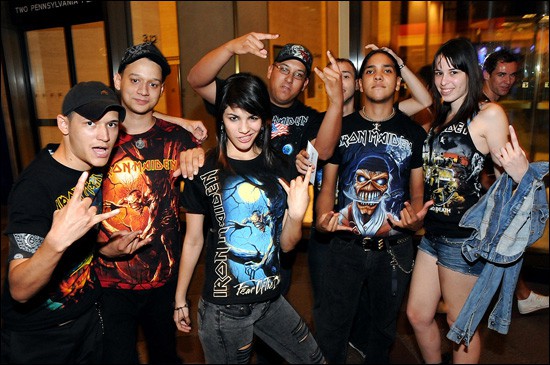
Concert t-shirts seem to be available for any major artist who tours, but they are the specialty of rock bands, particularly metal bands. You’ll see Maiden shirts worn around, but when’s the last time you saw someone wearing a Janet Jackson shirt, a Mariah Carey shirt, or a Madonna shirt? The black tour shirt is undeniably associated with the likes of Metallica, Ozzy Osbourne, Judas Priest, Iron Maiden, Motorhead, Slayer, Anthrax, AC/DC, Black Sabbath, Dio, Motley Crue, Skid Row, etc.
I’m not a manager and don’t pretend to grasp the economics of rock bands, but my understanding (especially after hearing of Marillion’s dispute with a venue over this issue) is that bands make a considerable amount of money on t-shirts and other merchandise sold at the venues, more so than the albums or concert tickets.
So it’s a little bizarre when it seems some bands, notably Wishbone Ash and Blue Oyster Cult, seem to offer a spectacularly poor and dull array of t-shirts – indeed, almost as an afterthought. “Oh, by the way, here are some t-shirts you might want to buy.” The WA shirt was a baseball-style (white with long black sleeves) that simply had “Wishbone Ash” in baseball-style script, whereas BOC usually give us the first album graphic yet again, or simply their Cronos/Saturn cross logo with the band name (ZZZ). Occasionally Godzilla or the Reaper will reappear, but by now those are too traditional and boring to catch my imagination. Iron Maiden and Judas Priest, however, appear to put far more imagination and creativity into this “art form”, you might call it.
Front. The least imaginative image to grace the front of a metal t-shirt is simply the album cover of the most recent album, but this appears to be the default. Some bands will screw around with this and offer some sort of clever variation (again, Maiden are the best for this). Jethro Tull seem to default to Aqualung or Ian Anderson standing on one leg playing his flute, or Broadsword and the Beast; Floyd tend to pull out the ubiquitous pig or Dark Side prism. Occasionally something really remarkable will fly out from the twisted brains of the t-shirt designers. I still have my Metallica “Metal Up Your Ass” shirt I bought at Donington in 1985 (the ONLY shirt Metallica was selling – as if I had a choice!) with the hand coming up from a toilet with an army knife. And long lost, and long missed, is my Scorpions “Crazy World” shirt with the “scorpion” made up of various provocatively built and dressed women. The all time best for sleazy and inappropriate is, of course, Whitesnake’s Lovehunter, which I had in shirt form before I was even aware the album existed, which shows a very well built, and very naked, woman, riding a very large snake coiled up and arching its hood at her.
Back. Unchained from the “album cover” motif, the back of a shirt is the band’s opportunity to draw on a tabla rasa and give us something special. A blank back is a real cop-out. Actually, as unoriginal as they might be, I prefer tour dates on the back, unless it’s something knock-down, drag-out amazing. Examples: Yngwie Malmsteen (“Yngwie FUCKING Malmsteen!”), Motorhead (“Born to Lose, Live to Win” with the Ace of Spades), and my favorite, Monster Magnet (“Space Lord MOTHER FUCKER”). From a European tour of Pink Floyd (Delicate Sound of Thunder tour – a tour of a live album??) the map of Europe with each country filled in with its flag, and PINK FLOYD in Cyrillic lettering.
Variants. For a long time, the baseball jersey – by which I mean, white shirt with long black sleeves – was popular. In more recent years, colors other than black or white popped up. My brother got a great shirt in deep, dark navy blue from Marillion, and I got grey shirts from Tool, Queens of the Stone Age, and Orange Goblin. Back in 1986, when Accept were on their Russian Roulette Tour, they even offered shirts in olive drab. Actual baseball variants – with buttons down the front – have popped up, and Metallica had a very pricey hockey jersey. Iron Maiden – again, thinking outside the box! – has issued several soccer jerseys.
Tie Dyes. Typically this is the realm of the Grateful Dead, though some other bands try to lock into this genre. The Allman Brothers are probably the #2 band for this; I find Ratdog (Bobby Weir’s band) or Phil Lesh & Friends to be derivative of the Dead and part and parcel of the same act. Usually you conceive of a tie dye as being appropriate for a jam band like GD or AB, so when AC/DC or KISS tries to do it, it seems a little stupid. Having said that, I’ve bought an AC/DC tie dye – only because it looked so damn good – and a Jethro Tull tie dye (because it was the best one of any shirt they had for sale). I have a Hawkwind tie dye from the Space Bandits tour, unfortunately a time when I was still buying shirts in L and not XL.
Sizes & shrinkage. The other thing is washing the hell out of your black t-shirt to give it the “veteran dark grey” look. One of my favorites is my Iron Maiden “Trooper” shirt which definitely fits that description. We used to get shirts in M or L back when we were teenagers. Now that I’m older and a little bigger (!) than I was in 1988, I buy in XL and find they usually fit OK, even after a few runs through the dryer at maximum heat (permanent press? What’s that?). A well-worn, dark grey shirt that clearly used to be black shows the rest of the metaleiros that you’ve been going to concerts for some time and didn’t buy your t-shirt at Macy’s or Sears (right, they were opening for Hannah Montana in a store concert).
What to wear, what to wear? I mentioned earlier about the food court druids at metal shows, who can’t be content to simply wear the usual metal uniform of “black concert t-shirt and jeans” but have to do this trench coat, eyeliner crap, or for the ladies, the fishnet stockings & Doc Martens deal. The comic “Cathy” would have us believe that it’s only men who have no self-consciousness, but I’ve seen too many girls at metal shows who dress provocatively, only to demonstrate how many meals they haven’t missed. For every Tawny Kitaen (inevitably there with her Lorenzo Lamas-lookalike biker boyfriend) there are 4-5 Kirstie Alleys, there with their Comic Book Guy boyfriends.
These days I’m too jaded to bother even wearing a concert t-shirt and just wear whatever I happen to be wearing that day, usually a soccer jersey. In the past I might have worn a shirt from the band I’m actually going to see. Is that some sort of violation, a metal fashion faux pas? (Droz: "You're wearing the shirt of the band you're going to see? Don't be that guy!"). Sometimes it seems the goal is to wear the oldest shirt you have, in some sort of pissing contest with the other veterans. “You have a Born Again tour jersey? I have Never Say Die!” “Pssst, I have you both beat! I have a Polka Tulk tour shirt!” Ultimately, though, since we usually buy a shirt at the show, and it’s more convenient to wear a shirt than to carry it around with you (and maybe lose it) you end up putting it on over whatever shirt you so carefully picked out at home and end up looking exactly the same as 50% of the audience who are doing exactly the same thing.
After the show. Now we’re in our late 30s, with regular jobs. We’re not in high school anymore. Metal shirts aren’t even acceptable as casual wear, more like “here’s what you wear when mowing the lawn, painting the house, or changing the oil in your minivan.” It’s reached the point where the only place you can wear them is...at metal shows! I joked that they need to make concert ties for us to wear with suits – or better yet, entire suits (jacket and pants). If you can get a real tattoo at an Ozzfest, why not a tailored suit? Well, at the AC/DC show we’ll make sure the suit pants are actually shorts, so you can go to work the day after an AC/DC show in the Angus outfit and instead of shocked stares, you get “whoa, cool, Angus, man!” in the hallway.
Come to think of it, the demographic at a KISS or Aerosmith show is fairly skewed towards the older edge of the age spectrum. The Ozzfest does attract the teenagers, mainly due to all the Slipknot, Disturbed, and other crappy bands that pass for metal these days; we may disagree with Sharon Osbourne fairly often, but she does know which bands draw in the under-20 demographic. I saw Tesla in 2004, and the person I went with – all of 20 years old – was still young enough to be the daughter of the average audience member. (Rolling Stones: Steel Wheelchairs Tour! Jethro Tull: Too Old To Rock’n’Roll, Too Young To Die).
Friday, May 9, 2008
Emmanuelle
I grew up in Paris – at least from age 10 to 21, with 17-21 spent mostly at college. Of course this was the time I started getting interested in sex. And of course, the Emmanuelle films were there in Paris ... but for some reason I never saw any of them in the movie theater then, although they personified SEX in Paris .
Years later I was working in my own law office, representing Vietnamese clients. This meant having Vietnamese secretaries. Of course, race + language + culture + age = incompatible, plus I was never very attracted to Asian girls anyway, so the lack of interest was mutual, with two exceptions: Thao & Jennifer. I’ll keep Thao down to just her name, and Jennifer (1/4 Vietnamese) is only relevant here because she persuaded me to buy the first 3 Emmanuelle films on DVD. I never watched them with her, though I did get some enjoyment from watching them with a woman from
These films (Emmanuelle with two M’s) are French films, originally featuring Sylvia Kristel, and coming out in the early 70s. I’ve seen about 60% of them by now, and have exhausted the supply available from Netflix. Given their extremely inconsistent quality, buying them outright, while possible, is definitely not advisable. I’ll comment on the ones I’ve seen, recognizing that this is by no means all of the films. With the exception of a few hardcore films, most of these are softcore, with the erotic element varying from mere full frontal nudity, from badly imitated sex, to well-imitated softcore sex. 60% of the sex is lesbian, and fortunately 0% is guy-on-guy. The other 40% is normal, garden-variety man and women sex.
The first three films are the best. They have some semblence of a plot, decent (if fake) sex, and are sensual enough to be enjoyable. They take place in Bangkok , Hong Kong , and Seychelles . Of these, I like the second one by far the most.
Like James Bond, the character changes actresses several times – to me, Silvia Kristel is the Sean Connery of the role, aside from Laura Gemser (above right, described below).
Emmanuelle 5. Now we have Monique Gabrielle, an American, suddenly dropped into the role. Is she French? Is she American? WTF?? I am not a film critic or aficionado, but even I cringe at the atrocious acting here (I could do better than these morons). The plot is incredibly stupid - something involving models kidnapped by an eccentric Sikh guy with a private army who look like NVA soldiers. Huh? She also has an American lover, some rich nerdy guy who looks like the nerd guy in “Riptide” (
By the way, I can’t figure out the fake sex. The couple is clearly completely naked. They are simulating sex, on screen. Why not have real sex? Is it so, if any friend or relative sees the movie, they can plausibly deny that it was real sex on screen and that they aren’t doing “hardcore porn”? Oh, it was tasteful. Err, OK. Dad to Mom, watching their daughter in “Emmanuelle 7”: “It’s OK,dear. You can clearly see they’re not really having sex.”
Emmanuelle 6 (w/Natalie Uher) Very softcore, with truly the supremely crappiest acting of all of them so far. Too stupid to even be erotic. An incredibly lame plot about her losing her memory and getting it back, something about a trip of a bunch of models sold into slavery in
Emmanuelle's Intimate Encounters. Here she’s American again, and runs into a couple that has perfected body-mind-exchange technology (like “The Thing on the Doorstep” by H.P. Lovecraft). Finally, one of the women in the film has a C cup bust, but she’s stuck in a wheelchair. Actually one of the sexier ones, even if it’s STILL incredibly stupid. This one is fairly recent (2000) and features the
Emmanuelle in
Laure (blonde, French). Despite the name, this is nominally an Emmanuelle film. The actress is some blonde chick, completely forgettable plot.
Emanuelle (Laura Gemser, "Black Emanuelle"). Hardly surprisingly, the Emmanuelle films inspired a second series of ripoff films, made in Italy , and they skirted the copyright issue by spelling the name with only one M (like we were really paying attention). Strangely, some of these are actually BETTER than the official ones, and unlike those, the character is consistently played by Laura Gemser, of Indonesian descent. She is definitely smoking, more so than even Silvia Kristel. For some reason the baseline plot has her as some sort of investigative journalist, like a hot, female Tintin, going after bad guys around the world and having lots of sex in the process (unlike Tintin, of course).
Emanuelle in
Emanuelle on
Emanuelle: Queen of the Desert. NO sex, only a modest amount of nudity from Gemser, who isn’t even the central character of the story, which focuses on a small band of mercenaries (complete with AK-47s and various accents) on the run after an assassination job ended and the “agency” didn’t pick them up. It looks like they took a movie they were going to make anyway that had a seductive female character, and decided to pimp it out as an Emanuelle film. Emanuelle turns out to be the daughter of a man they killed, and whose sister they raped, back for revenge against the group. She manipulates them into killing each other out of jealousy for her. Actually not a bad film in its own right, and it has a coherent plot; it just doesn’t fit with the overall trend of these movies, which are erotic adventures, not action flicks with some nudity.
Emanuelle in
Emanuelle and the Last Cannibals. Even worse than “
Sister Emanuelle. Anyhow, in this film she’s a NUN, who escorts a very naughty girl, Monica, to a convent for wayward girls. Fortunately some rogue Red Brigade guy invades the plot, otherwise there would be no male-female sex in the whole film. The ending is pretty surprising.
Emanuelle Around the World. Finally they hit the right balance! This one is still kind of hardcore with lots of nudity (and the women aren’t these 00’s porn stars constantly shaved, they look like normal, but attractive women) but without the nasty violence of “Emanuelle in
Friday, May 2, 2008
PPSH-41
I’ve never had the pleasure of firing this gun, or even holding one in real life, but it sure is impressive. This is the PPSh-41, the top submachine gun of the Red Army during WWII. It fired a 7.62x25mm pistol round at 900 rounds per minute. Although a 35 round box magazine was available, and was more reliable, the ubiquitous 71 round drum magazine, copied from the Finnish Suomi submachine gun, was considerably more common and popular. Approximately 6 million of them were produced during WWII, and entire units of the Red Army were equipped with it. It was the ideal weapon for close-quarters street fighting in Stalingrad, though once the distances opened up, the more advanced German Stg-44 assault rifle became more advantageous – provided there were enough Germans left alive to fire them. With a capacity advantage of more than 2 to 1 against the the Germans’ MP40 (with its 32 round box magazine), the PPSh-41 gave the already more numerous Red Army soldiers a definite edge. For their part, the Germans adapted the PPSh-41 to 9mm, and even attempted a double-stack magazine setup for the MP40, which worked as poorly as you can imagine.
After WWII, the PPSh-41 was supplied to North Koreans, Chinese, and other communist countries. Pictures circulate of rebels in Hungary in 1956 using them, and early in the Vietnam War, before the AK-47 became the standard weapon of the VC and NVA, it was used by those forces.
Remarkably, long after the AK-47 has captured our attention – thanks to the PLO and countless other terrorist groups adopting it as their signature weapon – the PPSh-41 made a comeback, in the most unlikely context. US forces in Iraq, involved in street fighting, have adopted the PPSh-41 and have been using it there - even fitting high-tech laser aiming systems obviously not available to the Red Army in WWII. Only the Danish Madsen machine gun has more staying power over the years – from 1903 to at last being retired by the military police of the state of Rio de Janeiro, in Brazil, as late as 2008.
Subscribe to:
Posts (Atom)