Friday, October 17, 2014

Rosslyn, Virginia

Recently I returned to this neighborhood on a Sunday afternoon.  I checked the entertainment center at River Place, walked around the grounds, went through the Rosslyn Metro Mall, and exercised at Gold’s Gym.  This was the Gold’s location at which I originally established my memebership in September 1999.

Personal Origins.   During home leave of summer 1980, our family stayed at the Key Bridge Marriott.  Its claim to fame is a pool which is both indoor and outdoor; you can swim under the glass window from one side to the other. 
            Sometime in 1984, my parents purchased a co-op efficiency (studio) in Rosslyn, Virginia.  During the summer of 1986, my entire family stayed in this efficiency during our summer home leave.  That’s two adult parents, two adult males (my brother and I) and our younger sister, who was 11 years old at the time. Two sofa beds and a cot took up 95% of the floor space when we were sleeping. This was somewhat claustrophobic, so we spent most of the time out and about, coming home just to sleep. 
            In summer 1990, I graduated from University of Maryland, College Park, my parents moved back to the US from Paris, and in August 1990 I started school at the George Mason University School of Law, which is located in Arlington.  Back then it was still in the former Kann’s Department Store building.   Since Rosslyn was just a few Metro stops, an hour walk, or a 10 minute drive, from there, I ended up moving into that efficiency.  In October 2004 I moved to a larger efficiency at Skyline (Route 7 & George Mason Drive), so it’s been 10 years since I lived in Rosslyn. 

History.  As you might imagine, my father knew much more about the world around us than I did – going back to the 1930s.  An example of this was his description of Rosslyn in the 1950s.   At that time, pawnshops were illegal in DC but legal in Virginia, so Rosslyn was a sleazy den of pawnshops.  By now only National Pawnbrokers, up the street on Lee Highway, remains.  
            In more recent times, Rosslyn is exempt from DC’s restriction on building heights – as not to obscure the Washington Monument – so it has a fairly modest skyline of skyscrapers, the tallest and oldest of which are the USA Today buildings; as a skyline, it’s about the same as Norfolk or Richmond, nothing too dramatic, but enough to piss off armchair architectural aesthetes from DC.  Too bad.  This little skyscraper city version of Rosslyn, as it is today, is the Rosslyn I lived in for 14 years. 

Road Hub.  More so than any other part of Northern Virginia, Rosslyn is the biggest hub of roads.  First off there’s Key Bridge, which crosses the Potomac into DC, veering west to Canal Road and Foxhall Road, and east to M Street and Georgetown.  From the northwest comes down the George Washington Memorial Parkway, which leads further south to Reagan National Airport and Old Town Alexandria. From Rosslyn, Route 110 runs south to the Pentagon, Crystal City, and I-395.  I-66 comes out of Rosslyn and goes due west, all the way out to Front Royal and I-81.  Not to be confused with the older Route 66 – Chicago to L.A. and mostly replaced by I-40 in the early 1950s – this highway is the main east-west highway in Northern Virginia. Route 29, also known as Lee Highway, goes roughly northwest of Rosslyn over to Fairfax.  Route 50, aka Arlington Blvd, also goes west to Fairfax and follows I-66 almost parallel, and it intersects Route 29 in downtown Fairfax.  Finally, Wilson Blvd. goes up the hill and leads through Arlington all the way to Seven Corners, where I work today. 
            About the only two major roads which don’t pass through Rosslyn are 495, the Beltway – Rosslyn is well within the Beltway; and 395, the extension of I-95 (the Maine to Florida interstate highway) which goes inside the Beltway up to DC.  I-395 comes over the 14th Street Bridge a bit further south than Rosslyn, although it’s a short 5 minutes on the GW Parkway passing by the Pentagon to get onto.  
            Another Dad-Nugget:  I-95 coming down from Baltimore does NOT hook up with I-395 coming up from the Virginia section of the Beltway.  Why not?  Because DC spent the money originally allocated for that connection to build the DC Metro.  I-395 finally expires in the center of town at New York Avenue.  Anyone driving from north of DC (coming down from Baltimore) and intending to continue south of DC (down towards Richmond), or vice versa, is theoretically supposed to follow 95/495 on its eastern half.  This is why the western half of the Beltway, running through Montgomery County, Maryland, spouting off to 270 northwest, and going into Northern Virginia, is called “495”, while the eastern half, going past College Park and through Prince George’s County, Maryland, across the huge Woodrow Wilson Bridge, and through Alexandria, is called 95/495.  Bypassing Baltimore on I-95 is as simple as just going through the Fort McHenry Tunnel, or the Harbor Tunnel, instead of having to take I-695 all the way around. 

River Place.   This is a co-op complex of 4 10 story brick buildings, all in a cross-shape.  My unit was in the North Building, on the fifth floor, facing southwest down Route 50, with a view of the front gate and Lynn Street.  The complex had an outdoor pool and an indoor “entertainment complex”.  This complex was primarily a poorly stocked gym with one treadmill, a ping-pong table, and 3 permanently disabled hot tubs.  Since I left, they’ve upgraded this to a somewhat more modern gym and pool tables. 

Phil Next Door.  My best friend Phil, who had visited me at River Place several time and fully appreciated Rosslyn’s hublike qualities, moved there in 1993 into a duplex.  He remained there until 2000, when he and his then-wife Julie moved to a larger single-family house in nearby McLean.  His duplex was a short 10 minute walk from me, so I could drink at his place and walk home.  That was fun and convenient while it lasted. 

Key Bridge & Georgetown.   Key Bridge is a large, ornate 20’s era bridge from Virginia to DC.  The DC end is Georgetown, a neighborhood consisting of M Street and Wisconsin Ave (perpendicular to each other).  There are lots of bars and trendy stores, so it’s a great place to hang out and socialize, especially on Halloween.   Walking across Key Bridge is a nice experience:  you can look up the Potomac and see DC. 
            In January 1996 I went to see Motorhead at the Bayou (a now-defunct club under the K Street Whitehurst Freeway).  Bone dry, walking across.  By the time the show was over, the bridge and all of Rosslyn was covered in 2 feet of snow.  This blizzard was so enormous, it killed almost a whole week of work.  My brother, who had been living with me at the time and working at TASC next door, was stuck out in Centreville with his wife’s family.   

Local neighborhood.  One of the very first Chipotle locations in Northern Virginia was in Rosslyn, at the corner of Wilson Blvd. and Lynn Street.  For awhile I resisted going, as it appeared super pretentious, but eventually I relented, and have been addicted ever since.  The USA Today Building’s mini-mall has basically lapsed, but the Rosslyn Metro Mall is still in existence.  Tom Sarris’ New Orleans Steakhouse is gone, as is the Roy Roger’s.  There really aren’t any clubs or bars, but some upscale condo buildings are going up.  

Friday, October 10, 2014

Jimmy Page

Having written blogs on Deep Purple (1984-present), Black Sabbath without Ozzy and Ozzy after Black Sabbath, a stab at Led Zeppelin guitarist Jimmy Page, focusing on his career outside Zeppelin, might be long overdue.  Maybe not.  Anyhow.

Early Years
He was born on January 9, 1944, in London.  He taught himself and played in various bands, winding up in Neil Christian’s band the Crusaders from 1961-63.  After briefly quitting the music business for health reasons, he returned in the form of a session guitarist.  To name his session work would be dull, but his contributions include “I Can’t Explain” by The Who, “Heart of Stone” by the Rolling Stones, and extensive work with Roy Harper and Joe Cocker.   I don’t have the patience to collect Page’s session work per se, and a similar collection of pre-Deep Purple recordings by Ritchie Blackmore costs $200 used on Amazon.

Yardbirds
In 1965, he joined the Yardbirds, replacing Paul Samwell-Smith who had recently quit, briefly sharing guitar duties with Jeff Beck, who had replaced Eric Clapton.  The pair can be seen on stage together – off in the background in a scene – in the movie “Blow Up”, unremarkable except for this element.  Soon after, Beck himself quit, leaving Page as the only guitarist.  This lineup released Little Games, the last of the Yardbirds albums.  “White Summer” is the song on this album most reminiscent of Led Zeppelin, but his playing on the album is recognizable.  The band seemed to be moving to a more mainstream 60’s hard rock/psychedelic sound like Cream, away from the commercial pop of the mid-60s which caused Clapton to quit. 

            The stress of touring and the lack of success led the remaining members of the band to quit in 1968, leaving Page with the name and no band.   He then assembled session bassist John Baldwin, better known as John Paul Jones, and two unknowns, singer Robert Plant and drummer John Bonham, to form The New Yardbirds.  As most of you know, this band is better known as Led Zeppelin.

Post Zeppelin
After Physical Graffiti (1975), Zeppelin put out three albums:  Presence (1976), In Through the Out Door (1979), and Coda (1982), with Coda being a later release of outtakes.  However, this was a release by the band, not one of these unauthorized record company throw-outs without the band’s consent.  Although many Zeppelin fans may disagree with me, particularly about Presence, I consider them to be well below standard; I refer to them as the Last 3.  However, Page & Plant stand by Presence, and some of those tracks resurface on the pair’s more recent live collaborations.
 
In October 1980, John Bonham choked on his own vomit (no evidence of anyone else’s) and died.   This broke up Led Zeppelin, forcing the three surviving members to kill time before subsequent reunions.  Along the way, Bonham’s son Jason (born 1966, before Led Zeppelin came about) developed his chops in Airrace – who opened for AC/DC in 1984 – and playing on Jimmy Page’s solo album Outrider

After Zeppelin, Page did some movie soundtrack work:  Death Wish II, Scream For Help (w/John Paul Jones), and Lucifer Rising.   I find this stuff (e.g. BOC’s Bad Channels) to be mood music or elevator music, hardly worth listening to in its own right.  I’ve passed on collecting it.

Honeydrippers, Vol. 1. (1984).  Remarkably – though perhaps not too surprising – his earliest post Zep musical work was a collaboration with none other than Robert Plant.   This was a 50s-style band which didn’t last long.  I never bothered to snatch this up.  For that matter, I haven’t bothered to collect any of Plant’s solo work, although of the three surviving band members, Plant’s career has been by far the most successful. 

 The FirmThe Firm (1985), and Mean Business (1986).  This was a “supergroup” with Free/Bad Company singer Paul Rodgers, bassist Tony Franklin, and drummer Chris Slade (who later joined AC/DC).  The music is typical 80’s AOR fluff, but aside from that not particularly bad or mediocre.  The group actually toured their albums, but collectively agreed that they would only do two albums and a tour.  Rodgers later joined up with the surviving Queen members to resurrect that band, an experiment which didn’t last long.  Freddie Mercury was a tough act to follow, and I don’t believe anyone, even Adam Lambert, can really fill his shoes, though I can’t really fault Lambert, May, and Taylor for giving it a shot. 

Outrider (1988).  Technically this is Page’s only real “solo” album.  Jason Bonham plays drums; Robert Plant sings on “The Only One”.  One song, “Hummingbird”, is a Leon Russell cover.  This sounds very close to the Led Zeppelin we know and love.  As good? No, but no worse than the Last Three.

Coverdale/Page (1993).  Back when I was in high school, my buddy Sean C consistently disparaged Whitesnake, the band former Deep Purple vocalist David Coverdale formed after DP Mark IV finally disbanded in 1976.  His verdict was that Whitesnake was ripping off Led Zeppelin.  Now having heard all of Whitesnake’s albums - mainly the Bernie Marsden/Micky Moody era of that time – and all of Zeppelin’s output, I’d say there is a very modest sliver of truth to that assertion.  But it doesn’t look like Coverdale was copying Led Zeppelin itself, so much as the blues-rock source material; you could just as easily accuse him of ripping off Free or Bad Company.
            Be that as it may, Jimmy Page and David Coverdale did finally manage to make an album together.  And guess what – it’s not bad.  In fact, It’s pretty good.  I was surprised at how heavy and intense it was.  In fact, I put it above the Last Three and equal to anything he’s done post-Zeppelin. 

Jimmy Page & Robert PlantNo Quarter (1994) & Walking Into Clarksdale (1998).   After the Honeydrippers and “The Only One”, Page and Plant got together again.  “No Quarter” is a live album with some mediocre extra song-age thrown in.  John Paul Jones was not invited, and even miffed that they used HIS song, “No Quarter”, as the title, and even played it – in his absence!   I don’t blame him.  The performances were OK.  Any Zeppelin fan starved for Page/Plant live material after The Song Remains the Same can certainly enjoy this.
            Walking was actually all new studio material.  I thought it would be shitty, but then again, would that pair really deign to release crap in 1998 with their names on it?  No, I didn’t think so.  Rank it up there above the Last Three and below the prior Zeppelin. 

Jimmy Page & the Black Crowes, Live at the Greek (2000).  Jimmy played a one-off concert with the Black Crowes at the Greek Theater In L.A.  In addition to Zeppelin songs – including “Hey Hey What Can I Do” and “Nobody’s Fault But Mine” - they also played “Oh Well” (Peter Green’s Fleetwood Mac), “Shapes of Things” (Yardbirds/Jeff Beck), and a few other blues songs.  The Crowes do a fantastic job of replacing Plant, Bonham and Jones.  Consider this practically a de facto LZ live concert.  (Maybe the Crowes should do a show with Bobby Weir, Phil Lesh, Bill Kreutzman and Mickey Hart....)

Celebration Day (2007).  This is the most recent LZ live show:  Page, Plant, Jones and Jason Bonham at the 02 Arena in London, a one-off show which whetted our appetites, only to have Plant piss on our parade shortly thereafter and nix the idea of any tour.  This was meant as a tribute to Ahmet Ertegun, the founder of Atlantic Records, who died in 2006.  Record label executives are so frequently the bad guys in most band’s stories, that it’s remarkable – the exception that proves the rule – that this man was so well-liked among musicians.  I don’t think there are enough well-esteemed, deceased record label bosses to produce sufficient tribute concerts to constitute a proper tour.   Anyhow.
            It’s a CD/DVD combo.   Let me piss off Zeppelin fans further by saying this:  enough already, give Jason Bonham his due.  Yes, his father was a great drummer, up there with Moon (or maybe we should say, “down there with him now”).  But the “Kid” has been playing on his own for some time, and even contributed original drumming to Black Country Communion.  Jason does the job.
            The setlist was unremarkable, but I’d have pulled the two Presence songs, “For Your Life” and “Nobody’s Fault But Mine” and brought in “Over the Hlls and Far Away” and some other song.

Page vs. Plant.  I don’t know if Jimmy Page has his tombstone or mausoleum picked out yet, but if he did, I wouldn’t be surprised if it simply had his DOB, the date he died to be chiseled in later, and “ZOSO” as his name.  If we only remembered him as the lead guitarist of Led Zeppelin, he would be 100% fine with that.

            Plant, on the other hand, would probably NOT care to have the circular “plant” symbol from LZ IV on his tombstone.  His would probably state his full name with no mention of LZ.  He remains consistently aggressive in asserting his musical identity independent of Led Zeppelin.  No tour, no new LZ material, nothing – back to his solo career, much to Page’s immense frustration.   Although Page obviously hasn’t asked for my advice, I’d give it to him anyway:  screw Plant, assemble an all-star supergroup, and play whatever the hell you want.  Because I can’t see Page as simply touring with Jones, Jason, and another singer – no matter how talented – and calling it “Led Zeppelin.”  But it would serve Plant right if he did.  Let some other singer embarrass Plant and put his own stamp on Zep’s classics.  

Friday, October 3, 2014

Vinyl

My next topic: VINYL.   Although I originally addressed this issue awhile back, (Olde Music, 5/23/08), I’d like to tackle it again in more detail. 

I repaired my Cerwin-Vega speakers a few weeks ago, and upgraded the mat on my turntable to a cork mat, so I’ve been accumulating some 180 grain vinyl: the first 6 Black Sabbath albums, the Sabbath set at California Jam (1974), Grateful Dead Anthem of the Sun and American Beauty, Moody Blues Days of Future Passed, King Crimson In The Court of the Crimson King, and Hawkwind, Hall of the Mountain Grill.  Urban Outfitters and FYE are beginning to carry vinyl as well.  Obviously Vintage Vinyl, in Ford, New Jersey (about 20 minutes north of Rutgers) carries this format – which is where I got the CA Jam record.  Here are some thoughts on this.

1.         78s.  First there were 78’s, on thick shellac but very fragile.  They were 10” in diameter and could fit 3 minutes of music on a side.  Because the grooves are much larger and require a special needle, 78s need a record player specifically designed for them, and will not play on any record player which plays LPs.  Because the LP format (see below) came out in 1948, any depiction of someone playing music in the 20s, 30s, or WWII is likely to be of 78s. 

2.         LPs.  The more familiar 12”, 33.3 RPM format came out in the late 40s, developed by Columbia.  Because this format could fit 20-30 minutes per side, they called it “long playing” (LP).  To the extent vinyl is still around – and making a comeback – it’s in this format. 

3.         180 Grain.  The prior standard, from 1948 to the 1980s, was 130 grain. The recent reissues are in 180 grain, which means a thicker album which can accommodate deeper grooves and thus – theoretically – a richer, fuller sound and better sound quality.

4.         I don’t think I’ll get any vinyl versions of recent albums which were originally released on CD.  The Beatles records are re-released on 180 grain vinyl, but that includes Past Masters – which should be all those 45s – and the BBC records.  (Still no Hollywood Bowl live album).  On the other hand, one big plus of vinyl is that the jacket displays bitchin’ artwork much better than a CD insert, and that includes Age of Winters by The Sword (2006).

5.         In one case, Sleep’s Dopesmoker, I really have to wonder about the wisdom of releasing the 90’s era music, originally released on CD, on vinyl.  This album was one 60 minute song without lyrics.  It’s basically a humungous jam.   Noway, nohow, is that fitting on one side of an LP.  In fact, it fits on 3 sides.  Breaking up a continuous song on multiple sides?  Huh?  That sounds like back when 78s were in vogue, and a complete opera or classical piece had to be split up over upteen 78s (capacity of less than 3 minutes per side), contained in a binder (“album”) with sleeves.

6.         We still have most of the original vinyl we collected up until the mid 80’s.  I believe it was 1988 when my brother got his first CD player, 1989 when I got mine.  The last few vinyl albums I bought were Judas Priest, Turbo (Ram It Down was among the first CDs), Van Halen 5150 (OU812 was among my first CDs), the three Deep Purple Mark I albums (we have all the Mark II and III albums on vinyl, plus Perfect Strangers, House of Blue Light, and Deepest Purple), and the early Scorpions albums, e.g. Lonesome Crow, In Trance, Taken By Force, and Tokyo Tapes, all bought in summer of 1988.  Thus I can identify 1988-89 as the period when we stopped buying vinyl and started buying CDs. 
**         Since car CD players were still a few years away and very prone to skipping when they did come out, and CD-Rs were also years in the future, the advent of CDs did not spell the immediate end of cassettes.  In fact we still had to retain that format if only to be able to listen to anything in a car. 

7.         How does 180 grain vinyl compare to …not-180-grain vinyl?  On the turntable, through the speakers, and turned up somewhat, the 180 grain records sound very good.  Very rich, very full.  Better than the original vinyl?  Probably, but I don’t have the patience to check.  Better than a remastered CD?  Aha, that’s the real question.  The experts (audio engineers, not hipsters) say remastered CDs are better than vinyl.  I don’t trust the audiophile hipsters who swear by 180 grain vinyl to admit if they can’t tell the difference.

            Keep in mind that when CDs were first released in that format in the mid to late 80s, no effort was made to optimize them for CD sound quality; the labels simply wanted to release something that you could physically play on a CD player.  I suppose they assumed that the buyers would assume the sound quality was better.  Only later did they go back and remaster them.  The Beatles were an exception: their first generation CDs were remastered, but the audiophile crowd disliked the job so much that the Beatles went back and redid the remasters a second time. [I compared Help! on first generation CD vs. the newer reissue, and the new version does sound noticeably better].   AC/DC (Atlantic & Elektra), Black Sabbath (Castle & Rhino), King Crimson (thirty-fifth Anniversary remasters vs. fortieth Anniversary remixes), and now Led Zeppelin (first Atlantic and now second Jimmy Page supervised Atlantic) are all bands with not one but TWO series of remasters.  While the difference between the initial non-remastered releases and the first generation remasters are probably noticeable, I have to wonder if anyone – aside from hardcore audiophiles – can detect the difference between the two generations of remasters.  Then there are bands like Soundgarden who have remastered Superunknown, which was originally released on CD in the first place (1994).

            I do read yahoos on Facebook swearing that vinyl sounds much better than CDs.  Again, the experts claim that this might only be true with respect to first generation CDs (not remastered).  Someone posted a back to back replay of a Tina Turner song in both formats, and the difference was noticeable – in favor of the CD.  A minority of people guessed that the better sounding recording was vinyl.  WRONG. 

            Finally I listened to Sabbath, Bloody Sabbath on my stereo.  Exhibit 1: 180 grain vinyl version from Rhino Records.  How was it?  It sounded nice.

            Exhibit 2: SBS in Castle Remasters [which are VERY difficult to distinguish from the later Rhino remasters].  How was it?  It sounded nicer:  clearer, less compressed, breathing better. 

8.         Aside from hipsters making vague claims of vinyl superiority, the most cogent and understandable – and verifiable – claims on behalf of vinyl, and this applies to the first generation as well as the 180 grain reissues, is this business of having to put on the record, drop the needle, and flip the record, an elaborate, retro ritual.  I mean, having done all that, it MUST sound better….right?

9.         Authenticity.  Ironically, if your point in going with 180 grain vinyl is a tribute to nostalgia, because you insist that music originally released on vinyl should be listened to on vinyl, you’re missing the point with 180 grain vinyl, which was not available back in the 60s and 70s and is a modern vinyl format.  The more cogent argument is that you’re dead set on listening to this in a vinyl format, for nostalgia purposes, and simply want to optimize the experience and come as close as you can to remastered CDs with this experience.  Fine:  but don’t be an idiot and try to argue that 180 grain vinyl is superior to a remastered CD, because – as noted above – most audio engineers and a blind listening test will tell you otherwise.

10.       Herbal Enhancement.  I'll officially pronounce myself neutral on the topic of cannabis, though strongly in favor of its legalization, as it is non-lethal and non-addictive.  One area where I think cannabis is having an impact, possibly unexpected, is this vinyl business.  With CDs and digital formats, especially streaming, you can go out and about and listen to your favorite music:  while at the gym, while driving, etc.  Not an option for vinyl, which you have to listen to in the privacy of your (or a friend's) home.  And under those circumstances, packing a bowl to enhance the listening experience might well be almost required.  Under the influence of the herb, practically anything you put on that turntable will sound amazing.  Has any stoner tried comparing remastered CDs vs. 180 grain vinyl while blazed?  Somehow I doubt it.  Perhaps the 180 grain vinyl people should be subsidizing the cannabis industry.....

Ultimately it looks like this.  If you have a good stereo, with good speakers, and a CD/DVD player going through them, but NO turntable – audiophile or otherwise – save your money and stick with CDs.  If you have a turntable going through that same stereo AND feel nostalgic for vinyl, by all means do as I did and get a few records here and there.  Do not pay $50-100+ for any vinyl, especially if you can get a remastered CD for a fraction of the price.  And “audiophile” turntables start at $300, going up to $1000, with no guarantee you’ll be able to tell 180 grain vinyl from remastered CDs.  The experts (audio engineers, not hipsters) say CDs are better; logic suggests that modern technology should surpass mid-twentieth century technology as well.  Is there any compelling reason why your ears should disagree?

Friday, September 26, 2014

My Way and 9th Company

Now it’s time for another blog on obscure foreign movies, and as you may expect by now, they’re about WAR, which is one of my favorite topics.

The first is a South Korean film about World War II. 

My Way.  A Korean – Jun-Shik Kim (JSK) – and Japanese – Tatsuo Hasegawa (TH) start off as friends/rivals.  Both are good marathon runners and compete against each other in the mid-30’s leading up to the war, even trying out for the Japanese Olympic team, i.e. the 1940 games which were supposed to take place in Tokyo, but which were cancelled due to the war.  Tatsuo is the grandson of the Japanese military governor.  Korea was a Japanese colony from 1895 (the first Sino-Japanese War) until 1945.  The movie depicts the Japanese as arrogant and mistreating the Koreans as second class.
            They both end up in the Japanese Army in 1938. Tatsuo is an esteemed officer, while JSK is a lowly private; he and his fellow Koreans in the unit were conscripted as punishment and suffer the abuse you might expect.  TH and JSK don’t get along.
            Part I:  Up in Manchuria, the Japanese bump ugly against the Red Army.   “Banzai” suicide charges aren’t enough to defeat several waves of Soviet tanks (which look like T-26s).
            Part II:  The pair wind up in Siberia in a Soviet POW camp.  One of the Korean soldiers is now the block leader and browbeats the previously abusive Japanese, now POWs.   TH and JSK still don’t get along. The Germans invade, so the Red Army comes by looking for warm bodies to fight the Nazis.  Facing imminent execution for a prison riot, our two buddies quickly agree.
            Part III:  Stalingrad?  Sverdlovsk?  Who knows.  In some battered Soviet city, the Red Army schmucks are thrown up against a wall of Germans with MG42s and other fun stuff; from the timeline it’s still 1941, so the Germans are still very much in the game.  And the stereotypical Commissar is right behind them to shoot anyone retreating.  SOMEHOW, both guys survive this…slip into German greatcoats and uniforms…and trudge through the snow to the German lines.  They get split up at this point for the next three years, each not knowing if the other has survived, although JSK did help TH survive the battle and helped him escape.
            Part IV:  These two Asians in German uniform who speak no German eventually wind up in an Ostbatallion (mixed Wehrmacht unit of Arabs and other miscellaneous Russian ethnic groups all thrown together because the Germans have no clue who they are, only that they’re not European) at Normandy in June 1944, and finally reunite.  Guess what happens! 
An epic story, very long, but intriguing to see what happens to these two, sometimes at odds, sometimes rivals, but ultimately friends.  They have to depend on each other to survive in a brutal war on three different fronts in three different uniforms.

The second film is a Russian deal, in Russian with English subtitles, taking place in Afghanistan.

9th Company (DVD).  This was in the previews which came with “My Way”.  Imagine your typical French Foreign Legion film:  various disreputable types flee to the FFL to escape either justice or boredom, get sent to the godforsaken desert of North Africa, and wind up practically wiped out by angry Arab tribesmen.   Got it?
            Ok, now instead of the French Foreign Legion, it’s the Red Army in 1988 – towards the very end of the Soviet Union.  Instead of North Africa, it’s Afghanistan.  Instead of Justin Bieber tribesmen, it’s the mujahedeen.   But almost exactly the same.  Some things never change, do they? 
            The funny thing about this film is that back in 1988, we’d be rooting for the mujahedeen against the Red Army.   Nowadays, knowing the “muj” (as the Russians call them) morphed into the Taliban?  Eh, not so much.  Most of the Russian soldiers are as sympathetic as Paul Baumer & his buddies in “All Quiet”, or the Band of Brothers gang, or any other close-knit squad of misfit soldiers who only want to survive.

Friday, September 19, 2014

NFL Bad Boys

Miami takes down Tom Brady!  The Vikings crush the Rams!   The Cardinals are on top of NFC West, above the 49ers!  The Bills are on top of AFC East, while the Patriots are on the bottom!  The Texans are 2-0, and on top of AFC South!  Luther Bliss to Teddy Roosevelt: “This is Kentucky, sir.  Everything is topsy turvy.”  I want to see how this season develops, if only out of morbid curiosity. 
            Well, I did… until this Adrian Peterson thing blew up.  Who knew what was going on?   On the Vikings site, the fans all charged immediately into “DUMP HIM IMMEDIATELY” mode.  Only a few said things like “let’s wait to see how this pans out,” or “innocent until proven guilty.”  Charles Barkley offered his predictably “out of the box”/”I don’t care what anyone else thinks” support for AP’s behavior.  As with Donald Sterling, I’m baffled as to why off-field behavior which doesn’t result in the athlete locked up pending the trial, will still result in a suspension or deactivation.  I can understand if a bank employee is accused of embezzlement – something directly related to his job – they would suspend the person pending the investigation.  But switching his kid in Texas doesn’t seem to bear any connection with running a football in a game. 
            For that matter, neither does punching your wife in a hotel elevator.  In Ray Rice’s case, the incident took place in February 2014, the couple later reconciled, they’re married now, and the local prosecutor’s office already made the determination not to press charges.   I’m not aware that their CURRENT relationship is abusive.  If it was one incident which was resolved at the time – however shocking it might have been – there is really no practical relevance to bringing this up now.  As Mrs. Rice herself complained, it just embarrasses both of them and costs her husband his job, without protecting her.   Ruining their lives and livelihood is a big price to pay simply so the rest of us can feel morally self-righteous. 
            Imagine, on your two week vacation, you go to Las Vegas.  Something happens.  Maybe not a corpse or a missing person, but something which results in a criminal charge against you, though it’s later dropped and you don’t even serve a day in jail; you hired a local attorney who resolved the matter without so much as a single court appearance on your part.  You return home, go back to your job.   Then the s**t hits the fan.   Your boss finds out.   Although the incident had no bearing on your job, your boss still decides to fire you because of “what happened in Vegas.” 
            From what I can tell, the logic behind suspending or releasing a player for off-field behavior which does not otherwise compromise his ability to play (e.g. Aaron Hernandez locked up pending a murder trial, or Michael Vick going to prison) is that athletes are celebrities and public figures, and that sporting events are public events.  The games are not conducted at fields away from public scrutiny, with the results simply posted after the fact for fans to know about. 
            Therefore the public has some expectations as to the character of the athletes that they watch playing.  Will the fans still come to the games, or watch them on TV or cable, if the team includes wife beaters or child abusers?  Will they still drink Budweiser if the brewery continues to sponsor a league with such players in it?  Are we, as fans, prepared to overlook the player’s off-field screw-ups if they produce sufficiently impressive results on the field?  Is the league’s potentially most explosive QB, running back, or wide receiver currently sitting on death row or in a maximum security prison as we speak?  Ironically, the Oakland Raiders are one of the cleaner teams in the league, but all teams seem to have some misbehaving athletes.  And this problem occurs in other professional sports as well. 
            Look at Michael Vick.  In 2007 his Falcons career took a nosedive in his dogfight scandal, he served 21 months in prison.  Yet he served his time, reformed, and is back in the NFL today. 
            If you indefinitely suspend any player facing any sort of criminal charges, even if they remain out on bail or can resolve the charges without interfering with their availability to play for the team (e.g. plead the case down to a lesser charge, suspended jail sentence, probation, etc), that will substantially deplete the available personnel in the NFL.  At any given point, SOME NFL player has a criminal charge pending against him.  DUI seems to be the most common, plus drug-related charges, or Plaxico Burress’ gun-related incident.  
            And consider this.  At the risk of sounding overly complacent or “boys will be boys”, this is a rough, full contact sport.  A certain aggressive spirit is necessary to play the game.  If we winnow out all the players with any aggressive impulses, we might compromise the intensity of the game.  Imagine an NFL where 100% of the players are meek angels with absolutely clean criminal records.  A whole load of Tim Tebows.  That may not hurt at the QB position – most of them, aside from Big Ben, seem to behave themselves – but the rest of the positions will suffer to some extent.  Are the fans somewhat inconsistent on this:  we want a good game, but we aren’t willing to tolerate the type of players necessarily to give us that game, vs. “yeah, he’s a punk, but he’s OUR punk!”? Only domestic and dog abuse, though, rises to the level where the fans morph into the angry villagers in a Frankenstein movie, wielding torches and pitchforks and seeking to drive the offending player out of town, tarred and feathered.
            Before we go any further, let me clarify one issue.  Not even Adrian Peterson’s defenders argue that he should be immune to criminal prosecution simply because he’s such a great running back.  To my knowledge, no one is claiming that professional athletes should be held to a lesser standard, let alone granted immunity.  If an ordinary person would be released on bail, merit probation, a first offender program, or a suspended sentence – fairly common accommodations which keep the defendant out of jail – then there’s no reason why a professional athlete shouldn’t deserve the same clemency. 
            However, if the offense took place in the town where the athlete plays, common sense indicates that a local prosecutor who refused to let a player go out on bail, jeopardizing his team’s chances for that season, might face some challenges when re-election came up.  Then again, the same overwhelming fan reaction to “dump him NOW!” should protect the local DA from political repercussions.  If I had to place bets on the Atlantic County, NJ prosecutor’s NFL allegiance, I’d say he’s in Eagles territory, while the Ravens are in a completely different conference.  I’m curious as to whether a Minnesota prosecutor would handle Peterson’s case differently than the Texas guy running the show now, or a prosecutor in Green Bay, Detroit or Chicago, for that matter.   Here’s some free legal advice to NFL players (worth what you pay for it, right?): be VERY careful what you do when you’re in enemy territory.
            Anyhow.  
            In all fairness, there are plenty of running backs who don’t switch their kids or punch their wives.  Maybe we should “clean house” once and for all – and see what happens.  Try a zero tolerance policy, suspend ALL these players for this season, and see what happens. 

            With morbid curiosity, of course.

Friday, September 12, 2014

Solutions

It’s time for another blog on more esoteric topics than movies, books, or music.   In this case, it’s a “meaningless corporate buzzword” (MCB), “solutions”.   I picked this one because it bothers me the most, but also because it’s the one most likely to be inflicted on the public at large and not just the poor drones at Initech.

Why do I dislike it?  Well, it’s deliberately vague.  “Solution”.  To what?   Presumably to problems.  What problems?  Most businesses can simply claim, “we sell a quality product or service at a reasonable price.”  What’s wrong with that?  Fairly straightforward and honest, right?  But the company barking “solutions” is claiming, we do better than that: we have “solutions”.   Huh?  Solutions to what?  Storage problems?  Staffing problems?  Business problems?  So vague, in fact, as to be meaningless. 

I don’t know who came up with this stupid expression, but I’ll venture a guess.  Either it was a New Age type who knew that New Agery doesn’t pay the mortgage, so he/she/it had to get a real job, but couldn’t simply accept bland, grey flannel, Don Draper corporate culture at face value.  No, this clown had to New Age the business so he/she/it would be nice and comfy, and New Age the crap out of everyone else too.

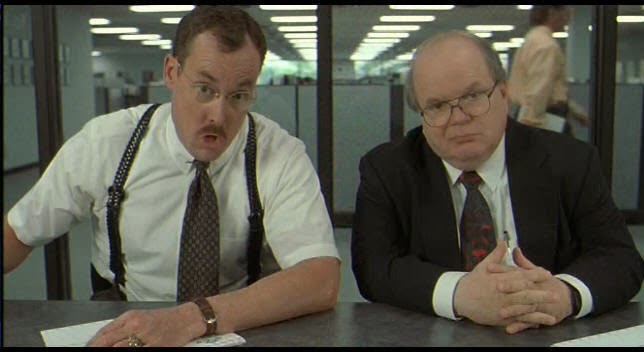
Or it may have been some consultant.  In “Dilbert”, Dogbert – the cynical little dog – explains that “consult” is a combination of “con” (as in, con artist) and “insult”.  The consultant in fact cheats the company out of $$$, as well as insulting them and their intelligence.  This Harold Hill type came into town – the Two Bobs, right? – and gave a slick spiel about “solutions”, after which the pointy haired bosses ate it up.  Now we’re stuck with it:  bosses, employees, and the general public.

Either way, it’s annoying.  Really annoying.  Remember George Carlin, the comedian?  I suppose he was somewhat liberal, somewhat anti-authoritarian.  But above all he was anti-bullshit.  Because the primary purpose of bullshit seems to be to lie, so that that someone can use, cheat, steal, rob, or exploit you.  So a company that deliberately uses a vague, meaningless term when interfacing with the general public is essentially saying that, as a matter of principle, its corporate philosophy is to be deliberately misleading.

Might I suggest that we boycott any company that uses “solutions” in its literature, advertising, and certainly its corporate name.  Boycott bullshit.

Friday, September 5, 2014

Opium, Morphine, and Heroin

As a “companion” to The Annotated Hashish Eater, is the Hashish Eater’s Companion.  However, as a practical matter, this volume is mostly about opium and not hashish.  It includes various articles on opium, including Thomas DeQuincey’s famous Confessions of An English Opium Eater (in its entirety) which served to inspire Ludlow to write his own Hashish Eater.

Opium was the original deal.  Opium essentially consists of a mixture of codeine and morphine.  Morphine is the underlying drug.  Laudanum is a mixture of alcohol and opium. 

Heroin came later.  Diacetylmorphine is the chemical name, tradenamed as heroin by Bayer.  It was originally synthesized in 1874, then developed into a commercially marketable drug in 1897, and sold from 1898 to 1910 – ironically, as a non-addictive alternative to morphine, although they soon realized that error.  It was banned in 1924.

Unlike Ludlow, whose hashish consumption was purely recreational, DeQuincey claims his opium habit stemmed from various painful and uncurable medical conditions, although both authors cite Samuel Taylor Coleridge, the author of “Rime of the Ancient Mariner” and “Kubla Khan”.   Coleridge’s own addiction to opium was well known to both of them.   What’s strange is that both were aware of Coleridge’s conditions before beginning their own consumption.

Back in the nineteenth century, up until the early twentieth century, morphine was the most powerful painkiller.  For many suffering from painful, incurable conditions, morphine was the only drug that worked.  Many soldiers were given morphine for their wounds and later became addicts.  “Heroes For Sale” (1933) describes a WWI US soldier given morphine by well-meaning German doctors and ultimately becoming addicted.  Oddly enough, back in 2000 I had back pain, so I was given one shot of morphine at the E.R. for it.  It did the job well.  But I only had that one shot, and did not turn into an addict.

In addition to killing pain and inducing a general state of intense euphoria, opium produced extremely lucid and colorful dreams, powerful enough to be remembered and recorded, thus Coleridge’s inspiration and muse.   However, the horrendous chemical dependence arguably offset this benefit.  Opium becomes a necessary ingredient for sustained life.  At that time there was no receptor substitute like methadone to help an addict wean off the drug.  Insomnia, chronic constipation, issues with appetite, skin complexion, in fact so many different problems that the addict’s body is taken over by the drug with irreversible physiological damage. 

Ludlow actually echoed this in his own stories.   Those who condemn the opium addict have no idea what the person is going through.  The drug is so powerful, the addiction and dependence so thorough, that the addict is consumed with the need to get more.  He will lie, cheat, steal, do whatever it takes, to friends, family, loved ones, anyone, to get more.   He is no longer in control of himself.

Ludlow himself described not only his own difficulty in trying to kick the habit, but his proposal for a rehab center – in third quarter of the nineteenth century – and efforts on his part to assist others in doing so.  Infrequent recreational use might not necessarily lead to addiction – Ludlow describes different patients having different levels of dependence – but after a certain point, there is no going back.   The withdrawal symptoms become so close to lethal that as a practical matter, the person is better off sustaining a modest habit than getting off the drug completely.  
At this point the victim is doomed to this for the remainder of his life.  Ludlow described this as a very slow form of suicide, oddly enough a sentiment echoed in Ozzy Osbourne’s song “Suicide Solution”.  But for all of Ozzy’s idiocy and substance issues, he was wise enough not to even dabble with heroin, much less become addicted to it: his song refers to alcoholism. 

By the twentieth century, opium and laudanum were replaced by heroin.  Several prominent rock stars got themselves hooked on heroin.  Of these, Sid Vicious (Sex Pistols) and Layne Staley (Alice in Chains) ultimately died.  David Crosby, of CSN/CSNY, described heroin (and other hard drugs aside from marijuana) as “a massive waste of time”.  The singer for Sublime, Bradley Nowell, is the most egregious example of this idiocy.  He deliberately got himself hooked on heroin because he believed it would help his musical inspiration and ability.  Naturally he learned what all the previous addicts learned:  it’s a losing bargain.  After a few cycles of clean and dirty, he finally fatally overdosed on the drug in 1996.

William S. Burroughs, the author of Naked Lunch and a member of the beatnik group that included Allen Ginsburg and Jack Kerouac, was an addict.  Much of Naked Lunch is a vivid depiction of heroin addiction and the extraordinary lengths to which an addict will go to procure more of the drug.  The appendixes to the latest edition include an essay by the author on heroin rehab, i.e. what works and what doesn’t.

By now there are several movies handling this topic, but “Trainspotting”, with Ewan McGregor long before Obi-Wan Kenobi or “Men Who Stare At Goats” as a recovering heroin addict, is probably the most graphic.   

Opium Wars.  In the 1840s, England traded with China.  They paid in silver, a valuable commodity, but had a surplus of opium grown in Afghanistan and India, so they decided they'd rather pay the Chinese in opium than silver.  The Chinese weren't idiots, and refused.  Unfortunately for the Chinese, despite having invented gunpowder centuries before the British, they fell well behind in its practical - military - applications; as early as the twentienth century, entire units of the Imperial Chinese Army and various warlord armies were equipped with spears.   Of course the British were successful at coercing the Chinese into accepting opium as payment instead of silver.  As you might imagine, this caused many problems in China and considerable anger and resentment.  See my blog on the Boxer Rebellion (1900).

Years ago our law office represented a heroin addict.  We negotiated a deal with his creditors to surrender his houseboat in a marina in southwest DC in exchange for writing off his debts.  He asked us to get a few personal belongings off the boat before surrendering it.  This boat essentially was a garbage scow, but he had been living on it.  Talk about a real life horror story.  Heroin? No thanks.