Friday, May 31, 2013

Elric Returns


I finally completed The White Wolf’s Son, book three of the Dreamthief trilogy; books 1 and 2 are The Dreamthief’s Daughter and The Skrayling Tree, respectively.  These are Michael Moorcock’s latest contributions to the body of Elric stories.

Let me start by correcting my earlier error: Elric is not just a tangential character here, although he is not the main character either.  All of his adventures herein, just like The Fortress of the Pearl, are somehow sandwiched into the saga as originally set out in six books, starting with Elric of Melnibone and ending with Stormbringer. 

First, The Fortress of the Pearl (published 1989).  This is set somewhere inside the Elric saga, apparently in Weird of the White Wolf before Elric met Moonglum.  Elric (Snake?) has been poisoned with a 24 hour toxin by a local merchant and blackmailed by him into retrieving a magic pearl.  The catch is that the pearl only exists in the dream of a young girl who is in a coma.  He needs the assistance of Lady Oone, the dreamthief, who guides him through the girl’s dreams to find the pearl.  The story is somewhat psychedelic and trippy, but I liked it.  Moorcock did a good job of adding an adventure for Elric (the book came out long after Stormbringer) without affecting the main saga story.

The Dreamthief’s Daughter (published 2001).  We’re introduced to a 20th century earthbound incarnation of Elric, Count Ulric von Bek, a German nobleman who finds himself at odds with his “cousin” Gaynor von Minct in Nazi Germany, plus a mysterious but articulate devil, Klosterheim.  When he refuses to turn Stormbringer over to Gaynor, the Nazis send Ulric to Saschenhausen concentration camp.  He’s rapidly rescued and then goes off into a parallel dimension, the so-called “Mittelmarch”.  Ultimately he meets up with none other than Elric himself.  Oona, the daughter of Oone, features heavily in this story – Fortress acts as a de facto prequel to this story, or rather, Moorcock used that as the basis for this trilogy. 

FYI:  all these dreamthief women are albinos, just like Elric.  There’s also a human-height intelligent talking fox (Sir Renyard), a Scotsman (Odhran), a French Legionaire (Fromental), a Brit (Sir Bastable), and a German count like Baron von Munchausen (Lobkowitz).  Did I mention Moonglum comes back briefly – somewhere in this big mess?

The Skrayling Tree (published 2003).  Now we’re transplanted to America, but in 1156 A.D.  There’s a heavy dose of American Indian adventure in this story, but fortunately Elric, Ulric, and Oona are back for more.  Ulric has been kidnapped by Indians, and Oona goes off to find him along with another set of Indians. Meanwhile, Elric, tied up to the rigging on Jagreen Lern’s flagship (Stormbringer), projects himself into a 1000 year dreamquest to summon Stormbringer and cut himself loose; so he starts off this adventure in medieval Europe, while Ulric gets a Nihrain steed in Elric’s original stomping grounds.  Gaynor is back as Gunnar, a Viking chieftain who takes Elric to America by longship (a la Leif Ericsson); as is Klosterheim.  1/3 of the story is told by Oona, 1/3 by Ulric, and 1/3 by Elric, and they all meet up at the end.

The White Wolf’s Son (published 2005).  Finally, everything gets wrapped up.  The story is mostly told from the perspective of Oonagh, the granddaughter of Oona.  She has a twin brother Onric, aka Jack, who is blind.  Mind you, he’s Elric’s son AND he’s an albino too, though despite the story’s name his role is extremely minor.  Gaynor and Klosterheim cause more problems – like all villains, they basically want to control everything and in the process destroy the universe as well.  The killer part of this story is that most of it takes place in Hawkmoon’s neck of the woods.  Granbretan and Londra are front center, and even Hawkmoon himself makes a VERY brief appearance (p. 155).  The villains of the Hawkmoon series are much more prominent herein, though, than Hawkmoon, Count Brass, Oladahn, or the Warrior in Jet and Gold.

If you’re a fantasy/sci-fi writer and you want your beloved characters to travel through time and/or space, you have to concoct at least some sort of semi-plausible explanation for how they do so, right?  Not necessarily!  Edgar Rice Burroughs never bothered to explain how John Carter wound up on Mars.  Philip K. Dick explained time travel as a drug’s side effects (Now Wait For Last Year).  Michael Crichton came up with quantum computers to do time travel (Timeline).  And for much of the Elric saga, Moorcock was content to simply invoke the easiest and simplest explanation: MAGIC.  Apparently, that’s not good enough for him anymore.

Thus all three stories are heavily dosed with the abstract mumbo-jumbo that Moorcock loves.  There’s far less swordplay and violence – in fact, Stormbringer’s body count is down to almost nothing since it appears so rarely in the entire story.  The price we pay for having characters travel through time and space is to be inundated with incessant babbling about “The Grey Fees”, the “Balance”, good, evil, God, the Devil, the Stone, the Sword, the Cup, the Grail, the RuneStaff, etc., though all of this also encompasses the overall story and not merely interdimensional travel.  But it reaches the absurd point where even half the characters are confused themselves.  Fortunately all is explained – fairly well, I’ll admit – by the end, but by that I mean the very end of White Wolf’s Son.  Until then you’ll probably be as confused as you are entertained. 

However, what Moorcock does give us is:  A) more Elric and Strormbringer – even Mournblade, B) some “Elric on Earth”, which is actually cool, and C) FINALLY some decent conclusion about the Hawkmoon story, because he dropped the ball big time on that the first time around (Corum and Erekose get a few lines).  So for those of you who think that SIX Elric books was not enough, pay heed.  Now, where’s the Elric movie????

Saturday, May 25, 2013

Escape from NY and LA


Having been to NYC far more often in the last 4 years, and L.A. for the first time in summer 2010, I decided to revisit these films again.  Oh, and I’m a Kurt Russell fan.

Escape From New York (1981).   According to this movie, the US has deteriorated considerably from 1981 to 1997 (when the movie takes place), meaning that Manhattan has been reduced from the poshest, richest island in the country, into a nasty, brutal prison island, effectively under siege by the US Police Force, i.e. the FBI considerably expanded and fascist-ified (is that a word?  It is now).
            The US President, on a flight en route to an international summit, was forced to bail out via escape pod (minus droids) into Manhattan and is now missing.  [In reality this would have been Bill Clinton, but at the time the movie was made, he was still Governor of Arkansas.]   The US authorities, in the person of bad-ass Chief Hauk (Lee Van Cleef, best known for being Clint Eastwood’s nemesis in the spaghetti westerns) sends a renegade ex-war hero, Snake Plissken (Kurt Russell) into NYC.  He’s given a 24 hour toxin for which only Hauk has the antidote.
            Once in NYC, he befriends Cabbie (Ernest Borgnine), Brain (Harry Dean Stanton) and Maggie (Adrienne Barbeau), while trying to rescue the president from the de facto mayor of NYC, The Duke (Isaac Hayes, better known these days as the voice of “Chef” from “South Park”). 
            As you might imagine, despite some heavy confusion and violence, Snake indeed finds and rescues the President and returns him to “civilization”.  Of course, being Snake, he refuses to fully cooperate and pulls a stunt at the very end to defeat the purpose of his rescue mission.
            I can’t say I really enjoyed the film very much.  First were the plot holes:  how do they feed the prisoners on the island? [Answer: food is dropped by chopper.  Sounds like Goering promising to feed the Sixth Army at Stalingrad with his overrated Luftwaffe.]  Where do they find gas for Cabbie’s car or Duke’s limo?  Or electricity?  I can’t say I found the explanations satisfactory.  I suppose “Manhattan as prison island’ is too attractive a concept to allow minor details like this to interfere with an otherwise compelling story.
            But I might have been able to overlook these conceptual shortcomings if it really appeared that Snake had actually landed in NYC.  What we see in the beginning is a backdrop of a dimly lit Manhattan, but when he actually is on the island, there is nothing identifiable as Manhattan.  It’s just random city streets.  According to Wikipedia, the film was shot in west St. Louis.  More accurate to call the film “Escape From Generic Run Down Urban Area.”

Escape from L.A. (1996).  These shortcomings were partially corrected in the sequel, which takes place in… 2013!  No, we don’t have a black president, we have Cliff Robertson, doing his best to act like Pat Robertson, which he does remarkably well.  Kudos on being able to make the US President into a tangibly evil villain here.
            This time around, the president’s daughter Utopia (???) has bailed out into L.A. which has become an island thanks to a major earthquake which separated it from the California mainland.  Moreover, the US government has seen fit to turn the island into a permanent exile for all the perverts and degenerates accused (convicted?) of moral crimes.  The daughter was entranced by a Shining Path Che Guevara wanna-be, “Cuervo Jones”, to whom she delivered a black box:  a control device for a global satellite network which emits electromagnetic pulse (EMP).  EMP is essentially a nuke detonated at high altitude which causes minimal damage on the ground but destroys all computer and electrical networks, dooming the target area to pre-industrial status.  Needless to say, the President wants this black box back from Jones  especially since hostile forces intend a mass invasion of the US in conjunction with Jones’ anticipated use of the device.
            Yet again, Snake is drafted  this time it’s Malloy (Stacy Keach) and Brazen (Michelle Forbes) who act as his handlers.  He’s given a 24 hour toxin (yet again) and a bunch of nifty gadgets  all of which you can guess will be employed at various points throughout the film.  This time around his “allies” on the island are Map to the Stars Eddie (Steve Buscemi), Taslima (Valeria Golina), Hershe (Pam Grier), and surfer dude Pipeline (Peter Fonda).  We’re just missing Dennis Hopper.
            This time around L.A. is prominently featured  at least in portrayal, because clearly the real L.A. was not reduced to a prison island for the film.  Beverly Hills, Sunset Blvd., the Chinese Theater, L.A. Coliseum, and DisneyLand, among many other famous L.A. landmarks.  Even Bruce Campbell appears  heavily made up  as the Surgeon General of Beverly Hills.  Really there was nothing like this in the NY film.
            I watched this in Blu-Ray, which was perhaps a bit unforgiving of the production values; the 1080p resolution probably exposed far more of the artificiality of the sets than might have been apparent to moviegoers (such as myself  I saw the movie when it came out in 1996) who had seen the film back in 1996 on the big screen. 
            Naturally, Snake does in fact retrieve the black box, and as with the prior film, sees fit to screw everything up at the end with an arbitrary and petulant “F**K YOU” signature act; trust him to detonate a global doomsday device should one ever be at his disposal at the end of a mission.  Did you honestly expect him to cooperate?  And just as with his Disney films from the 70s, e.g. “The Strongest Man in the World” and “The Computer Wore Tennis Shoes”, Kurt Russell’s character resolves the issue at literally the VERY LAST SECOND.


Snake As undeniably over the top and often silly as both films are – “L.A.” even more so than “N.Y.”, probably deliberately so – the redeeming factor in both is the undeniable badassness (is that a word? It is now) of Snake Plissken, as brought to life by Kurt Russell.  Five o’clock shadow, eye patch, military record, criminal record, great one liners, the attitude, and last, but not least, the killer nickname (“Call me Snake”).  It’s like the movies don’t even deserve the character – like a balanced and blueprinted 350 V8 dropped into a beater Camaro or Nova. 

Friday, May 17, 2013

Hagerstown, Maryland


I had a divorce case in Washington County, Maryland, this morning and had to go to the county seat, Hagerstown, for the hearing.  There’s something odd about this village.

The city is 30 minutes west of Frederick on US 70.  My first trip there was December 2004 when my father suffered a stroke.  A chapter 7 bankruptcy hearing, a minor traffic case, and now this divorce – all work-related issues - were the only reasons to go back there again.

US70 west of Frederick passes some incredibly scenic areas.  Huge valleys open up and you can see for miles on end; unfortunately that part of the drive lacks a “scenic view” stop, so you have to take in the view as you drive.  I can’t say it’s “breathtaking” (e.g. Elaine Benes or ugly baby) as I suffered no respiratory lapses due to the view.  But it’s nice to see, which isn’t something you can usually say about a drive on an interstate.

The town itself is fairly small and OLD.  Very few buildings appear to be newer than the 1960s, and the majority seems to date from the Civil War or turn of the century.

History.  Founded in 1762 by Jonathan Hager as Elizabethtown, renamed Hagerstown in his honor in 1813.  As it was not only a road and railroad hub but on the way from the Shenandoah Valley to Gettysburg, the city was a frequent target during the Civil War.

Many towns in the US date from well before the Civil War, but in most cases the “downtown” area has been developed and surrounded by so many later buildings that the CW era portion is practically nonrecognizable.  NYC is a clear example of this:  the Wall Street district, despite its irregular streets, is mostly modern skyscrapers, e.g. the World Trade Center.  DC, Boston, and Philadelphia are the same.  I couldn’t identify an “old town” Los Angeles, apart from some residential neighborhoods north of Wilshire Blvd. which obviously date from the 1920s. When the filmmakers made “The Last Samurai” (Tom Cruise movie) which takes place in Yokohama, they had to literally recreate the 19th century Yokohama on a set, because modern-day Yokohama was far too developed and modern.

So the challenge becomes to find the city which is the least changed from its 19th century format.  Paris, France, actually is a good example of this, as even the Eiffel Tower is an 1889 addition, with very few modern elements:  the Pompidou Centre and the Tour Montparnasse.   Richmond (Virginia!) also comes close to this, but its Broad Street still has a fair amount of new, big buildings; that’s another city which I’d like to visit at my leisure, but so far I’ve only been there on business and pressed for time to return home.

What makes Hagerstown unique is that the old part of town is largely unmolested and sits by itself in the valley.  You don’t have to drive though a modern city to find it, you drive up Route 40 and...there it is, the OLD, NAKED, CITY.  Voila. 

Friday, May 10, 2013

Archer


“Archer” is the FX animated series about a handsome but dimwitted secret agent, Sterling Archer, who works for ISIS, an international spy organization.  ISIS is actually the size of a small law firm. It’s run by Archer’s mom, Malory Archer, a brash but still beautiful bitch. 

Plot.  Sometime in the current future, this small spy organization tackles international espionage, terrorism, sex, partying, drinking, debauchery, the KGB, and any number of bizarre and entertaining adventures.  Archer gets engaged to a smoking hot KGB agent, Katya, who is then murdered by the callous and charismatic KGB cyborg Barry (with no trace of a Russian accent, though Katya’s voice is certainly hot).  Basically it’s the off-color and offbeat adventures of this team of spies, even more irreverent and amusing than “Get Smart”.   The day is “saved” either by accident by Archer or despite him by the others (e.g. Lana). 
            The sex is a bit teasing with lots of “Austin Powers” risqué-teasing/convenient object placement (i.e. Cheryl naked on the copier with a book over her naughty parts – I find her just as attractive and alluring as Lana, as she’s more provocative and fun than Lana, who is too serious).  There’s also a fair amount of drugs, drinking, and strange substances involved, but very little in the way of hallucinations:  though the latter can usually be blamed on Dr. Krieger’s experiments.

Characters
Sterling Archer (voice: H. Jon Benjamin; body model: Jason Fitzgerald).  Head field agent, even if he is pretty stupid.  Like Homer Simpson and too many other such characters, he mostly survives by sheer dumb luck.  His father is ….still unknown, though the top candidate was a KGB general.  I was watching “Bob’s Burgers” and recognized Benjamin’s voice. 
Malory Archer (voice: Jessica Walter; body model: Rebecca Cohen).  Head of ISIS.  She still gets around.  She’s extremely arrogant and difficult to deal with.
Lana Kane (voice: Aisha Tyler; body model: Kynyetta Lester).  Rivals Archer himself for field agent status but is actually much more intelligent and better skilled…and well equipped. 
Cyril Figgis (voice: Chris Parnell; body model: Stuart Fierman).  Nominally he’s the firm’s accountant but sometimes goes out into the field.  Mostly he tries to rein in Archer’s exhorbitant expenses.  Cyril is said to be well endowed, a trait from Fierman and not Parnell. 
Cheryl Tunt (voice: Judy Greer; body model: Siobhan Price).  Malory’s secretary.  She seems to like lots of sex.  She’s actually extremely rich, an heir from a wealthy family.
Pam Poovey (voice: Amber Nash; body model: Candi McElhannon).  The firm’s buxom, pot-smoking HR director.  If there’s a vice, she’s probably familiar with it.
Dr. Krieger (voice: Lucky Yates; body model: Ben Brieger).  The firm’s “mad scientist”.  He’s like the Walter Bishop of ISIS.  Instead of a live cow, he has a holographic Sailor Moon-type girlfriend.
Ray Gillette (voice: Adam Reed; body model: Lucky Yates).  Another field agent, though I rarely see him actually in the field.  He’s more notable for being gay than going out and doing things.
Brett (voice: Neal Holman; body model: Neal Holman).  If ISIS has a “red shirt guy from engineering/security”, it’s Brett.  His role seems to be just to get physically abused in a semi-humorous way.

Seasons.  Three seasons on DVD, the fourth season is now running on FX.

Book. How to Archer: The Ultimate Guide to Espionage and Style and Women and Also Cocktails Ever Written.  I got this on Amazon Kindle – it’s pretty funny, but remarkably well-written and very informative as well.  For a spinoff of a fictional spy TV show, this book gets a lot of stuff remarkably dead on.

UPDATE 2/13/2020.  Now we're up to 10 seasons, with an eleventh ordered by FX.  Things get stranger and more fun, but the same characters continue.  S4/E1 gives us a Bob's Burgers crossover.   I'm watching the whole series all over again and enjoying it the second time around. 

Friday, May 3, 2013

If I Were NFL Commissioner


…for one day, that is.  I don’t even play fantasy football, i.e. presume to even pick a full team.  So my modest commands would be as follows:

1.         Realignment.  Not happening on my watch.  Keep both conferences and all 8 divisions just as they are.  Don’t confuse everyone by switching teams around.  But see #5 below.

2.         Cleveland Browns.  Enough with the plain orange helmets (with the stripe).  You’ve been an NFL team since the late 40s.  Plain helmets are for college teams like Notre Dame or Penn State.  I don’t see fans dressing as Paul Brown, so if you want, put something clever like a “dawg paw print” or a “dawg face” on the helmet, maybe in brown – or orange on brown.  Something like that.  No, not Calvin peeing on Steelers logo.  Which brings me to my next command:

3.         Pittsburgh, Y U NO HAVE DECAL ON BOTH SIDES?  It was cute at first, maybe a little different.  Time to stop with this.  Put the decal on BOTH sides of the helmet.  Get with the program.

4.         Icing the Kicker.  So help me, if you call a timeout when the opposing team’s kicker is due to attempt a field goal, fine.  If he makes it, it’s worth 6 points instead of 3.  Maybe that will teach you.

5.         Relegation.  How about this?  The teams with the worst two records get kicked to NCAA Division 1, and the top 2 college teams get promoted to NFL, taking the losers’ places in the divisions.  A slice of professional soccer stuffed into football.   This should really mix things up.

Friday, April 26, 2013

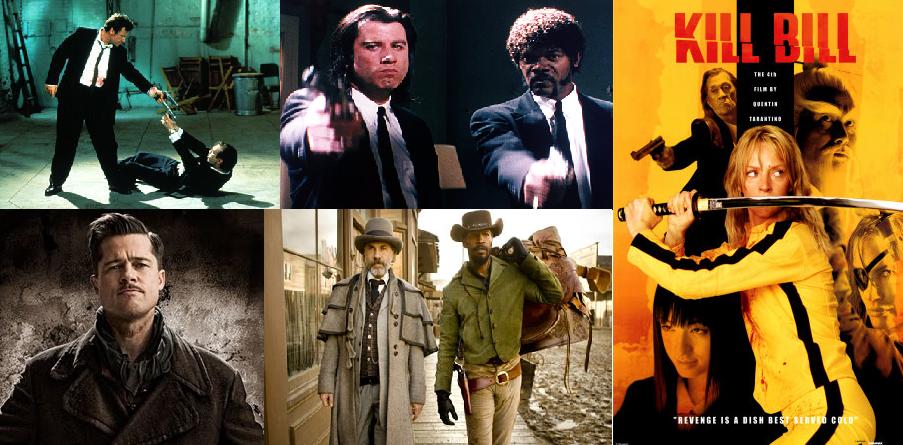
Reservoir Dogs to Django Unchained


The movies of Quentin Tarantino.  Recently I watched “Django Unchained” on DVD, following that up with re-watching “Reservoir Dogs” a second time.  QT makes interesting, entertaining films; they’re sometimes controversial, almost always violent, with non-linear plots, and practically no sex.  They are films for guys to watch, and women typically do not like them; though I wouldn’t be surprised if “Pulp Fiction”, “Kill Bill”, or “Jackie Brown” have some female fans.

Reservoir Dogs.  His debut.  The film has a common beginning and ending, but the middle branches out into several parallel story lines based on the individual characters.
            A crew of bank robbers fall apart on each other after the heist goes bad.  Remarkably, the heist itself is completely absent from the movie and is only referred to after the fact.  It went so bad, so quickly, that the characters naturally suspect a police informer in their midst…and they’re right.
            For security reasons, the gang members are given color code names: Mr. Blonde (Michael Marsden), Mr. Pink (Steve Buscemi), Mr. Blue (Eddie Bunker), Mr. Orange (Tim Roth), and Mr. Brown (Harvey Keitel). 
            A uniformed police officer is caught and tortured by Mr. Blonde – he cuts his ear off.   Personally, I found that a bit distasteful, but nowhere near as unpleasant as the shower chainsaw scene in “Scarface”.
The deleted scenes on the DVD show more background of the cops’ purpose in allowing a robbery they know will happen to take place so they can finally catch Mr. Brown redhanded and send him away for life.
            BONUS  BICKERING ABOUT NOTHING.  Do you tip? 

Pulp Fiction.  By far the most popular and probably the most overrated of his films.   It competes with “Reservoir Dogs” for being the more cult favorite; my preference is for this one.  “Basterds” and “Django”, though, have impressed me enough to give “Pulp” competition for favorite status.
            Non-linear plot, various characters. 
            1)         Travolta and Jackson as Vincent Vega and Jules Winnfield.   Matching suits?  Good.  Bible quote? ZZZ.  That got tiresome immediately.  This role stuck an adrenaline needle in the heart of Travolta’s acting career.
            2)         Rhames & Thurman as Marcellus and Mia Wallace
            3)         Harvey Keitel as the “Cleaner” + QT in his own role
            4)         Bruce Willis as Butch Coolidge (+ his dopey GF), a boxer paid by Marcus to take a dive – predictably, he wins his fight. 
            5)         Eric Stoltz as the drug dealer; Christopher Walken as the veteran
            6)         + the weirdos in the pawnshop basement.
            I can’t even begin on this.  The plot is all over the place, but the great thing is that it never gets confusing – except for the moment before you realize the story has looped in on itself at the diner.  
            The other great thing about this film, and what distinguishes it from all the others, which are either homages or genre type films, is that “Pulp Fiction” is QT’s own original story.  This is why he could make it so wacked out.  Keitel and Roth return again.
            BONUS  BICKERING ABOUT NOTHING.  What do they call a Quarter Pounder in Paris? 

Jackie Brown.  An all-star cast, including Pam Grier herself, plus Bridget Fonda and Robert Deniro.  This is essentially QT’s “homage” to 70s blackploitation films.  There’s actually some sex in here, but not from Grier.
  Because it’s a homage to simple films from the 70s, it has a simple plot.

Kill Bill 1 & 2.  Now we have a martial arts/revenge tribute.  Moreover, QT is doing the environment a favor by recycling actors:  Michael Madsen and Uma Thurman reappear.  Here we have a major female character.
            Thurman is “The Bride”, left for dead at the altar by her erstwhile gangmates and the groom himself.  She tracks down and kills each one separately:  Vernita Green (Vivica Fox), Elle Driver (Darryl Hannah), Budd (Michael Madsen), Ishii (Lucy Liu), and then Bill himself, David Carradine.  The Lucy Liu segment is my favorite: an animated sequence plus an implausibly vast number of attackers.

Grindhouse: Death Proof.  Kurt Russell and Rose McGowan are the stars.  Russell plays a mysterious killer, first driving a primered Chevy Nova, then a primered Dodge Charger.  The story has two parts.  This looks like QT’s shot at doing a horror movie.  Russell is cool as the bad ass villain, even nastier than Snake Plissken.  The fake trailer for “Machete” eventually became the real Danny Trejo film.  Nude Lindsay Lohan?  Awesome, but “Machete” tops both this film and “Planet Terror”, the Robert Rodriguez zombie film tacked on to “Death Proof” as the “Grindhouse” double feature.

Inglorious Basterds.  QT takes a shot at a World War II film.  Although Brad Pitt, leader of an eccentric “Dirty Dozen” type Jewish-American unit going behind German lines collecting “Natzi scalps”, is supposedly the lead character in this movie, Christoph Waltz, as the personable, multilingual, charismatic SS officer Hans Landa, really steals the show.

Django Unchained.  This is the newest one.  Jamie Foxx plays Django, a freed slave who becomes a bounty hunter seeking to find his long lost wife, Broomhilda.  He’s assisted by King Schultz (Christoph Waltz), a former dentist now acting as a bounty hunter.  Mind you, “bounty hunter” at this time (1858) means “kill wanted criminal and collect the reward”, not “capture bail escapee and bring back to trial alive”, as it does these days.
    Don Johnson plays a Colonel Sanders-type plantation owner, Leonardo DiCaprio plays Calvin Candie, the plantation owner who owns Broomhilda, and Samuel L. Jackson is the “house slave”, always with his master’s best interests at heart, who alerts Candie to the pair’s agenda of seeking Broomhilda, rather than Candie’s fighting slaves (mandingos).   QT himself, Tom Wopat, Bruce Dern, and Jonah Hill are in here as minor characters; Franco Nero himself (the original “Django”) has a minor role as an unlucky mandingo owner. 
   This seems to be QT’s “take on slavery”.  The N-word gets heavy abuse, and there is just as much delicious violence as any of QT’s other films, but bear with it.  It’s another fun ride.  This one has the slugfest at the end, where it usually ends up.

Honorable (?) mentions (QT as actor and not director):
1)         From Dusk Till Dawn.  QT and George Clooney take on vampires in a Mexican bar.  Salma Hayek may possibly salvage this horrible movie from oblivion with her undeniable hotness.  Cheech didn’t.
2)         Sukiyaki Western Django.  Here’s the funny part.  “Django Unchained” has nothing to do with the original movie, “Django”, in which Franco Nero played the title role.  QT simply took the name.  But this film, which actually has QT in a minor role, takes “Django” and transplants it to Japan.  Those of you familiar with “A Fistful of Dollars” will recognize the plot: mysterious stranger comes to town and plays two gangs against each other.  However, both “Django” movies include an ingredient Eastwood left out: the coffin.  Watch and enjoy.

Friday, April 19, 2013

Please Stand Up


In three monumental instances, an anonymous fan has dramatically impacted a band’s direction, yet to this date has never come forward, and thus remains unknown – even after the story has been told countless times, and will be told again here by me.

Moody Blues.   By now the ‘Blues are best known for pretentious prog-rock masterpieces like December 1967’s Days of Future Passed.  Before that, though, they had one album, The Magnificent Moodies, full of R&B tunes which sound nothing like their later material; Justin Hayward and John Lodge weren’t even in the band.  Hayward, the guitarist/vocalist, replaced Denny Laine (later to wind up in the Wings with Paul McCartney) and bassist/vocalist Lodge replaced Clint Warwick.  Instead of obvious MB favorites like “Tuesday Afternoon” or “Nights in White Satin”, Ozzy Osbourne covered “Go Now”, which dates from MB Mark I, so to speak.
What pushed them into prog territory was a chance encounter with a disgruntled fan after a show in Stockton, wherever that is.  Despite a new lineup, they were still doing their R&B set.  The fan bitched at them for a terrible show and a waste of 12 pounds and a ruined evening with his wife.  Drummer Graeme Edge concurred with the fan’s assessment: a change was needed.  After the record label had asked them to do a cover of Dvorak’s Symphony #9 in stereo, they simply decided to make their own concept album, about the passage of a day from dawn to midnight:  Days of Future Passed.

I read the account in the most recent PROG magazine article (cover story) on the Moody Blues.  But to date, that mysterious couple appears lost to history.

Deep Purple.    In December 1971, Deep Purple were due to record the album which would be Machine Head at the Casino in Montreux, Switzerland.  Before that, Frank Zappa and the Mothers of Invention played a concert there, which was interrupted by “some stupid with a flare gun…burned the place to the ground.”  They had to record at the Grand Hotel next door, using the “Rolling Truck Stones thing” (mobile unit).  One song which came out of the recording sessions was the story of the whole debacle, better known as “Smoke on the Water”, with its classic riff.  Without the flare gun incident, the album would have been recorded at the Casino, without “Smoke on the Water”.   Who knows how it would have sounded, but it would have been without the band’s ultimate anthem.

But the gun nut?  Somehow this person has never come forward to take the blame – or the credit – after over 40 years.  

Pink Floyd.   On the 1977 In the Flesh tour for the Animals album, Pink Floyd were now playing stadiums, far larger venues than the UFO club in London where they started out as the house band for the London equivalent of Ken Kesey’s Acid Tests in California – for which the house band was the Grateful Dead.   Instead of tight, intimate venues, the band faced a vast multitude of faceless fans.  Some of these fans were rather rude and boisterous.  Something in Roger Waters snapped, and at the show in Montreal, he spit on a fan.   Afterwards, shocked at his own behavior, Waters realized that an invisible wall had somehow erected – either by circumstances or by Waters himself – between the band and its fans.  Waters explored the concept further, into what we now know of as The Wall album.

   To date, I am not aware that the Spit Victim has ever come forward, perhaps (in French Canadian accent) “ees me, ‘e spit on!  I am zee inspiration for ze Wall!  Ou sont mes royalties??”

** IN fact, since none of these persons have come to light, perhaps they are all… the same person!  A mysterious muse who remains anonymous, yet spurs the great and mighty minds of music to greater heights.   Someone had to tell the Moody Blues they sucked, so they would write Days of Future Passed instead of repeating The Magnificent Moodies yet again.  Someone had to shoot off a flare gun in the Casino, to inspire “Smoke on the Water.”  Someone had to incite Roger Waters to spit on him, so we could enjoy The Wall. 

So, Mr. Mysterious Musical Muse, a Real Man of Genius, Bud Light salutes you.