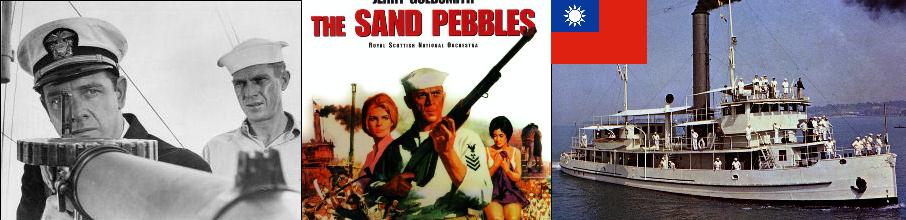
I watched the movie recently, called “The Sand Pebbles”, which takes place in China in the 1920s. It’s based on the book of the same name.
In the 19th century, the US, European countries, and Japan forced China to sign certain treaties which opened the country up to foreign trade and made citizens of those countries, so-called “treaty people”, immune to Chinese law. The former element was at least partially a coercive deal to allow the British to trade opium to the Chinese for tea, a trade arrangement the Chinese had initially resisted and which resulted in opium addiction amongst the Chinese. With regard to the latter element, westerners responded that Chinese law lacked due process and defendants were beheaded willy-nilly, so this immunity was not necessarily a bad thing. Certain ports and cities in China were “treaty ports” with foreign “concessions”. The Chinese resented this intrusion but were mostly powerless to stop it. In 1900 the Boxer Rebellion was put down (the movie “55 Days in Peking” (1963), featuring Charlton Heston, David Niven, and Ava Gardner, describes that occasion). The treaty powers continued to put warships and gunboats in Chinese waters. In particular, the US Navy’s Yangtze River patrol featured gunboats, many of which had been taken over from the Spanish after the Spanish-American War, though they kept the original Spanish names (it's considered bad luck to rename a ship).
Gunboats. These were oversized barges with little in the way of armament (nowhere close to destroyers or cruisers) and very ugly, but they could get by in fairly shallow water. Most were ancient relics, obsolete trash boats thrown to the river patrol and looked down on by the surface fleet. An officer sent to a gunboat was in a career shithole. The river patrol sailors were treated as, and considered themselves, rejects and misfits, by the rest of the Navy. They often stayed on and shacked up with Chinese women after their service was over.
Coolies. The gunboats had an unofficial staff of Chinese “coolies” who did all the menial, unpleasant work (which on most Navy ships would have been done by the sailors themselves), allowing the sailors to live a more leisurely lifestyle. They were paid in “squeeze” (unofficial kickbacks); they referred to their income from these tasks as their “rice bowl”. Eventually “gearwheel” pressure forced the coolies off the ships and the sailors had to do their own dirty work. Sailors are forbidden to marry Chinese; the government will not recognize the marriages and missionaries generally refused to perform ceremonies. One sailor, Frenchy, wanted to marry his Chinese lover Maily but couldn’t find anyone to actually perform the ceremony. Chinese have a strange status in the story – many favorable (Po-Han and Maily), many unfavorable (gearwheels – and Cho-Jen is very arrogant) and others fairly neutral.
Missionaries. Christians who lived in China and attempted – none too successfully – to convert Chinese to Christianity. Though I know of many Chinese and Vietnamese Christians, they seem to be a very small minority. The missionaries hated the gunboats and sailors: to them, the sailors were immoral scoundrels, bad examples from Christian society which made the missionaries appear to be hypocrites, as most Western sailors were nominally Christian themselves. The missionaries disagreed with the treaties and took the Chinese side; the gunboats were an embarrassment to them, even if they fled to these gunboats for safety whenever they felt threatened by hostile natives (how convenient, the treaty people would note). The Navy didn’t particularly like the missionaries either – the gunboats had to protect these people who were rarely grateful and deliberately put themselves in harm’s way by overestimating the locals’ esteem for them. Given their poor track record and the frequent abuse they suffered from the population they claimed loved them (treaty-favoring businessman to arrogant missionary: “we understand the Chinese don’t like us, but you don’t seem to realize that these people hate you almost as much as they hate us”), it seems the missionaries had an unreasonably favorable opinion of themselves and their status in China.
Warlords. At that time (1920s) China was run by different warlords who controlled parts of China. The central government was fairly weak until Chiang Kai Shek attempted to unify the country and subjugate the warlords. Warlord armies were lax in discipline and poorly equipped; they seldom fought well, and most disputes were resolved with money (“silver bullets”). However, the gunboats seemed to get along far better with the warlords than the Nationalists.
Gearwheel. In the book, the Kuomintang (KMT)(Nationalists) are referred to as “gearwheel” by the US sailors, based on the sun in the Nationalist flag which looks to them like a gear wheel. The KMT stoke up resentment and violence against the gunboats. Invariably, the gearwheel forces in the story are a bunch of hostile, lying assholes who end up causing problems for the San Pablo and its sailors – far more so than the warlords ever do.
Bolsheviks. They had recently won power in Russia and were attempting to expand their influence in China. Here’s where it gets Byzantine: Sun Yat-Sen and Chiang Kai-Shek were both courting Stalin’s favor and support, which Stalin did in fact grant, yet there was a growing Chinese Communist Party (CCP), for which Mao Zedong attempted to take control. The KMT and CCP fought each other, but Stalin didn’t necessarily support the CCP over the KMT; Stalin was more worried about the Japanese and wanted the KMT and CCP to make a common front against the Japanese, whereas Mao wanted to use the Japanese to destroy the KMT.
As in Spain, Stalin was less concerned with the ideological purity of his minions and far more concerned about how consistent and reliable they were about following orders from Moscow; “Trotskyist” was the consistent label applied to undeniable Marxists/socialist/communists who defied Moscow’s orders even if they weren’t actually associated with Trotsky himself. Thus Stalin was more apt to support Chiang Kai Shek if he was willing to do what he asked, whereas Mao tended to appear to him – correctly so – to be an undisciplined, loose cannon who was primarily looking out for his own interests, not even of his own party or country.
Japanese. Ironically, in The Sand Pebbles, the KMT work out to be bad guys and the Japanese – allied and among the treaty powers – turn out to be good guys. This was just years before the invasion of Manchuria in 1931 and the rest of China in 1937. In the book, the fleet sailors the Sand Pebbles encounter consider the Japs to be rivals, whereas the Sand Pebbles themselves consider the Japs to be friends.
Germans and White Russians. In “55 Days in Peking” the Germans and Russians are among the treaty forces putting down the Boxer Rebellion. The Germans had been stripped of their treaty privileges after WWI, though when the KMT started harassing, persecuting and killing treaty people in the late 20s, this meant the Germans were actually safer. In the book, Holman strikes up a friendship with a German engineer, Scharf, who offers a refreshingly different point of view on many of the issues.
White Russian refugees from the Russian Civil War were stateless “nonpersons” with no treaty rights, and considered by the US to be equal in status to Chinese. In the book, one of the sailors, Lynch, marries a White Russian woman who uses his Liberty Bond money to buy a tea shop in Shanghai. Because she’s a “nonperson” the other sailors tell him that as far as the Navy is concerned, he’s not really married.
Book (1962). After watching the movie I read the book on my Android Kindle. It’s a very long book; in print it’s 600 pages. Somewhat confusingly, the author’s name is Richard McKenna, not to be confused with actor Richard Crenna (see below). The book features a fictional gunboat, the San Pablo, (a former Spanish ship – they kept the name) of which the crew members called themselves the Sand Pebbles. The main character is the ship’s engineer, Holman (who the Chinese call “Ho-mang”); in addition to being the protagonist, he’s also one of the most sympathetic characters, easily the “hero” of the story. Frenchy is a North Carolina sailor who falls in love with a Chinese woman named Maily. The captain, Lt. Collins, has an impossible job of keeping morale when Coolidge and the missionaries constantly tie the Navy’s hands back in yet more of these inane “you can be shot at but not shoot back” missions the military always hates. The missionaries are Miss Eckert, the leader Craddock, a teacher Gillespie, and promising Chinese student Cho-Jen. Holman’s coolie sidekick is Po-Han.
As is so often the case with books vs. movies, the book goes into considerably more detail of the background and has much more going on than can be effectively done in a movie lasting less than 10 hours.
Movie (1966). The film itself was made by Richard Wise, the same director as “The Sound of Music”. Steve McQueen played Holman; Richard Crenna played Lt. Collins; Candice Bergen, (Murphy Brown, and more recently Shirley Schmidt on Boston Legal) younger even than in “Carnal Knowledge”, played Miss Eckert. The actress who played Maily, Marayat Andriane, went on to write the Emmanuelle books; Po-Han is played by a Japanese actor, Mako. The movie lagged on for 3 hours, but it was fairly faithful to the book.