Friday, September 19, 2014

NFL Bad Boys

Miami takes down Tom Brady!  The Vikings crush the Rams!   The Cardinals are on top of NFC West, above the 49ers!  The Bills are on top of AFC East, while the Patriots are on the bottom!  The Texans are 2-0, and on top of AFC South!  Luther Bliss to Teddy Roosevelt: “This is Kentucky, sir.  Everything is topsy turvy.”  I want to see how this season develops, if only out of morbid curiosity. 
            Well, I did… until this Adrian Peterson thing blew up.  Who knew what was going on?   On the Vikings site, the fans all charged immediately into “DUMP HIM IMMEDIATELY” mode.  Only a few said things like “let’s wait to see how this pans out,” or “innocent until proven guilty.”  Charles Barkley offered his predictably “out of the box”/”I don’t care what anyone else thinks” support for AP’s behavior.  As with Donald Sterling, I’m baffled as to why off-field behavior which doesn’t result in the athlete locked up pending the trial, will still result in a suspension or deactivation.  I can understand if a bank employee is accused of embezzlement – something directly related to his job – they would suspend the person pending the investigation.  But switching his kid in Texas doesn’t seem to bear any connection with running a football in a game. 
            For that matter, neither does punching your wife in a hotel elevator.  In Ray Rice’s case, the incident took place in February 2014, the couple later reconciled, they’re married now, and the local prosecutor’s office already made the determination not to press charges.   I’m not aware that their CURRENT relationship is abusive.  If it was one incident which was resolved at the time – however shocking it might have been – there is really no practical relevance to bringing this up now.  As Mrs. Rice herself complained, it just embarrasses both of them and costs her husband his job, without protecting her.   Ruining their lives and livelihood is a big price to pay simply so the rest of us can feel morally self-righteous. 
            Imagine, on your two week vacation, you go to Las Vegas.  Something happens.  Maybe not a corpse or a missing person, but something which results in a criminal charge against you, though it’s later dropped and you don’t even serve a day in jail; you hired a local attorney who resolved the matter without so much as a single court appearance on your part.  You return home, go back to your job.   Then the s**t hits the fan.   Your boss finds out.   Although the incident had no bearing on your job, your boss still decides to fire you because of “what happened in Vegas.” 
            From what I can tell, the logic behind suspending or releasing a player for off-field behavior which does not otherwise compromise his ability to play (e.g. Aaron Hernandez locked up pending a murder trial, or Michael Vick going to prison) is that athletes are celebrities and public figures, and that sporting events are public events.  The games are not conducted at fields away from public scrutiny, with the results simply posted after the fact for fans to know about. 
            Therefore the public has some expectations as to the character of the athletes that they watch playing.  Will the fans still come to the games, or watch them on TV or cable, if the team includes wife beaters or child abusers?  Will they still drink Budweiser if the brewery continues to sponsor a league with such players in it?  Are we, as fans, prepared to overlook the player’s off-field screw-ups if they produce sufficiently impressive results on the field?  Is the league’s potentially most explosive QB, running back, or wide receiver currently sitting on death row or in a maximum security prison as we speak?  Ironically, the Oakland Raiders are one of the cleaner teams in the league, but all teams seem to have some misbehaving athletes.  And this problem occurs in other professional sports as well. 
            Look at Michael Vick.  In 2007 his Falcons career took a nosedive in his dogfight scandal, he served 21 months in prison.  Yet he served his time, reformed, and is back in the NFL today. 
            If you indefinitely suspend any player facing any sort of criminal charges, even if they remain out on bail or can resolve the charges without interfering with their availability to play for the team (e.g. plead the case down to a lesser charge, suspended jail sentence, probation, etc), that will substantially deplete the available personnel in the NFL.  At any given point, SOME NFL player has a criminal charge pending against him.  DUI seems to be the most common, plus drug-related charges, or Plaxico Burress’ gun-related incident.  
            And consider this.  At the risk of sounding overly complacent or “boys will be boys”, this is a rough, full contact sport.  A certain aggressive spirit is necessary to play the game.  If we winnow out all the players with any aggressive impulses, we might compromise the intensity of the game.  Imagine an NFL where 100% of the players are meek angels with absolutely clean criminal records.  A whole load of Tim Tebows.  That may not hurt at the QB position – most of them, aside from Big Ben, seem to behave themselves – but the rest of the positions will suffer to some extent.  Are the fans somewhat inconsistent on this:  we want a good game, but we aren’t willing to tolerate the type of players necessarily to give us that game, vs. “yeah, he’s a punk, but he’s OUR punk!”? Only domestic and dog abuse, though, rises to the level where the fans morph into the angry villagers in a Frankenstein movie, wielding torches and pitchforks and seeking to drive the offending player out of town, tarred and feathered.
            Before we go any further, let me clarify one issue.  Not even Adrian Peterson’s defenders argue that he should be immune to criminal prosecution simply because he’s such a great running back.  To my knowledge, no one is claiming that professional athletes should be held to a lesser standard, let alone granted immunity.  If an ordinary person would be released on bail, merit probation, a first offender program, or a suspended sentence – fairly common accommodations which keep the defendant out of jail – then there’s no reason why a professional athlete shouldn’t deserve the same clemency. 
            However, if the offense took place in the town where the athlete plays, common sense indicates that a local prosecutor who refused to let a player go out on bail, jeopardizing his team’s chances for that season, might face some challenges when re-election came up.  Then again, the same overwhelming fan reaction to “dump him NOW!” should protect the local DA from political repercussions.  If I had to place bets on the Atlantic County, NJ prosecutor’s NFL allegiance, I’d say he’s in Eagles territory, while the Ravens are in a completely different conference.  I’m curious as to whether a Minnesota prosecutor would handle Peterson’s case differently than the Texas guy running the show now, or a prosecutor in Green Bay, Detroit or Chicago, for that matter.   Here’s some free legal advice to NFL players (worth what you pay for it, right?): be VERY careful what you do when you’re in enemy territory.
            Anyhow.  
            In all fairness, there are plenty of running backs who don’t switch their kids or punch their wives.  Maybe we should “clean house” once and for all – and see what happens.  Try a zero tolerance policy, suspend ALL these players for this season, and see what happens. 

            With morbid curiosity, of course.

Friday, September 12, 2014

Solutions

It’s time for another blog on more esoteric topics than movies, books, or music.   In this case, it’s a “meaningless corporate buzzword” (MCB), “solutions”.   I picked this one because it bothers me the most, but also because it’s the one most likely to be inflicted on the public at large and not just the poor drones at Initech.

Why do I dislike it?  Well, it’s deliberately vague.  “Solution”.  To what?   Presumably to problems.  What problems?  Most businesses can simply claim, “we sell a quality product or service at a reasonable price.”  What’s wrong with that?  Fairly straightforward and honest, right?  But the company barking “solutions” is claiming, we do better than that: we have “solutions”.   Huh?  Solutions to what?  Storage problems?  Staffing problems?  Business problems?  So vague, in fact, as to be meaningless. 

I don’t know who came up with this stupid expression, but I’ll venture a guess.  Either it was a New Age type who knew that New Agery doesn’t pay the mortgage, so he/she/it had to get a real job, but couldn’t simply accept bland, grey flannel, Don Draper corporate culture at face value.  No, this clown had to New Age the business so he/she/it would be nice and comfy, and New Age the crap out of everyone else too.

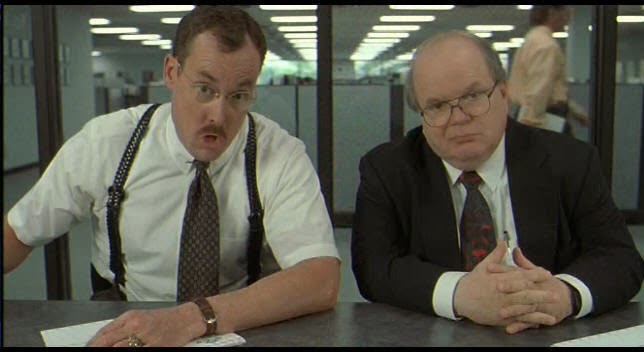
Or it may have been some consultant.  In “Dilbert”, Dogbert – the cynical little dog – explains that “consult” is a combination of “con” (as in, con artist) and “insult”.  The consultant in fact cheats the company out of $$$, as well as insulting them and their intelligence.  This Harold Hill type came into town – the Two Bobs, right? – and gave a slick spiel about “solutions”, after which the pointy haired bosses ate it up.  Now we’re stuck with it:  bosses, employees, and the general public.

Either way, it’s annoying.  Really annoying.  Remember George Carlin, the comedian?  I suppose he was somewhat liberal, somewhat anti-authoritarian.  But above all he was anti-bullshit.  Because the primary purpose of bullshit seems to be to lie, so that that someone can use, cheat, steal, rob, or exploit you.  So a company that deliberately uses a vague, meaningless term when interfacing with the general public is essentially saying that, as a matter of principle, its corporate philosophy is to be deliberately misleading.

Might I suggest that we boycott any company that uses “solutions” in its literature, advertising, and certainly its corporate name.  Boycott bullshit.

Friday, September 5, 2014

Opium, Morphine, and Heroin

As a “companion” to The Annotated Hashish Eater, is the Hashish Eater’s Companion.  However, as a practical matter, this volume is mostly about opium and not hashish.  It includes various articles on opium, including Thomas DeQuincey’s famous Confessions of An English Opium Eater (in its entirety) which served to inspire Ludlow to write his own Hashish Eater.

Opium was the original deal.  Opium essentially consists of a mixture of codeine and morphine.  Morphine is the underlying drug.  Laudanum is a mixture of alcohol and opium. 

Heroin came later.  Diacetylmorphine is the chemical name, tradenamed as heroin by Bayer.  It was originally synthesized in 1874, then developed into a commercially marketable drug in 1897, and sold from 1898 to 1910 – ironically, as a non-addictive alternative to morphine, although they soon realized that error.  It was banned in 1924.

Unlike Ludlow, whose hashish consumption was purely recreational, DeQuincey claims his opium habit stemmed from various painful and uncurable medical conditions, although both authors cite Samuel Taylor Coleridge, the author of “Rime of the Ancient Mariner” and “Kubla Khan”.   Coleridge’s own addiction to opium was well known to both of them.   What’s strange is that both were aware of Coleridge’s conditions before beginning their own consumption.

Back in the nineteenth century, up until the early twentieth century, morphine was the most powerful painkiller.  For many suffering from painful, incurable conditions, morphine was the only drug that worked.  Many soldiers were given morphine for their wounds and later became addicts.  “Heroes For Sale” (1933) describes a WWI US soldier given morphine by well-meaning German doctors and ultimately becoming addicted.  Oddly enough, back in 2000 I had back pain, so I was given one shot of morphine at the E.R. for it.  It did the job well.  But I only had that one shot, and did not turn into an addict.

In addition to killing pain and inducing a general state of intense euphoria, opium produced extremely lucid and colorful dreams, powerful enough to be remembered and recorded, thus Coleridge’s inspiration and muse.   However, the horrendous chemical dependence arguably offset this benefit.  Opium becomes a necessary ingredient for sustained life.  At that time there was no receptor substitute like methadone to help an addict wean off the drug.  Insomnia, chronic constipation, issues with appetite, skin complexion, in fact so many different problems that the addict’s body is taken over by the drug with irreversible physiological damage. 

Ludlow actually echoed this in his own stories.   Those who condemn the opium addict have no idea what the person is going through.  The drug is so powerful, the addiction and dependence so thorough, that the addict is consumed with the need to get more.  He will lie, cheat, steal, do whatever it takes, to friends, family, loved ones, anyone, to get more.   He is no longer in control of himself.

Ludlow himself described not only his own difficulty in trying to kick the habit, but his proposal for a rehab center – in third quarter of the nineteenth century – and efforts on his part to assist others in doing so.  Infrequent recreational use might not necessarily lead to addiction – Ludlow describes different patients having different levels of dependence – but after a certain point, there is no going back.   The withdrawal symptoms become so close to lethal that as a practical matter, the person is better off sustaining a modest habit than getting off the drug completely.  
At this point the victim is doomed to this for the remainder of his life.  Ludlow described this as a very slow form of suicide, oddly enough a sentiment echoed in Ozzy Osbourne’s song “Suicide Solution”.  But for all of Ozzy’s idiocy and substance issues, he was wise enough not to even dabble with heroin, much less become addicted to it: his song refers to alcoholism. 

By the twentieth century, opium and laudanum were replaced by heroin.  Several prominent rock stars got themselves hooked on heroin.  Of these, Sid Vicious (Sex Pistols) and Layne Staley (Alice in Chains) ultimately died.  David Crosby, of CSN/CSNY, described heroin (and other hard drugs aside from marijuana) as “a massive waste of time”.  The singer for Sublime, Bradley Nowell, is the most egregious example of this idiocy.  He deliberately got himself hooked on heroin because he believed it would help his musical inspiration and ability.  Naturally he learned what all the previous addicts learned:  it’s a losing bargain.  After a few cycles of clean and dirty, he finally fatally overdosed on the drug in 1996.

William S. Burroughs, the author of Naked Lunch and a member of the beatnik group that included Allen Ginsburg and Jack Kerouac, was an addict.  Much of Naked Lunch is a vivid depiction of heroin addiction and the extraordinary lengths to which an addict will go to procure more of the drug.  The appendixes to the latest edition include an essay by the author on heroin rehab, i.e. what works and what doesn’t.

By now there are several movies handling this topic, but “Trainspotting”, with Ewan McGregor long before Obi-Wan Kenobi or “Men Who Stare At Goats” as a recovering heroin addict, is probably the most graphic.   

Opium Wars.  In the 1840s, England traded with China.  They paid in silver, a valuable commodity, but had a surplus of opium grown in Afghanistan and India, so they decided they'd rather pay the Chinese in opium than silver.  The Chinese weren't idiots, and refused.  Unfortunately for the Chinese, despite having invented gunpowder centuries before the British, they fell well behind in its practical - military - applications; as early as the twentienth century, entire units of the Imperial Chinese Army and various warlord armies were equipped with spears.   Of course the British were successful at coercing the Chinese into accepting opium as payment instead of silver.  As you might imagine, this caused many problems in China and considerable anger and resentment.  See my blog on the Boxer Rebellion (1900).

Years ago our law office represented a heroin addict.  We negotiated a deal with his creditors to surrender his houseboat in a marina in southwest DC in exchange for writing off his debts.  He asked us to get a few personal belongings off the boat before surrendering it.  This boat essentially was a garbage scow, but he had been living on it.  Talk about a real life horror story.  Heroin? No thanks. 

Friday, August 29, 2014

Acoustica

On the way back from Fort Lee, I stopped by the Park City Mall in Lancaster, Pennsylvania and picked up Grateful Dead’s Reckoning album, the acoustic live album paired up with Dead Set – which I’d bought a few years ago mainly because it has “Brokedown Palace”, a great tune from American Beauty. 

This was my second attempt to listen to this album, the first was in high school in Paris in the early 1980s.  At that time I plunked down the vinyl, preparing to hear some totally bad-ass music.   I mean, with a name like Grateful Dead and a skull and crossbones on the cover, and an album called Reckoning, we’re talking melting your face off like “Raiders of the Lost Ark”, right?

WRONG.   I couldn’t even get through “Dire Wolf”, the first song, before I took it off in disgust.  What the hell is this???   I gave the album to my buddy Sean C, and that was it for the Dead for a long, long time.   It wasn’t until Anthem of the Sun, which sounds Duane Allmann-y, that I could finally digest the acid country of the Dead.   This must have been in the early 00’s.   Yet I even saw GD w/Jerry Garcia in 1992 and 1995, so go figure.

This time around?  Well, I survived all the way to the last track, “Ripple” (also from American Beauty), though the “Bird Song” on here is underwhelming compared to the Fillmore East show in 1971 with the Beach Boys.  “Dire Wolf” is still not my favorite: “please….don’t murder me!”  Hardly a good theme song for the Stark family. 

As of right now, I have several electric guitars and no acoustics, not even a 12 string.  I really don’t like playing acoustic guitars.  A bulky body and super high action?  No thanks.  I can select clean channel on the Marshall and the neck pickup on an electric, turn on the chorus pedal, and that’s the sound I need.  Authentic?  Maybe not.  But it’s right.  And face-melting distortion is a footswitch away.  Acoustic guitars became mostly obsolete when Fender brought out the Broadcaster/No-Caster/Telecaster in 1948. 

I really do not like acoustic sets.  Let me articulate further with some examples.

Scorpions.  They did an acoustic album, Acoustica, AND an unplugged show in Athens, Greece fairly recently for MTV.   No sign of Michael or Uli, but Rudy pulled out his acoustic Flying V.  The highlight was “Born To Touch Your Feelings”, from Taken By Force.  Boring? No.  Tolerable?  Sure.  Exciting – and as good as the Wacken show with Uli Roth?  No way in Hell. 

Tesla.  Their Five Man Acoustical Jam (1990) started this nonsense way back when.  A few songs, like “Signs” and “Truckin” were OK, but mostly they butchered their awesome electric songs by making them acoustic.  Which is even more baffling because they’re named after Mr. Electric himself, Nikola Tesla.  Brian Wheat claims they resisted the idea, but apparently someone prevailed.  Fortunately they’ve been 100% electric since then, so Tesla himself can stop spinning in his grave, providing alternating current somehow.

Led Zeppelin III.  Tolerable.  The songs are… OK.  My favorite on here is “Since I’ve Been Loving You” – electric – and of the other two electrics, “Out on the Tiles” sucks a whole herd of donkeys, whereas “Immigrant Song” is …OK.  I like the Viking theme.  Granted, Page’s acoustic stuff is what makes Zeppelin so well-rounded, but I can take it in small doses only: the intro to “Stairway”, “Ten Years Gone”, etc., not a barrage of folk songs like III.

Alice In Chains.  Jerry Cantrell has some rare skill:  he can write original acoustic stuff that doesn’t suck.  SAP and Jar of Flies are both albums (EPs, sorry) which I listen to as often as any of their electric stuff.

Ultimately I find acoustic guitars boring and pretentious.   Remember that scene in the movie “Animal House”, where the guy on stairs sings, “I gave my love a cherry, that had…no…pit…” and Bluto (Belushi) comes by and smashes his guitar?  To me anyone with an acoustic guitar is “that guy”, and my inclination is the same as Bluto’s.  Don’t be “that guy”.

Friday, August 22, 2014

Death to Smoochy

With Robin Williams’ untimely demise due to self-inflicted asphyxiation, naturally his name comes up as a topic for discussion.   He has too many movies out there – and several seasons of “Mork & Mindy” – to allow an exhaustive “tribute” via marathon viewing or even movie reviewing.  Rather than attempt the impossible, I picked one film to focus on.   At some later point I’ll watch stuff like “Good Will Hunting” which I never got around to watching before.
            Anyhow, RW plays Rainbow Randolph, a kiddie TV show host who abruptly loses his show after a sordid bribery scandal.  Along comes Sheldon Mopes (Edward Norton) as Smoochy, an annoyingly saccharine rhino, obviously based on Barney.  Mopes is hopelessly idealistic and truly clueless about life in general and show business in particular but takes over RR’s place, much to RR’s anger and resentment.  Jon Stewart plays the network executive, and Keener – Carell’s love interest in “40 Year Old Virgin” – is another network exec.  The Mob gets involved, things get violent and complicated, but always remain hilarious despite the often dark subject matter and body count.  This is a film which bathes in its cynicism but is so damn funny anyway.  There’s even a VERY oblique tie-in to “American History X”; see if you can catch it. 
            What I loved about this film is how Williams could be both funny and sleazy at the same time.  After a while all his “heartwarming” films get so damn tiresome and tedious, and also a bit self-serving.

Having reviewed this particular film, allow me to return to a basic tribute to Williams.

Mork & Mindy.  This was the show that started it for him.  The charmingly naïve and good-natured alien from Ork, lands in Boulder, Colorado of all places, and lives with Mindy (Pam Dawber).  The music store she works in is in downtown Boulder.  It seems Williams had a huge talent for improvisation, and the oddball character really let him bring it out.  Even Morgan Fairchild is hot.  This is a show I’ve never gotten tired of even after all these years.

Depression.   Gene Simmons clearly put his foot in his mouth.  Judging by his prompt retraction it seems someone gave him a basic primer in mental illness, preceded by a slap in the face and a kick in the ass, well deserved.  Fortunately, I’ve never been depressed, although I have been heavily discouraged in the past when life wasn’t going as well it could.  So when it comes to describing depression, I have to really stretch my imagination to try to ascertain what it’s all about. 
            Highly successful people, like Robin Williams, suffer from depression.  Not only are these people rich and famous, they also have ample resources such as therapists and professionals who can treat the problem, in theory.  Logic suggests that someone like Robin Williams would prefer not to feel suicidal 24/7 and would take whatever drug or therapy might be effective at making his daily life bearable.  Naturally, the rest of us who aren’t as rich and successful as Williams may shake our heads and wonder what the hell he has to be suicidal about.  That suggests to me that despite drugs and therapy, we haven’t quite reached the point where we can say we’ve succeeded at taming the depression demon. 

General Impressions.  I don’t know Williams personally and never met him.  Nor do I know anyone who has.  Like the general population I have to gauge his true off-screen personality by an aggregate of his movie roles – because no matter how great an actor you may be, some part of you always shines through in your acting.  Also he was politically active and did lots of charity work.  The latter often strikes me as insincere or intended for public relations purposes.  Was that the case with Williams?  Probably not.  God forbid any actor have any true compassion for those around him or the less fortunate.  My impression is that he was a genuinely nice guy and a lovable person, as flawed as he might have been.  This is why movies like “Death to Smoochy” are illuminating:  they allow the actor to channel his darker impulses into a role and act them out without killing anyone in real life: depravity by proxy.  I haven’t seen “One Hour Photo”, but I have seen “Insomnia”.   Williams strikes me as more weird and depraved than homicidal maniac, so “Death to Smoochy” may be the off-color movie which best illustrates the worst of Robin Williams, the actor.

Spielberg’s recent biopic on Lincoln, with Daniel Day Lewis as the famous President, gave a very different but entertaining depiction of the man.  In the process of trying to get the thirteenth Amendment ratified before the war ended, Lincoln had to do some somewhat unsavory political maneuvering behind the scenes.  Spielberg shows us that behind the folksy wit and wisdom we usually associate with Lincoln, was a very savvy political genius.  But even when the dust clears and we see him with all his flaws, he still comes off as a giant man, a hero. 

And this is what “Death to Smoochy” does for Robin Williams.  Rest in peace.  Mork calling Orson!

Friday, August 15, 2014

House of Cards

I finally finished the second of two seasons of this Netflix Original show.  It’s based on a British show I have no patience or inclination to watch, as someday – like all other mortals – I won’t be alive any longer.  In fact, I’m not getting any younger.  Is anyone?  Anyhow.

It’s January 20, and US President Garrett Walker (Michael Gill) is being sworn in.   Behind the scenes, House Majority Whip (D-SC) Frank Underwood (Kevin Spacey) eagerly awaits the post of Secretary of State, his reward for doing so much to get Walker into the Oval Office.

Not so fast, Frank.  It seems the President has other plans.  Nope, no cabinet posts at all.  “We think you’ll do better right where you are.”  Huh?   Naturally, Frank is not happy.  Naturally, Frank plots his revenge.  Naturally, Frank does not tell the President about these plans.

Early on, he befriends an ambitious-but-cute Washington Post reporter, Zoe Barnes (Kate Mara), feeding her inside stories in between naughty time in her cramped and decrepit DC apartment, much to the jealousy of fellow reporter Lucas Goodwin (Sebastian Arcelus).  Did I mention that the NY bitch from “Boston Legal”, Constance Zimmer, is here too?  She is.  Sorry, no transvestite Uncle Ruckus here.

His wife Claire (Robin Wright, Forrest Gump’s slutty GF) does a good Lady MacBeth here, sharing his intrigue.  Short of sleeping with her twin brother – does she even have one? – she’s just shy of Cersei Lannister for sheer evil, the perfect companion for Frank.  And while he’s nailing Zoe, she’s got her own action with pretentious B&W artsy photographer Adam Galloway (Ben Daniels). 

Season 1 focuses mainly on Frank’s attempt to get a messed up, alcoholic cokehead Rep. from PA, Peter Russo (Corey Stoll, who will be in TWO new movies coming out, but looking exactly the same) elected governor of Pennsylvania.   Predictably, that goes down in flames, but it gets the VP to slide in as the PA Governor and Frank can thus take over as VP, just an embarrassing resignation-to-avoid-impeachment away from the top spot.

Season 2 focuses on an old chum of the President’s, Raymond Tusk (Gerald McRaney), a wealthy businessman from Missouri with big business in China - he even speaks Mandarin.  Never quite friends, it doesn’t take long for Tusk and Frank to start bumping ugly and pissing at each other.  After receiving a nonstop barrage of horrendous advice from Frank, which gets him impeached, the President finally suspects that Frank is up to something – too late.  D’oh!

Not since Iago from Shakespeare’s Othello do we have a villain so deliciously evil as Frank Underwood – yes, that includes Petyr “Littlefinger” Baelish (Aiden Gillen) from “Game of Cards”, err… “House of Thrones”….err… “Game of Thrones.” 

Fourth Wall.   Here’s the real brilliance of this show:  Frank likes to talk to the audience.  He faces the camera and shares secrets with us.   It’s even better than Michael Weston’s (Jeffrey Donovan) voice-over narration in “Burn Notice”.   No one else does this, mind you, just Frank.  (Freddy faces the camera: “if they only knew I just went around to Safeway and bought these ribs, then sell them as my own.”)   No matter how evil Frank is, because we’re in on it with him, how can we help but like him?  We’re part of the conspiracy!  D’oh! 

Someone commented on the Net that the series was implausible, as Frank is a little TOO competent.  Even Reagan wasn’t this diabolical, was he?  Nixon?  Clinton?  Can we think of ANY of our Presidents who can compare with him?  Hmm, perhaps not.  Maybe that's a good thing...

But does it really matter?  We know dragons don’t exist, and that doesn’t stop us from watching “Game of Thrones”.  So sink your teeth into it and enjoy.   And wait for Season 3…. 

Friday, August 8, 2014

Dallas Buyers' Club

Months after the Oscars, if I haven’t seen the top films already, I may deign to put them on my Netflix queue and watch them at my leisure.  The Academy has a tendency to favor artsy-pretentious films (“The Artist”, “The English Patient”, “Life of Pi”), politically charged films which advance a Blue State agenda, and of course the old fall-back, any films highly favorable to the GLBS community or its agenda.  

Is there good acting here?   Should we be impressed that Matthew McConaughey and Jared Jeto dropped upteen pounds for these roles?  Should Leto’s transformation into uber-drag-queen Rayon go unnoticed or ignored?  All valid questions, and perhaps we shouldn’t dismiss this film out of hand simply because we’re uncomfortable with the subject matter: AIDS.  On the other hand, “just because you tolerate something doesn’t mean you have to like it.”  So when we strip away the “drama”, what are we dealing with here?

Ron Woodruff (McConaughey) discovers he has AIDS – this was in 1985, when the disease first started becoming known.  According to the film, he caught it from unprotected sex with a female heroin user, possibly a prostitute.  The person who gave it to him is never identified (possibly he never found out), and neither his straight friend who shared his female lovers, nor those lovers, are portrayed as contracting the disease themselves.  In any case he was careless about his sexual partners and very promiscuous – plus he used drugs.  You know, the biblical “Prodigal Son” lifestyle. 

Ok, so what does he do now?  The first major drug was AZT, but due to FDA regulations it had to be “tested” first, which meant double blinds and placebos to the control group.  Woodruff initially procures AZT from a hospital worker until the hospital tightens things up.  Then he goes to Mexico and finds a doctor, Vass (Griffin Dunn) who knows that AZT – at least in the existing dosages – is garbage and has better results with a cocktail featuring vitamin supplements (totally legal in the US), an “unapproved” drug, DDC, and a protein which the FDA knows is safe.  In other words, leave it to a rogue doctor in Mexico to come up with a better treatment than the fancy rich folks in the US. 

In addition to setting up the framework of a smuggling operation, Woodruff-as-Walter-White finds his “Jesse Pinkman” – the marketing genius – in Rayon (Jared Leto), a transvestite drag queen.  They form the Dallas Buyer’s Club, a $400/month “club” which distributes “free” AIDS pharmaceuticals out of a motel room.  He also befriends Dr. Eve (Jennifer Affleck) who can see for herself that the clinical trials of AZT are obviously flawed.

In addition to Mexican sources, Woodruff travels to Europe and Japan to find alternative sources – whatever he can find, however he can do it.   This itself takes some ingenuity, persistence, and diligence.

Naturally, the FDA wasn’t asleep at the switch.  After some cat-and-mouse business, eventually the FDA succeeds at shutting down Woodruff’s operation, and an appeal to the US District Court in California eventually fails when a sympathetic judge, able to see the forest for the trees, nonetheless has to acknowledge that he has no authority to grant the relief requested:  victory for the FDA.  Bravo, Mr. Peck, you’ve shut down the containment field.  (Yes, I know, different agency.)

Interestingly enough, the FDA doesn’t come off as homophobic here.  Rather, it’s an entrenched bureaucracy trying to defend its turf and its “way of doing business”, plus it has a vested interest in remaining cozy with the pharmaceutical industry.  Even without any homophobic bias, however, the FDA is still hidebound, inflexible, and utterly devoid of imagination and compassion.  This is the government, remember, protecting us from snake oil salesmen, patent medicines, and other harmful quackeries from the early twentieth century - just doing its job, right?  The private sector would penetrate us six ways to Sunday were it not for good old Uncle Sam, right?  If nothing else, this movie should get the liberals who love the GLBS community rethinking their blind faith in the infallible government and its superiority over the wild, untamed private sector – you know, that unscrupulous doctor down in Mexico doing who-knows-what with the lives of AIDS victims.

What about Woodruff’s motives?  Since he himself had full-blown AIDS, clearly he had a personal interest in establishing a working “cocktail” of treatment, whether the FDA approved of it or not.  Sometimes he comes off as money-motivated, which perhaps he was; though if he was truly out to fleece his fellow AIDS victims, somehow I doubt this film would have seen the light of day.  Most likely he was simply trying to cure himself and others and possibly turn the operation into a self-sustaining enterprise, and maybe even reform the FDA’s regulatory procedures in the process (scant luck with that, though).  Ultimately he died of AIDS in 1992, seven years after an initial prognosis of 30 days to live (in 1985). 

However, there’s another angle I wasn’t keen on.  My “gaydar” suggested that Woodruff, although portrayed as a heterosexual throughout the film, was probably bisexual, if not gay.  I’m led to understand that in fact he was.  But how sympathetic to him would we be, as straights watching the film, if they were honest about his lifestyle?   Outside the US, off in Africa where married men consort with prostitutes as a matter of course, AIDS hits the straight community pretty hard.  But here in the US, aside from outliers like Magic Johnson, the AIDS problem is almost entirely that of gays & heroin addicts.  If the film was honest about Woodruff, chances are most straights would write this whole thing off as, “what do we care if gays and junkies die of AIDS?”  Even without joining the Westboro Baptist Church and barking and braying that “God Hates Fags”, our tolerance hardly stretches far enough to warrant throwing our time, money, and efforts at an issue which primarily concerns a disfavored minority of our society. 

Again, the GLBS community has a right to ask for tolerance, forbearance, and perhaps a little compassion.  But beyond that, it can’t expect the rest of society to shoulder the cross and jump into the fray.  We’ll remain neutral, we won’t put up obstacles, we won’t fight you.  But it’s up to us to determine exactly how much help we feel comfortable giving.  That, I maintain, is not homophobic.

Finally, even allowing for a pro-GLBS bias in Hollywood, McConaughey and Leto did achieve remarkable transformations.  Leto’s was just short of the Andy Serkis-as-CGI-Gollum, but in live action.  Bravo!