Friday, April 20, 2018

Happy 420


Yeah, more weed jokes.  But not from me.   I’ll just offer up more observations on the topic.

4:20 & 4/20.   It’s not just Hitler’s birthday, it’s the alleged time and/or date to toke up.  Really, you can toke up at 4:19, 4:21, or any other time of day, and any other day of the year.  By now it’s so well known it’s not even special or unique. 

Stoners have a bad habit of assuming because they’re stoned and find literally everything funny, that everyone else will too – and find their nonstop laughter and amusement endearing.  Nope.  Please, laugh at everything responsibly.

New Jersey.   Despite the promises now-Governor Phil Murphy made during his election campaign last fall, weed is still not legal in the Magic Garden State.  Remember, he’s the governor, not the NJ state legislature, so he doesn’t pass laws, he simply refrains from vetoing laws which Governor Fatso would have nixed.   As for when the legislature will pass anything, we’ll have to wait and see.

Decriminalization vs. Legalization.   Chuck Schumer (D-NY) has indicated he’ll try decriminalizing MJ at the Federal level.  In Virginia, decriminalization is what Ralph Northam promised.  A step short of legalizing, it means possession of modest amounts, typically under a half ounce, becomes merely a civil offense.  In Virginia, possession of a half ounce – a large amount for personal use but too small to be Costco quantity (try more like a pound) – is still a Class 1 misdemeanor, i.e. the worst misdemeanor short of a felony.   Doing so at a Federal level would get the FBI and DEA off everyone’s ass, nationwide. 

The following states have decriminalized marijuana: Delaware, Connecticut, Maryland, Minnesota, Mississippi, Missouri, Nebraska, New Hampshire, New York, North Carolina, Ohio, Rhode Island

By the way, we associate Federal drug enforcement with the Drug Enforcement Agency (DEA), but the Federal Bureau of Investigation (FBI) is also actively investigating and prosecuting drug offenses.  It seems the two agencies had a brief turf war but eventually reached an agreement: the FBI hassles us at home, and the DEA goes outside the US. 

Anyhow.  Decriminalization is NOT legalization.  The latter exists in several states right now, the pioneer being Colorado.  In that state, officially sanctioned dispensaries sell recreational marijuana.  An adult – and you don’t even have to be a Colorado resident – can go in and purchase modest amounts of high quality, THC-laden marijuana with colorful names like Ghost Trainwreck, Green Crack, Soul Diesel, OG Kush, Girl Scout Cookies, AK-47, and so on.  [Maybe the Trump crowd would be more tolerant if someone named a strain AR15.]

The following states have LEGALIZED recreational marijuana:  Alaska, California, Colorado (the first), Maine, Massachusetts, Nevada, Oregon, Washington State.   Leave it to the District of Columbia (Washington, DC) to screw things up:  possession and growing is legal, but buying and selling is not.  Either you live there and figure out how to grow it yourself, or you play games bartering with people.  The MA law is in effect but their dispensary system is not yet operational – they hope to have it going by fall 2018.  They will sell to non-residents but all weed has to be smoked in MA.   How about a reboot of Cheers?  Woody would be the perfect budtender. 

Outside the US, Uruguay was the first country to legalize recreational MJ.   Canada did so recently, but their system isn’t online yet.  FYI, weed is NOT legal in North Korea.  What is are some hemp cigarettes with no THC, and which the locals will not sell you.   

Medical vs. Recreational.  Marijuana has two major ingredients:  THC and CBD.  THC is the active ingredient which gives it psychoactive effect and makes Pink Floyd albums so awesome.  CBD is what cures cancer.  Recreational strains emphasize THC and ignore CBD, whereas medical strains have almost no THC and instead maximize CBD. 

The medical laws vary.   The more liberal laws simply allow a doctor to issue a prescription for MJ if he/she believes you have some condition for which it would help.   California’s law, passed back in 1996, was this type, which acted in some ways as de facto legalization.   Other states were stricter, specifically narrowing this to certain unpleasant conditions like cancer, epilepsy, and other nasty diseases which most people don’t have.  Moreover, they often limited the patient to CBD oil which has no THC – i.e. you can’t get high off it.

Flower vs. Edibles vs. Hash.  Generally we think of MJ as the leafy herb people smoke in joints (horrendously inefficient), pipes, bongs, or more recently, vaporizers. 

Edibles are weed-infused cookies, brownies, gummies, etc.  The MJ has to be specially treated into butter or oil and then cooked normally into food you can eat.  The effects come on in two hours – instead of relatively instantaneously for smoked herb – but are 4 times what you could expect for the smoked version.  This has screwed up people who had never smoked and suddenly munched down on cookies and wondered what happened.  Even experienced smokers are warned to start slowly and take into account the two hour delay.  A major benefit of edibles, however, is not having smoke and smell everywhere.   With more places banning indoor smoking these days – e.g. literally everywhere in DC – that makes edibles more convenient.

At the top end is hash, wax, shatter, etc., essentially highly concentrated marijuana.  This can be consumed in a bong or special pipe.   See The Hasheesh Eater, by Fitzhugh Ludlow (1850s account by a verbose New Yorker).  It’s available wherever legal marijuana is available and probably best for those who have “been there, done that” and ready to maximize their MJ experience. 

Vape Shops.  These have sprung up like wildfire.  It seems every time I drive down the street I notice a new vape shop open.  Ostensibly these are for tobacco smokers who use vape pens and vaporizers to smoke their traditional herb, but they sell bongs and other items which are almost exclusively associated with marijuana.  Do NOT refer to marijuana, even if you’re buying a bong. 

Other drugs.  California is now debating legalizing – or at least decriminalizing – psychedelic mushrooms.  These are usually psilocybe cubensis – though there are lots of different psychoactive varieties – and considerably stronger than marijuana.  Mushrooms are a good approximation of LSD, though not exactly the same;  mushrooms sometimes induce nausea and other unpleasant physical effects which are absent with LSD.  Both cause intense hallucinations when consumed in sufficient quantity.   Even if these were fully legalized for recreational use – an outcome I’d consider optimistic even for California – the sheer intensity of these drugs makes them much less appealing and desirable relative to marijuana.

Heroin.   Rather than go on about meth, ecstasy (MDMA), cocaine, etc. I’ll simply head to the top.  Heroin is by its nature physically addictive.  Bayer invented it in 1895 as a safe, non-addictive alternative to morphine, only to find it was neither.  It was criminalized in the US in 1924.   As too many people have found out the hard way, you can die of a heroin overdose – which is not true of marijuana.

Despite that, I would argue that heroin should be legal.  While legalizing it would not make it non-addictive, it would be safer, though not completely safe.  The #1 thing making heroin dangerous, though, is its illegality.  Available cheap, in known doses and quality, the risk would be brought down to manageable levels.  As a practical matter, I would argue that demand for cheap, legal, top quality heroin would still be a fraction of demand for any other drug, especially marijuana. 

Moreover, if heroin can be legalized, all those drugs between marijuana and heroin could also be legalized.  The biggest concern for doing so is the consensus – an unproven assumption but taken as irrebuttable fact – that if you legalize something, literally EVERYONE will do it.  Legalize gay marriage, and overnight all these happily married heterosexual couples will abandon their opposite-sex spouses and hook up with same-sex partners.  Legalize cocaine and everyone will snort it.  Legalize heroin and we’re all stabbing our arms with needles.  Legalize LSD and we’re all flying jumbo jets into rainbows.  You get the idea. 

I know several people who live in Colorado.  How many of them smoke marijuana? NONE.   I don’t know anyone who left their opposite sex spouse to go get married to a same-sex partner simply because their state suddenly legalized gay marriage.  I know nobody – myself included – who would even try heroin if it were legalized tomorrow.  And if you really think about it, very few people actually would.  
   
For those of you who do toke, enjoy today while it lasts.  And tomorrow, and the next day….

Friday, April 13, 2018

Uber

By now most of us know what this is, even if we’ve rarely used it as a passenger and never as a driver.  So my point here is not so much to de-clueless everyone, rather simply to offer my own opinion and thoughts on this issue.

For those of you living in caves without Internet access and thus unable to read my Facebook blogs, Uber is a ridesharing app that lets ordinary people arrange transportation from other relatively ordinary people (non-cab drivers) using their own private vehicles.  No direct payment occurs as the rider pays through online banking to Uber, and the driver gets paid the same way through Uber.  It relies on GPS and smartphones, so if you have neither, you might have a problem.  However, you can call and arrange Uber for someone else, e.g. an older parent without a cell phone.

Passenger.   I’ve used it a few times, more often lately to get to concerts in DC in neighborhoods where parking is nonexistent.  It also allows you to drink or consume mind-altering substances which would normally preclude driving.  (No comment).  It also helps people from out of town, they simply punch in their origin and destination and let the Uber driver worry about how to get from one to the other.  In between the issues of parking, driving, navigation, etc. I’d say that Uber is quite practical for many people – myself included. 

It’s available overseas:  my brother used it in Paris, while we simply took the Metro and RER. 

Driver.   Lately I’ve been driving more often.   I never considered myself a cab driver and don’t watch much “Taxi”.  As a practical matter, being an Uber driver makes you a de facto cab driver, albeit driving your own car. 

Uber tells you how to get to where you’re picking up your passenger, and once picked up, how to get to where they’re going.  It’s not perfect:  it’s told me to go through construction barriers and chain link fences.  Not to worry, though: if you have to detour, Uber will readjust and send you where you’re going by an alternate route.  Sometimes there’s a lag, though.

You accumulate a balance and can cash out fairly efficiently.  I’ve yet to ascertain whether I’m earning more in fares than spending for gas (89 octane for a 370 HP 5.7L V8 which gets 15 mpg in city driving) but my subjective impression is that yes, I am – though (Judas) Prius drivers undoubtedly have a better margin than me. 

Meeting new people is really not the thing for me.  Half my rides keep quiet and focus on their cell phones, others actually engage me in conversation.  I’m driving a 2009 Dodge Charger R/T with Flowmaster mufflers, which sometimes elicits comments from male passengers.   It’s unlikely any female passenger would notice if I was driving a Hellcat (700 HP).    Incidentally, your car has to be a sedan or an SUV, so Corvette, Camaro, Mustang and Challenger drivers need not apply.

For me the most fun part is finding new parts of town I might otherwise never visit.   Southeast DC in particular has been dramatically built up and is much more upscale.   That’s an adventure in itself.  But it’s also fun when the trip returns to familiar neighborhoods like the 14 Street corridor, Adams Morgan, and my own part of Northern Virginia. 

Most often I wind up picking up someone in Northern Virginia, taking them into DC, and getting a new trip set up before I’ve even dropped off the first passenger.  Eventually a DC passenger asks to be taken to suburban Maryland or Virginia and my shift ends – until I get ANOTHER fare just blocks from home.  Very often DC winds up being back-to-back fares, but the stop-go nonsense means the return on investment is less than you’d hope for.  The ideal fare is from DC out to somewhere in the suburbs.  But I can’t always count on that. 

Uber passengers can POOL, which means I’m picking up a series of passengers and dropping them off.  Pooling is cheaper for them, but unfortunately likewise less lucrative for me.  An ideal arrangement is a series of passengers, not a pool.  Shrug.

PEEVE.  Sometimes I arrive at the location and my passenger is nowhere to be found.  No-shows are fairly common, though thankfully not the majority of instances.  The other issue is when my passenger is a block away OR on the other side of the street.  Hint: it’s easier for a passenger to cross the street and get into the car, than it is for me to drive around the block, especially somewhere like DC.

PEEVE 2.  Some of DC’s streets are still not in good shape.  The city streets are nominally well set-up – numbered streets run north-south, lettered streets run east-west, state streets are diagonal, with the city bifurcated into NE/NW/SE/SW by Independence & Constitution Ave. & the Mall (north-south) and North and South Capitol Streets (east-west).  Much of what we’d think of as “SW” is actually Arlington County, Virginia, so SW DC is fairly small. 

Despite that, there are way too many dead ends, one-way streets, circles, confusing intersections, and so forth, which seriously compromise the city’s otherwise sensible format.   When it comes to planning the exceptions, I suspect DC paid the least expensive and least qualified person, e.g. Mayor Barry in a highly compromised state, to handle this. 

Long term, I’d wonder if less people wind up buying vehicles altogether and begin relying upon Uber. I don’t see it as practical to commute every day, but we’ll see.  I tried signing up for NYC as well, but Uber won’t let you be registered in multiple metropolitan areas simultaneously.  For that matter, I don’t know if DC includes Baltimore.  I dare say I’ll find out.  I’m also curious about the maximum range:  “take me to Hawaii”. 

one way to find out….

Thursday, April 5, 2018

Three Mile China Chernobyl F-U-Shima Syndrome

Growing up in the US in the 70s, we accepted the commonly held – but false – belief that if you dug straight down from America, through the planet, through the core, to the other side, you’d wind up in China.

Recently I screwed around with an app that tells you exactly where you would wind up if you did exactly that.  And from most places in the US, that would be somewhere in the middle of the South Pacific ocean, literally in the middle of the ocean.  To come up in China, you’d have to start digging somewhere in Brazil, Paraguay or Argentina.   But d’uh!  Both the US and China are well north of the Equator.  Shouldn’t this be obvious?

Which made “The China Syndrome” even more puzzling.  We have smart people designing nuclear power plants, and presumably equally smart (?) people concerned about what might go wrong.  Assuming they’re not planning on building these plants in Paraguay, why would they assume a meltdown would go all the way to China?  Especially a plant in Japan…

Anyhow.  I also had occasion, when driving back from New Jersey, to drive down past Three Mile Island.  My toll-free route takes me past Harrisburg, either north of TMI across the Susquehanna River on 83/581, at Harrisburg, or well south of it on Route 30 from Lancaster to York.  My cousin Jimmy, upon learning of my travels, informed me of the location of TMI, which I had NO CLUE was near Harrisburg.  On an occasion of leaving NJ in the middle of the day and not close to midnight, I had extra time and decided to drive past it.
     
It’s a small island off the east bank of the river, which is pretty wide, though not nearly as wide as it is down in Maryland where 95 crosses over it on the Tydings Bridge.  There are four cooling towers.  The southern two are inactive and that reactor has remained shut down since the incident in 1979.  The northern two still belch steam, as the northern reactor is still in operation.  Presumably the issues of 1979 have been resolved.  But if there is a problem, it will melt down to the South Pacific, not China.

X-Men Origins: Wolverine is a recent MCU film.  We see Logan (Hugh Jackman) aka Wolverine, and his brother Victor (Liev Schreiber) aka Sabretooth grow up, serve in the Union Army, the AEF, and at D-Day taking out German bunkers on Omaha Beach.  Then they wind up in Vietnam, and Logan gets fed up and quits, eventually hooking up with the babacious Lynn Collins.   Eventually his exploits land him at Three Mile Island, where he and Sabretooth take on Deadpool 1.0.   Earlier in the film Ryan Reynolds treats us to a smart-ass version of his later self, so the film is worth watching for that alone, but I find Lynn Collins another good reason.  Note:  Taylor Kitsch is here as Gambit, a New Orleans-based superhero who throws playing cards at people and makes stuff happen that way.  He joined Lynn Collins in “John Carter”, with him as the title character and her as Deja Thoris, the heroine of that story.  ANYHOW.

The China Syndrome” came out before the TMI incident, and takes place at a reactor in L.A.   Jack Lemmon plays the stressed out plant boss, Jane Fonda is a hot reporter trying to break out of soft news about tiger birthdays at the zoo and do serious s**t about reactors melting down.  Michael Douglas is a renegade cameraman who wants to blow this whole thing wide open.  Part of me wonders why they build reactors where earthquakes happen most often (yeah, how about that, Japan?) but the general idea was that the greedy bastards who built the thing falsified the records and left the plant built unsafely.   This begs the question, however:  are reactors safe IF properly built?  Are they safe if built in an earthquake-prone area?  Is nuclear power only unsafe if you cut corners and cheap it out, or can it be made safe?  The movie really doesn’t answer these questions.  But Jane Fonda is undoubtedly hot, especially as a redhead.

Which leads me to my next topic: brief discussions of the three most infamous reactor failures, Three Mile Island, Chernobyl, and F-U-Shima.

Three Mile Island (March 28, 1979).  What’s remarkable is that the failure at TMI was almost exactly the problem depicted in “The China Syndrome” released EARLIER (March 16, 1979).  A valve stuck open, but another sensor gave false readings of high coolant levels, resulting in a situation where the readings were mutually inconsistent and prevented the crew from correctly ascertaining the problem and fixing it quickly.  Some radiation was released, but no meltdown occurred.  Today, the unit which failed (TM2) is closed, and has been since the accident.  The northern unit, TM1, remains in operation but will close in 2019.

The shock of having Three Mile Island fail in exactly the same way predicted by the movie gave serious impetus to the movement against nuclear energy, and Fonda herself became a vocal opponent to nuclear energy and an advocate of using NVA anti-aircraft to shoot down US nuclear power plants.

Chernobyl (April 1986).  Next to this one, TMI was much less (level 5 on a scale of 7) – moreover, no one died as a result of TMI and as of today the area is non-contaminated.  We were in Paris by the time TMI occurred, but were still living there when the Ukrainian reactor blew up.   There was an explosion and a leak, resulting in enormous amounts of radiation being released – the equivalent of a nuclear attack.   28 rescue workers died soon after, 14 later died of cancer, and 15 cancer deaths from the surrounding population have been noted. 

F-U-Shima (2011).  Here an earthquake AND a tsunami screwed everything up, but experts concluded that the plant should have been able to prepare for these events (which Japan is well acquainted with) and even allowing for the natural disasters, the engineers still did not do enough to prevent problems, including a partial meltdown and release of radioactive material.  Unlike Chernobyl, there were no immediate deaths, but they estimate that 130-640 will eventually die from cancer caused by the radiation leaked out.  There’s also talk that the Pacific Ocean, as far east as the west coast of the US, is still contaminated by radiation.  Mind you, the plant is currently operating today.

Nuclear energy.  Think of this: until the early 1900s, most of the world had NO electricity.  Now we take it for granted and freak out if the power goes out.  Notwithstanding mankind’s ability to live and enjoy life for centuries before Edison and Tesla gave us 110/220 volts, abandoning it now would be unthinkable.  So how to reliably, consistently, and sustainably provide this to as many of us as possible remains an issue.

            In “The China Syndrome”, plant supervisor Godell (Jack Lemmon) claimed that his power plant provided 10% of the local energy needs of L.A.   Today, nuclear power provides 11% of worldwide needs, as much as 21% for OECD countries, whichever those are.  Ironically, aside from those pesky and inconvenient meltdowns and leaks, nuclear power is actually very clean relative to other forms of generation (e.g. oil, coal, and natural gas).  From what I understand, nuclear reactors are specifically designed not to accumulate critical mass and allow an actual nuclear explosion to take place.  And even the worst incidents, both rated 7 out of 7 on the scale of “nuclear s**t hits the fan”, Chernobyl and F-U-Shima, did not result in a meltdown to the opposite side of the globe. 

            Fossil fuel – coal, oil, and natural gas – remains the primary source, though it’s the dirtiest and not renewable, though I suppose biodiesel could be considered somewhat renewable.  The problem is that crops grown for biodiesel take up cropland and cannot be eaten.  Also consider, with regard to electric cars, that the electricity they run on is mostly generated by fossil fuels which are just as environmentally detrimental as the gasoline or diesel we might otherwise use in regular cars or trucks. In fact, these days even vehicles running on gasoline or diesel are close to zero emissions.  Driving an electric car is really not any better for the environment or for natural resources than driving a regular gas or diesel vehicle.  However, they are ALL vegan AND gluten-free - and electric cars have NO GMOs.  Anyhow. 

            That leaves two more:  wind power is nice, but too weak to provide much help.  It’s dependent upon the wind and you need lots of windmills to make a fairly small amount of electricity, making it sadly inefficient.  Hydro-electric (water) power is the best, providing 20% of the world’s energy, though dams are big, difficult to build, and eventually wear out, plus they’re very disruptive of the local ecosystem and entire areas have to relocated.  This means that nuclear power is really no worse than any other form of energy production.  So we’ll stick with it for the near future.  

Tuesday, April 3, 2018

Bruce Dickinson

By now most of us are familiar with a popular heavy metal band, Iron Maiden.  They began in London in the late 70’s with original singer, Paul D’ianno, replaced him with Bruce Dickinson in 1982, briefly replaced Dickinson with Blaze Bayley from 1993 to 2000, and have continued with Bruce back on vocals from 2000 to the present.

Samson.  This was another New Wave of British Heavy Metal band, led by guitarist Paul Samson.  Their first album was as a three-piece, Samson singing as well as playing lead guitar.  Dickinson joined, then known by his stage name Bruce Bruce, and having a mustache.  He’s on Head On and Shock Tactics, two fairly decent albums.  Ironically, Iron Maiden drummer Clive Burr had been in this band earlier, before Dickinson joined.  Also, they have an instrumental track credited to Steve Harris (“Thunderburst”, from Head On), which is essentially “The Ides of March”, which appears on Killers.

Quality-wise I’d say this is competitive with early Iron Maiden.  His voice is already well-developed and easily recognizable.  If you like his material, by all means add these two to your collection.  I’m glad I did. 

Iron Maiden.   He joined Maiden in 1982 and features on what I consider their best album, Number of the Beast.  From there it’s:  Piece of Mind, Powerslave, Somewhere In Time, Seventh Son of a Seventh Son (concept album), No Prayer For the Dying, and Fear of the Dark.   This era is best illustrated with the Live After Death live album and video recorded on different nights at L.A. during the Powerslave tour.   It’s capped off by Raising Hell, filmed on the tail end of the Fear of the Dark tour.  The bass is nonexistent and the crappy magician screws things up, but for a guy who’s already quit the band by that point, Dickinson does a fairly good job.

From 1993 to 1999 he pursued a solo career (see below), returning in 1999 to record Brave New World, Dance of Death, A Matter of Life and Death, The Final Frontier, and Book of Souls, a double studio CD. 

Solo.  As noted, he went solo.  My brother saw him on one of the earlier tours (in 1990, meaning Tattooed Millionaire), while I saw him in New Jersey in 1997 on what would have been the Accident tour.  Albums:  Tattooed Millionaire, Balls to Picasso, Skunkworks, Accident of Birth, The Chemical Wedding, and Tyranny of Souls.   To me these all sound the same and also sound – surprise, surprise – very similar to Iron Maiden.  But none are crappy, the standard being consistently high.  Leaving aside whichever bizarre idiots out there prefer Paul D’ianno or Blaze Bayley, if you’re an Iron Maiden fan, do yourself a favor and add 6 albums to your collection.  You’re welcome. 

Style.  BD has a strong voice with impressive vibrato.  I haven’t noticed any deterioration over the years.  Live, he has a tendency to chat with us between songs, but I’d say he has a good sense of measure to keep it reasonably brief.  Perhaps a spoken word tour would be nice.  [Although I never had the pleasure of seeing Frank Zappa, as opposed to his son Dweezil, play music live, I did catch him give a spoken word lecture at University of Maryland.  Unfortunately I can’t remember the substance of his speech, but suffice to say everyone was highly entertained.]  At the solo show my brother saw, he reminded the French audience chanting “EE-RON MAI-DEN” that “ce n’est pas Iron Maiden, c’est Bruce Dickinson!”   At our show at the Birch Hill he pissed off my friend Ken by accusing Soundgarden of ripping off Black Sabbath without giving due credit – whereas Ken and I were well aware that Kim Thayil was open in acknowledging Iommi’s influence.   Contemporary interviewer to Thayil: “Maybe you should be paying royalties to Tony Iommi.”  Thayil: “Maybe”.

Cancer.   Recently he caught cancer, but it was diagnosed fairly early.  With characteristic aplomb, he went ballistic and conquered it.  Neil Peart’s wife should have consulted him, were it not that her cancer took her 20 years earlier (at which point BD was going solo).

Hobbies.  BD loves to fence – fight with swords, not sell stolen merchandise.  He reached a point almost good enough to compete in the Olympics.  On tours he’d bring his epees and practice whenever possible.  His flight hobby reached the point of being able to fly commercial jumbo jets, and when Maiden acquired their own jets, he flew them himself.  In addition to the logistics of keeping everyone, band, crew and equipment, on the same plane, it also allowed the band to tour many places like Brazil, India, Antarctica, Mars, Middle Earth, Melnibone, etc. which most bands tend to ignore because they don’t actually exist. 

AutobiographyBruce Dickinson, What Does This Button Do?   From his childhood in England, born in 1958, raised partly in Sheffield, he also worked with Ian Gillan – his idol – early in his career.  From early bands, to Samson, to Iron Maiden, his solo career, and back with Maiden again, it’s here.  Don’t ask who he’s married to, though:  he kept his social life off-limits (Rob Halford).  I found it a bit long on his fencing and flying, but the anecdotes and honesty were more than entertaining enough to make this an enjoyable read.   

Hair.  Yes, oddly enough, I have a comment about this.  As a fan of heavy metal, my inclination and preference is to have long hair.  Unfortunately, my lifestyle as an attorney has largely prevented this.  Moreover, my hair has a tendency to curl up when it gets longer, and I don’t have the time to allow it to grow longer and curl down.  HOWEVER, for my senior year in high school in Paris, I did achieve the unlikely and sadly brief distinction of having long hair, which was cut during summer 1986 before going to college.  My high school graduation picture and UMCP student ID photo are the last surviving evidence of this. 

Anyhow.  When it came to getting it trimmed, I would take a picture of Bruce Dickinson to the stylist to assist them in knowing what look I was going for: IRON MAIDEN.  This was ages before the man himself cut his hair, prior to his return to Maiden in 2000.  After copying him, now he’s copying me.  

Friday, March 23, 2018

Too Old To Rock'n'Roll, Too Young To Die


No, not the Jethro Tull album (1976).  Ironically, Ian Anderson is still touring today.  So much for that. 
My topic comes up due to Judas Priest replacing Glenn Tipton with Andy Sneap on its current Firepower tour of the US.

Glenn Tipton has Parkinson’s Disease and has had to stop touring (though he did play the most recent JP show…).  There’s some dispute as to whether he’s in the band or not.  My understanding is he’s become like Brian Wilson in the Pet Sounds and later era Beach Boys), contributing in the studio but with a live replacement for the tour.

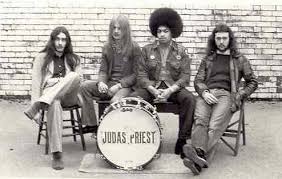
For the upcoming tour, he’s been replaced by Andy Sneap, much to the annoyance of K.K. Downing (second from left above), who quit several years earlier (2011) and resented not being asked to fill Tipton’s shoes.  This has opened a whole can of worms.  As I understand it, Tipton actually wrote and played on this album, along with Downing’s replacement (and youthful lookalike) Ritchie Faulkner.  As noted, Downing QUIT the band several years earlier, and my impression is that it was under bad terms but everyone concerned kept their mouths shut out of mutual respect and tactfulness.  It was NOT because Downing was too old to tour and had to retire for health reasons, the usual excuse these days.  But when the Tipton/Sneap deal emerged, Downing felt no longer compelled to hold his tongue.  As I said, a can of worms.  One thing is certain:  Sneap, not Downing, has replaced Tipton on the current tour.  We’ll see how well he does and IF Downing can repair any damage.

Judas Priest (Black Star Riders, Saxon), at Anthem, DC.  This is a brand new music venue in Washington DC, on a newly developed pier/wharf district just southeast of 395 and the 14 Street Bridge.  It opened last fall with the Foo Fighters being the first act to play here.  In terms of format it’s a bit like a larger version of the 9:30 Club:  big floor/standing room with seats up on the edges.   The original 9:30 Club at 930 F Street (1980-1996) had a capacity of 200 standing, probably a minority of that standing room actually anywhere near the stage. We saw Faith No More (The Real Thing tour), Hawkwind, Nik Turner’s Hawkwind, and Type O Negative (headlining) (RIP Peter Steele) at this venue.  The new version, at 815 V Street, is much larger: 500-1200, most being floor standing room (except Steven Wilson’s show, which was floor seated), with some upper level sitting areas.  This new venue is much larger: 2500-6000. 

The Black Star Riders went on first, and I immediately recognized Scott Gorham, former Thin Lizzy guitarist, at stage right playing – you guessed it – a Les Paul through Marshalls.  Only one TL track: “Jailbreak”.  Although Gary Moore is deceased, classic Lizzy guitarist Brian Robertson is still alive and playing music.  If anyone knows why he hasn’t played with Gorham in decades please let me know.

They were followed by Saxon, who still have Biff singing and Paul Quinn on guitar, plus Nigel Glockler on drums.  “Heavy Metal Thunder” closed the set.  Thank you.  We’d first seen Saxon back in Paris in the 80s on the Innocence is No Excuse tour.  Along with Iron Maiden and Def Leppard, Saxon are one of the few surviving bands from the so-called New Wave of British Heavy Metal which emerged in England around ’79-81, after the punk movement finally lost steam.  Whereas Def Leppard morphed into a pop band with Hysteria, and Iron Maiden developed their sound without straying too far from their NWOBHM roots, Saxon has been by far the most faithful of the three in trying to remain true to their roots of 1980.  Fortunately we’ve seen them a few times in the past, mostly as headliners in smaller clubs, and they were always honest and high energy.  My brother even got his picture taken wiff Bith. 

And then… The Priest came on, and it was sad seeing two relative unknowns on guitar:  Ritchie Faulkner replacing K.K. Downing, even down to the long blond hair and Flying V; and as noted above, now Andy Sneap on a Gibson Explorer (or clone) (similar to mine before I swapped in EMG81s and a mirror pickguard).   Faulkner joined the band in 2011 and is on Redeemer of Souls (second newest album), Firepower (newest, freshly released album), and the live video Epitaph, which I have on DVD.  Our last JP show was in 2009 at Merriweather, the tour when they played British Steel in its entirety, so this was our first time seeing them live with Faulkner.   Sneap did a fair job of replacing Tipton.  Ian Hill (bass) and Scott Travis (drums) were as solid as ever.  “Painkiller” made it into the set, apparently the band’s most popular late-model song, but I never cared for it.  “Saints In Hell”, a song I much prefer, also made it, for the first time ever since its original release on Stained Class all those years ago (1978); “Beyond the Realms of Death” is my favorite from that album, and fortunately we’ve seen them play it on prior tours, just not this one.   For me the top song of this set was “The Ripper”, but my prayers to have Sad Wings of Destiny played in its entirety instead of British Steel have fallen on deaf ears.  On Epitaph they did play “Never Satisfied”, from Rocka Rolla.  Fingers crossed for “Run of the Mill”. 

Overall set:  Firepower (new); Running Wild; Grinder; Sinner (!); The Ripper (!!!); Lightning Strike (new); Bloodstone; Saints In Hell; Turbo Lover; Angel; Evil Never Dies (new); Some Heads Are Gonna Roll; Breaking The What?; Hell Bent For Leather; Painkiller (zzz); Encore: Hellion/Eclectic Eye; Metal Gods; You’ve Got Another Item On Its Way; Living After Midnight.  Nothing at all from Rocka Rolla, Point of Entry or Ram It Down. 

Ironically, with Halford replacing original singer Alan Atkins (far right in the picture above) ages ago (before the first album was even released) this makes bassist Ian Hill (far left) the only remaining original member left, similar to Deep Purple, Ian Paice being the only member to serve in all lineups from 1968 (Mark I, Shades of Deep Purple) to the present. 

To go a step further, the current touring lineup of Foreigner has NO original members left, though guitarist Mick Jones (getting too old to tour) has played with the lineup in the past and has apparently given his blessing to this one.  I don’t know where singer Lou Gramm is these days.  The Eagles are down to Don Henley, although Don Felder is alive and active (touring separately as he doesn’t get along with Don Henley), and Joe Walsh still tours with them.  Blackfoot is touring without Ricky Medlocke, himself in Lynyrd Skynyrd which only has Gary Rossington left.  Wishbone Ash only has Andy Powell, but that’s because he won’t let Martin Turner into the band.  Ted Turner and Steve Upton are retired.  I don’t know if their absence is because Powell insists on keeping the profits to himself and touring with paid musicians, or whether Ted and Steve would rejoin even if Andy asked nicely and agreed to share $ with them on acceptable terms.   [Mind you, Rick Wright was demoted to paid musician on The Wall tour, but since that tour lost money, he was the only member of Pink Floyd to actually make money on that tour.] 

All these bands are getting old and losing their original members, leading some fans to accuse the current lineups of being little more than officially sanctioned tribute bands.  This is nothing new, though:  the Marshall Tucker Band lost Toy Caldwell ages ago (1993), and the Sensational Alex Harvey Band (SAHB) actually toured without Alex Harvey after his death.  

The fans seem to be split on this.  One segment refuses to see a band under these circumstances, no matter how well the band actually plays on stage; the other segment is willing to see the band IF the replacement members do a respectable job and know their places.  I took a chance and saw Wishbone Ash back in 2002 despite Andy Powell (as noted above) being the only original member, and I’m glad I did.  The rest of the band is competent and they play all the classic songs well.  Holding out for the return of both Turners and Upton means missing some good shows. 

Van Halen recently got David Lee Roth back, but bassist Michael Anthony was not invited back even though he was ready & willing to do so.  I suspect Eddie was paying his son Wolfgang nowhere close to the cut Anthony would be justified in asking for, so it’s money above all.  Having said that, we saw the show with Roth and he was fine.  Then again, we had never seen them play earlier with him (1984 and earlier tours) so the only comparison we had were the OU812 and F.U.C.K. tours with Sammy Hagar. 

Hell, there were people bitching that Tommy Clufetos was touring with Black Sabbath instead of Bill Ward on this final farewell tour.  But Ward has NEVER been consistent since 1978, dropping off tours as early as Mob Rules and Born Again, and only showing up again briefly in 1999.  Expecting him to tour now is downright idiotic, as is a boycott of a tour with Clufetos on drums.  

Finally, the big NO NO here was the infamous Deep Purple tour of 1980.  Rod Evans was the only original member left.  The Mark IV lineup had broken up back in 1976 and the other members were scattered through other bands like Rainbow and Whitesnake; fellow Mark I veteran, bassist Nick Simper, wisely refused to join this fiasco.  Yet they claimed to be Deep Purple and played Mark II and III material as it was their own.  Surely a distinction can be made between this blatant ripoff and an older band trying to bring music to the fans with as many original members as can reasonably get up on stage and play. 

One more thing I’d like to point out.  Not only musicians, but us fans as well are getting older and dying, whereas some fans are younger and had no opportunity to see the band play decades ago with its classic lineup intact.  For the latter group, the current lineup is the only option.   If you’ve seen the band play back in the day and don’t want to waste your money on what you consider a glorified tribute band, save your money and stay home.  As for me, intent on seeing the band in as many different lineups as possible, regardless of how many past shows I’ve seen, I’ll spend the money and see the show and won’t bitch that so & so is too old to tour, is dead, doesn’t get along with the rest of the band, or for whatever reason, good or bad, isn’t on the tour.  And I’ll enjoy sitting in the seat you might have taken if you weren’t staying home.  We all win.

Friday, March 16, 2018

Roommates

As I’ve probably mentioned countless times already, I went to college at the University of Maryland, College Park (UMCP).  I couldn’t get into West Point, and with my GPA and SAT scores, plus my parents being from Maryland, I was guaranteed admission and in-state tuition at Maryland’s state university.  Moreover, the College Park (main/flagship) campus is huge, beautiful, and conveniently located just outside of DC and close by to Gaithersburg, where I grew up.  Though I had really wanted to go to West Point, I wasn’t too disappointed to be going to UMCP.   I didn’t want a small campus in the middle of nowhere, nor a city campus like Boston University or George Washington University.  UMCP gets on screen for “National Treasure” (Cage’s character consults an expert on campus) and “St Elmo’s Fire” (Frat Row for Rob Lowe’s character). 

Unless you either avoid college or spend it commuting from home, you’ll probably spend it with roommates.  Freshmen start out with doubles, working their way to a single by senior year.  My friends Phil and Baron even went off-campus, which changes the picture slightly.   With my parents overseas all four years of my journey at UMCP, commuting from home was not an option (though my brother still stayed on campus his senior year even with my family back in Gaithersburg by then) and my father deemed living off campus not worth the hassle of giving up the convenient ability to walk to class.  Anyhow.

I’ll use first names, adding last initials if necessary to distinguish parties with the same first name.  The high rise dorms were named after Maryland county seats, e.g. Hagerstown, Bel Air, Ellicott, (though I’ve yet to see a Rockville Hall), whereas the low rise dorms were named after counties in Maryland.   In a double you share the room with a roommate, whereas a single you have to yourself.   Depending on the circumstances, you might have a double to yourself (see below). 

With one major exception, all my experience with roommates was bad.  Part of the college experience is having to learn how to deal with unpleasant people you don’t like, total strangers who you have to live with.  It’s not on the syllabus but it’s part of what college inevitably teaches you, one “benefit” of living on campus.  Just like how to drink irresponsibly. 

Freshman Year (F86/S87).  Hagerstown Hall (high rise) (double).  Mike P., from Mount Airey, Maryland, my only good roommate for those whole four years.   We got along fine.  During the spring semester he was gone substantially due to chemotherapy.   Since he’s still alive today, and friends on Facebook, I’d say he kicked cancer.   We caught the Jimmy Page concert at the Cap Center in 1988.

Sophomore Year (F87/S88). Talbot Hall (low rise, renovated) (double).   Fall:  Greg.  Spring:  Mike B.   Greg wasn’t too bad, but he did get into a fight with my best friend Phil after a party we threw in our suite.  He transferred to Towson State, north of Baltimore; I believe he was from that area.   Mike B. came in from Denton Hall, a high school buddy of Chip & Woody from Hagerstown.  He was a major league asshole, and got kicked out of the dorm system before Spring Break for a prank he pulled in Denton.  He successfully got into Kappa Alpha fraternity and into their house, later getting Woody and others into KA as well.  Because he was kicked out mid-semester, Mike B. was not replaced for that period and I had the room to myself for the remainder of the semester. 

The minor irony here is that these assclowns were all from Hagerstown, Maryland, yet none of them were living in Hagerstown Hall, where I had been for my freshman year.  Years later I had a few court cases in Washington County, Maryland, of which Hagerstown is the county seat.  So I eventually got to see this small, unimpressive town 30 minutes west of Frederick, the latter being the second largest city in Maryland after the big one, Baltimore.  Oh, and my dad died in the hospital in Hagerstown in December 2004.  Life has a strange sense of humor. 

Junior Year (F88/S89).  Talbot Hall (Fall)/Montgomery Hall (low rise, renovated) (spring).   Fall:  Eric S.  Spring:  John.  Not learning my lesson with Mike B., I pulled in Eric S., another of Woody’s Hagerstown comrades.   Eric S. was just as much an asshole as Mike B.   I wound up moving to Montgomery Hall (finally in the dorm named for the county I was actually from!) for the spring semester, only to get another asshole roommate, John, who racked up $300 phone bill arguing with his GF Mary back in northeastern MD.  His parents finally paid the bill for him that summer after his incessant promises to pay were all bullshit.  By the way, I found out the hard way that Maryland, though not a particularly large state by American standards, is large enough that some parts of it qualify for long distance calling rates.  The more you know…

Senior Year (F89/S90).  Montgomery Hall.   A SINGLE.   The guys in the suite next door, with whom I got along fine (see below) let me know that the guy in their big single, Eric T., would not be coming back in fall, making that room available.  Thanks to them, and a letter to Resident Life, I got it.   Not only that, it was a big single.  Fortunately, Gene, who had the small single, didn’t voice any objection.   Finally I had a decent living situation.

Due to judicious scheduling and course choice, I managed to complete 156 credits and two separate degrees, a BA in Government & Politics and a BS in General Business, in 4 years, though it took a full summer with two sessions (4 classes) between sophomore and junior years, and a half session (2 classes – COBOL and Money & Banking, dead end classes which weren’t prerequites for any other classes).  This allowed me to start law school at George Mason University (now the Antonin Scalia School of Law) in the fall of 1990. 

All summer housing was in New Leonardtown, an apartment complex on the other side of Route 1 back behind Frat Row.  Apparently New Leonardtown was easily able to accommodate all the summer students, as the units were half empty during this time.  These had kitchens.  My buddies Dave B. and Ken were living in Old Leonardtown our senior year, an older set of apartments right next to New Leonardtown, so I spent considerable time hanging out with them there. 

Summer ’88.   A single in New Leonardtown for both sessions, from after Memorial Day to the middle of August, and I finished up the summer with my family up in New York City for the end of August.  Jeff & Dave F. (Diamondback photographer) were in one double, the other single and double being empty.  Dave F. articulated the clever and plausible theory that New Coke was Coke’s way of switching from sugar to high fructose corn syrup in Classic Coke without anyone noticing.  Well, aside from those of us like my brother who can taste the difference and make it a point to buy Mexican Coke, which has sugar.  

My brother actually came down from NYC and stayed with me in the suite for much of the summer.  This was also the summer I got my first car, a 1984 Chevrolet Cavalier, which served us well until 1991.  It was a great summer for concerts:  Pink Floyd, Van Halen Monsters of Rock (Metallica, Dokken, Scorpions, Van Halen) at RFK, Iron Maiden & Judas Priest at the Cap Center, and AC/DC at Madison Square Garden.   

Summer ’90.   A double to myself in new Leonardtown.  I can’t recall who else might have been in the suite, and I was only in it for the first session, going back to Paris in mid-July.  That ended my stay at University of Maryland, College Park. 

Suitemates.   The high rises are all doubles and singles.  In the newly renovated low rises, they had suites without kitchens and either three doubles (Talbot Hall) or two doubles and two singles (Montgomery Hall).  So the suitemates are those in the same suite but not the same room. 

Talbot HallWoody & Chip, Bill D. & Scott, then Chris.   Scott was not an issue, though he moved out, replaced by Chris.  I got along with him even though he didn’t actually like me.  Same deal with Chip & Woody, both from Hagerstown.  I had met Woody at Freshman Orientation and been friends with him during freshman year.  It was a coincidence that I wound up moving to a suite in Talbot Hall that he and Chip also moved into.  Bill D was not a problem either, and he was a former roommate of my buddy Dave.   Bill, Dave & I are still friends today, though I haven’t met Bill since college. 

Montgomery Hall.   Senior year:  Marcus & Jay, AJ & Bill M; Gene in the small single.  Except for Gene, they were all Theta Chi brothers.  Jay actually brought me to a 2 a.m. party at Theta Chi.  Had I not been a senior I might have considered rushing Theta Chi, as I actually got along very well with them. 

Other Roommates.  My best friend Phil was on campus at George Mason University for his first two years, and for much of that time his roommate was a Costa Rican guy, Victor.  They got along fine and even wound up living in a house in Centreville with Victor’s fellow Costa Rican, Mariano.  Baron had a roommate for his first year, in Wicomico Hall, before getting a single in the same dorm the next year and then moving off campus for junior and senior year.  While he was living in Bel Air Hall at the beginning of his college experience, my brother Matt had a roommate, Dave K., from somewhere northwest of Baltimore.  He got along fine with Dave K., later getting a single in Montgomery Hall.  So of all of us, I had by far the worst roommate experience.  

Tuesday, March 13, 2018

Ulysses vs. Jason & The Argonauts


Recently I watched the 1594 Kirk Douglas film, “Ulysses”, which is about the famous Greek hero of the Trojan War.   Thankfully it was shorter than “Spartacus” and easier to tolerate.

Basic story.   A long time ago, Greece and Troy were at war.   Troy was a big city in what is now called Turkey, in the far northwest corner, now known as Hisarlik, close to Canakkale.  It had HUGE walls (huge, I tell you, no one has bigger walls, they were fabulous – we totally got Mexico to pay for them) which the Greeks couldn’t deal with.  So our good friend Ulysses (also known as Odysseus) came up with the brilliant idea of leaving a huge wooden horse behind as a “whatever, we lost” gift.   Like idiots, the Trojans opened their gates, pulled in the horse, and at night the Greek soldiers hidden inside got out, opened the city walls, and let their comrades in to sack and destroy the city.  Game over for Troy.

However, in doing so, Ulysses pissed off Poseidon, aka Neptune, the god of the sea, and so he had a bit of trouble getting home to Ithaca (an island off the west coast of Greece), to his wife Penelope and his now-grown son Telemachus.  His major problems were (A) cyclops (one-eyed giant) who trapped him and his crew in a cave, (B) Sirens who sing, and (C) the sorceress Circe, who turned his crew into pigs.   Ulysses was able to overcome all of these, though it took him 10  years – on top of the 10 years the Trojan War lasted – to finally get home.  His wife was VERY patient.

Finally at home, he had to rescue his wife from a crew of horny suitors trying to replace him.  He did so firing an arrow through a row of axeheads.   Happy ever after.  Aside from Kirk Douglas, Anthony Quinn is in here as the most arrogant and capable competing suitor. 

Ulysses is not to be confused with another famous Greek mythological hero, Jason, as in “Jason & the Golden Fleece” and the Ray Harryhausen film, “Jason & the Argonauts”.  This stop-action animation film from 1963 is cited by Tom Hanks as his favorite film. 

Jason was a Greek hero who had a ship called the Argo, staffed by his crew of Argonauts.  His goal was to get a Golden Fleece (golden sheep skin) guarded by the Hydra (multi-headed dragon).  Jason also (A) fights huge golem Talon, (B) rescues blind dude harassed by harpies, (C) gets through the crashing rocks, (D) fights skeleton warriors raised from dragon teeth, and (E) hooks up with sorceress Medea.   It seems there was a cyclops in this film too.

Both had a quest, made more difficult by monsters and magic, and both aided and opposed by the gods and goddesses.  The Jason movie had far more special effects, thanks to Harryhausen, though there was plenty of magic in “Ulysses”.  Oddly, the same actress, Silvana Mangano, played both Penelope and Circe.  Both are worth watching and enjoying, particularly if you’re a fan of Greek mythology.