Friday, March 26, 2021

Collections


The challenge of coming up with another blog hits again.  Let’s see how this works.

 Maryland band Clutch recently reissued – yet again – its album Blast Tyrant on vinyl.  It was a limited release including a t-shirt, which caused muito problemos and much anger and frustration.  Mind you, it’s one of their more popular albums and has been out for awhile – originally on CD in 2004, with a two disc reissue in 2011 - including this newly resurgent vinyl format. 

 Having only one of something varies.  Can you collect spouses?  Maybe in a Muslim country, and only if you’re male.  Polyandry (husband equivalent of polygamy, having multiple wives) doesn’t seem to be common anywhere.  And the Mormons have dropped their own polygamy.   Some people collect real estate.  I see some on Facebook bragging about having 10+ vinyl copies of Machine Head (Deep Purple).   I’d just as soon find the best version and stick with that.  I thought my 1998 CD version was optimal, until I discovered that they reissued it yet again in 2012 with not just two songs in quad but the whole album.  D’oh!

 Stamps.   When we were kids in Paris, we’d collect this, even going to the stamp market, which – to the best of my recollection – was somewhere close to the US Embassy.  That collection has fallen by the wayside for decades, but I still have my blue book of stamps.

 Compact Discs.   By now I’ve lost count, having started with Van Halen OU812 and Judas Priest, Ram It Down, both in 1988.  My brother’s first were KISS Double Platinum and Poison, Look What The Cat Dragged in, back in 1987.  It’s still my preferred format.

 Vinyl.   Until 1987-88 we were collecting music on vinyl.  One thing we were NOT doing was buying as many different versions of the SAME album as possible, and I still find picture discs somewhat nonsensical.  The vinyl experts complain that the sound quality is inferior and they wear out quicker.  Anyhow.  Now that 180 grain has come by, I periodically purchase records in that format, even if I have it on CD.  Unless the band – for whatever reason – insists on ONLY releasing the album on vinyl, I’ll buy the CD.  Sleep and SunnO))) have been the only ones to do so.  I am NOT collecting vinyl of albums released once CDs became the standard, I’ll stick with material originally released on vinyl. 

 Soccer jerseys.   In 1999 I started dating a Brazilian woman, Leila, from Rio de Janeiro.  In summer 2000, when we visited her home town, I bought my first jerseys:  Flamengo and Botafogo, followed by Fluminense and Vasco da Gama, the four teams from that city.  Bayern Munich, with Giovanni Elber’s name and number on the back, I bought from the team’s own website.  The premiere soccer jersey websites will sell personalized jerseys with star players, though the team’s own website will sell you a jersey with any current player’s name and number.  I’ve lost count of how many I have, but continued even after the relationship with Leila ended in February 2005.  These include other Brazilian teams, Bundesliga teams (several Bayern Munich), Premier League (Arsenal being my favorite), a few from Real Madrid and Serie A, but none from MLS.  Fortunately, despite putting on weight over the years, my 1999 Flamengo jersey still fits.

 Concert T-shirts.  When we first started going to shows (1984) we’d get a shirt from each concert.  Nowadays I’m more selective.  Dead Meadow didn’t have any nice ones, so I got a poster instead.  It’s reached the point where I have to separate them out into black A-K, black L-Z, and non-black.  It’s also nice when the band puts tour dates on the back and doesn’t simply default to the current album cover for the front design.  Iron Maiden are probably the most imaginative when it comes to this.

 Pint glasses.  These are taking up space in my freezer now.  That being the case, I’ve cut down on seeking out more pint glasses and only get one if it catches my eye.  I can’t stand drinking beer or cider out of the can or bottle, and prefer drinking from a pint glass.   From King Crimson I have Red and Discipline, and a nice FARM one from the dispensary in Boulder, Colorado.

 Guitars & Amps.  Although I’m not, and never have been, a professional guitarist, I do have multiple guitars: a Fender Stratocaster, a Gibson SG Standard, a Gibson Explorer, a Gibson Les Paul, and a Gibson Firebird (reverse).   With the exception of the Black Cherry Pearl LP, the others are all black.  I see people bragging about having 10 sunburst Les Pauls – again, I don’t see any reason to collect more than one of each model, let alone several in the same color.  I pick the version I like the most and personalize or customize it as I see fit.  The Stratocaster is a Fat Strat made in Mexico, with locking tuners (large, 70s style headstock), a DiMarzio ToneZone zebra coil humbucker in the bridge position, and V-Runner tremolo.  The Les Paul is a Studio Pro with a Gibson 500T in the bridge position.  The Firebird is stock except for a black pickguard – it has the Firebird-specific pickups (which are NOT mini-humbuckers) and Steinberger locking tuners.  The Explorer, a ’90/’76 Reissue, has EMG81 pickups and a mirror pickguard.  And until recently, the Gibson SG Standard was stock, I added in locking tuners. 

 Electric guitars are useless without amplifiers, but I can’t say I’m really “collecting” amps per se.  I have a Marshall 2554 1x12” combo, a Marshall 4100 Dual Reverb head with 1960AV slant cabinet (a half stack), and a Laney L20T-112 combo.  Were I to start collecting, I would get a Fender Twin Reverb and a Mesa Boogie Mark II.  Not anytime soon. 

 Guns.  Hardly an arsenal, but here it is:  Beretta 92FS, Springfield Armory Saint (AR15), AK47, and three bolt-actions:  Russian 91/30 Mosin-Nagant, 1917 Enfield (US WWI), and WWII German Mauser 98K.  Those went from plentiful to rare.  About the only addition I’d prefer – absent winning the lottery and going Class III crazy – would be an FN FAL. 

Cars.  I’ve never been rich enough to accumulate a collection.  Again, if money were no object, I’d purchase a ’89-92 Firebird Formula and put my rebuilt, car-less L98 in it, and restore my ’76 Firebird, then add a ’67-68 Firebird 400 and a 1974 Trans Am SD455 in dark blue.  That begs the question of where I’d park them all. 

Hmm.  I've identified seven different types of items I collect.  It looks like I have a collection collection.   

Other stuff.  I was at Third Eye Comics in Annapolis recently and saw they had a huge selection of Pop Vinyl dolls - those pop culture dolls with the oversized heads - and late model action figures (same size as the Star Wars ones we had back in the day).  What I can't figure out is what these are for, since they're clearly marketed for adults.  How are adults supposed to play with dolls - sorry, "action figures"?  Maybe my imagination is defective here.  The only other reason I can see is to collect them.  But to me, collecting things for the sake of collecting, something which doesn't have any use in itself, is a bit strange.  I can drink beer out of my pint glasses, wear my t-shirts or soccer jerseys, shoot my guns or play my guitars, and listen to my CDs and vinyl.   What can you do with dolls if you're an adult?  Anyhow.

Friday, March 19, 2021

Some Assembly Required


Until gramophones and 78s became common around the turn of the century (1900), then electrical versions in the mid '20s, if you wanted music, you had to make it yourself.   A music store could sell you a musical instrument, of course, and the sheet music to play the music yourself.  If you wanted to hear someone else play it, you’d have to attend a live concert.   Perhaps, back then, there were bootleggers, sitting in the audience at concerts, rapidly transcribing them into sheet music for sale or distribution among kindred souls.  Who knows.

 Throwing sheet music at someone and telling them, “play it yourself”, strikes me as an example of “some assembly required”.  Years ago, when I was taking guitar lessons with my teacher, Joel, in Paris, I asked him about reading sheet music.  He advised me that he could teach me, but for guitarists, reading sheet music was somewhat of a waste of time.  By that time (mid-‘80s), something called tablature existed, showing 6 lines (representing the six strings of a guitar) and noting which frets and strings the activity occurred on.  Traditional sheet music is considerably less direct and more complicated, especially since it was never originally designed for guitarists in particular.

 Sears Modern Homes.  From 1908-1940, you could buy an entire HOUSE from Sears.  Sears Modern Homes had various different styles available, though the “bungalow” strikes me as most noticeably from that time period.  Mind you, the house would be sent to you in two box cars, then delivered by truck to the building site.  You could pay someone to put it together for your or, if you were handy enough, assemble it yourself.  It did NOT come fully assembled.   Back in the nineteenth century, many communities would gather together to build their homes, balloon frame houses.  Of course, back then there was no electricity or indoor plumbing, a house was simply a wooden structure, with glass windows, as shelter from the elements. 

 Obviously I’m too young to remember when electricity first made its debut in homes in offices, some time around the turn of the century.  Somehow I doubt codes and standards existed back then, nor electric utility companies with monopolies.  Pictures of cities show bewildering arrays of electric lines strung up all over the place, possibly from competing firms.  And without stringent standards, fires were common.  My father used to joke, whenever balking at taking us somewhere like the toy store, “didn’t you hear?  There was a huge fire, the place burned down.”  Not sure if Brooklyn had its act together by 1928 when he was born, but I suspect that expression had its roots in his parents’ time and experience when substandard building codes made electrical fires far more common than they are these days.  Hell, some of the Vanderbilt homes in Newport, Rhode Island, burned down – these were huge mansions built for the richest Americans.   Even they couldn’t count on competent installation of electricity in their homes. 

 Anyhow.

 Sadly, Sears itself had a corporate paperwork housecleaning which destroyed almost all of their prior records, including their records on Sears Modern Homes.  Since they were copying existing designs, and apparently there aren’t design patents on home designs, they could do so at will.  These homes did have electricity and plumbing but not air conditioning or internet.   Anyone wondering if their early twentienth century home originally came from Sears would need paperwork from the prior owners. 

 I am seeing some newer homes built in the older style, presumably with modern amenities and less prone to fires.  And I would also imagine they are being built by contractors – not by the owners themselves.   My own home is an efficiency on the twentieth floor of a twenty-six story high rise apartment building.  I can bet that the first owners in the 1970s did not build Skyline themselves….

Friday, March 12, 2021

Deer and Dogs Delivered


 Three movies starting with “D”:  The Deer Hunter, Dogs of War, and Deliverance.

 The Deer Hunter.  I mentioned Michael Cimino’s epically horrible film “Heaven’s Gate” earlier, but now I’ll review his other masterpiece.  This is three hours long.

 Four guys in Pittsburgh, in an ethnic Russian community.  Stan/Stosh (John “I knew it was you, Frodo!” Cazale) is exempt from military service for some reason;  Steven (John Savage); Nicky (Christopher Walken); and Michael (Robert De Niro).  They celebrate Steve’s wedding to Angela, who is pregnant with another man’s child.  They go deer hunting, and Mike kills an impressive male deer.  They go to Vietnam (minus Stosh), and get captured (together) by the VC/NVA and forced to play Russian Roulette.  Mike figures to play with three bullets, and then uses those three shots to kill the three most attentive NVA, takes their weapons and shoots the rest.  In the process of being picked up along the river after escaping, the three lose track of each other.

Mike goes back immediately with no apparent injuries or PTSD.  He hooks up with Linda (Meryl Streep).  Angela is catatonic, but manages to reveal Steve’s location:  missing his legs, playing bingo at a VA hospital.  He wants to stay there indefinitely, as despite being drab and depressing, he’s not much worse off than anyone else.  The only news about Nicky is that he’s AWOL and has not come back.  Ironically, Mike saw him in Saigon before leaving, but couldn’t chase him down after finding him in a Russian Roulette gambling club.

Mike returns again to Saigon, where it must be April 1975:  all hell is breaking loose and civilians are storming the US Embassy compound to leave the country with the Americans.  After some difficulty, he finally tracks down Nicky through the Frenchman.   Sadly, he doesn’t quite manage to get Nicky back to Pittsburgh.  There’s some residual scenage back in Pittsburgh, with Steve now rejoined the community with Angela, but mostly it’s over.  Three hours with only two truly memorable scenes in the entire movie. 

 Dogs of War.  Lately I’ve been checking out older actors’ earlier roles.  Helen Mirren is a major babe in “Age of Consent” (and showing considerable skin).  Jay Pritchett (Ed O’Neill) actually had a career before “Married With Children” – he’s a NYPD cop in “Cruising”, Al Pacino’s NY cop movie in which he tracks down a serial killer preying on NYC’s gay community.  And in this movie he’s a mechanic who briefly meets with Shannon (Christopher Walken).  

 Shannon is a covert ops guy from NYC who’s hired to assist with a regime change in fictional Zangaro, a country in west Africa.   First he goes on a reconnaissance mission to scope the place out, is badly mistreated by local authorities, barely managing to survive to return to NYC.   Despite this, or maybe because of this – and a huge paycheck promised – he agrees to assemble a team to return and put in a marginally less crappy dictator in place of the crazy current guy.  Lots of violence and explosions.  Tom Berenger is the only other major actor in this. 

 Deliverance.  Four normal guys – Lewis (Burt Reynolds, sans mustache), Ed (Jon Voigt), Bobby (Ned Beatty), and Drew (Ronny Cox) - go on a canoeing trip in Georgia.  The river in question has some dangerous rapids, but the bigger picture is that they are building a dam in the local area which will eliminate the river and put much of the local area permanently underwater.  Although not a hunting trip, per se, Lewis has (helpfully) brought along a bow & arrow.  After Drew has a brief jam with the local banjo kid, they set off down the river, having paid difficult and hostile locals – all of whom consistently give them the “you’re not from around here” treatment – to drive their station wagon and Harvester Scout down to Aindry, the town at the end of the river where they expect to end up.

            Along the way, Ed and Bobby are captured by local Trump supporters and forced to endure unwanted sexual advances that go well beyond merely sniffing their hair.  They are rescued by Drew and Lewis; the consensus seems to be that the locals intended to murder Ed and Bobby after their involuntary romantic interlude.   Then and there, the four agree on a “story”, an alternative explanation of the events, knowing that honestly relating the facts will simply get them a jury of locals sympathetic to the deceased.  On the way back, Drew drowns and Lewis is badly injured.  The authorities suspect foul play but can’t prosecute anyone as the stories are consistent enough and the evidence is buried.   And there was much rejoicing…

Friday, March 5, 2021

Confess, Maynard


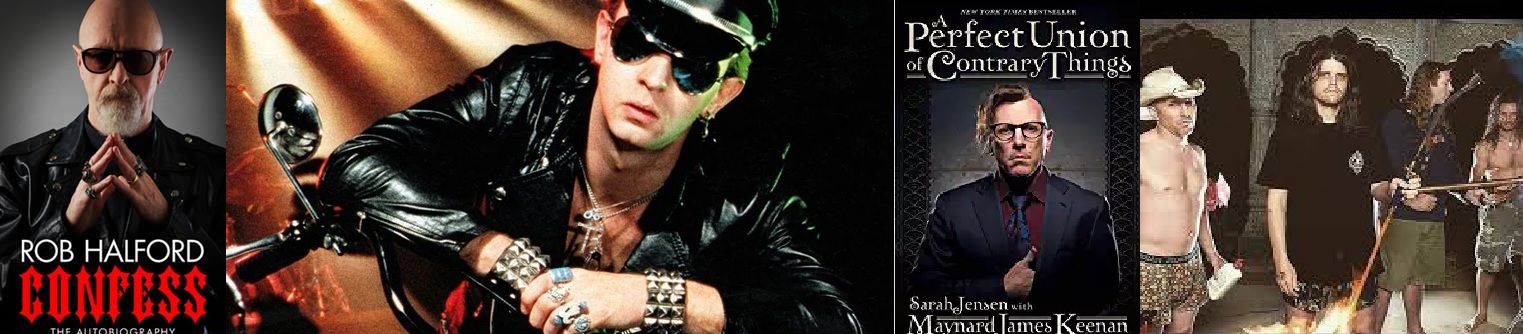
 I put two books on my Amazon Wish List last Christmas, and my Santa-esque brother (my only one, Matt) thankfully got both for me.  The first is Confess, the autobiography of Judas Priest singer Rob Halford, and the other is A Perfect Union of Contrary Things, by Sarah Jensen with Maynard James Keenan, the enigmatic singer for TOOL, plus his side projects A Perfect Circle (APC) and Puscifer.  Confess is told in the first person by Halford himself, and covers the period all the way up to Andy Sneap’s replacement of Glenn Tipton for Firepower, the band’s latest album.  APUCT is in the third person with some direct quotes from MJK himself.

 Confess.  With the exception of original singer Alan Atkins – who left the band long before its first album, Rocka Rolla, was released in September 1974 – and brief replacement singer Ripper Owens, who only sang on Jugulator and Demolition (1995 and 1998), the singer for heavy metal band Judas Priest has been Rob Halford, from Walsall, a suburb of Birmingham, England. 

 Defenders of the Faith.  We received this album, on cassette, for free, in spring 1984 (i.e. their newest album at the time) and immediately got hooked on the band. That summer we picked up Sad Wings of Destiny on vinyl and discovered Early Priest.  When the issue of Halford’s social life came up, we took at face value his denial of homosexuality, but my friend Sean said – back in 1984 – “if he isn’t gay, why is he dressing that way?”  When Halford finally did “come out” in the early 90s, it was hardly a surprise.  Well, whatever.  We still bought Angel of Retribution, Nostradamus, Redeemer of Souls and Firepower, and still went to the concerts. 

 Having said all that, his autobiography is a bit heavy on the gay-ness, roughly 50%.  I wasn’t concerned about his “keeping in the closet”, of cruising and hooking up, of winding up with straights who have sex with men (“then you ain’t that straight!!!! Tiger Guy).  Talk about a heavy dose of TMI.  He could cut it down by half and still tell us all the stuff we care about:  how he joined Judas Priest (long before Rocka Rolla came out), the circumstances of each lineup change (particularly drummers), the background on each album and tour, and the band’s interaction with other metal bands.  Oh, and he loves “Spinal Tap”.  That’s the part I care about, and fortunately it’s here. 

 Gay Stuff.  I don’t want to devote an entire blog to this topic so I might as well address it here.   I am straight and always have been.  I have very few friends these days, and none of them are gay.  I’ve had gay acquaintances but not close relationships.   But what other people do among themselves, as consenting adults, is their business.  I have enough to worry about in my own life without getting bent out of shape about others.  Moreover, most people who bark and bray the loudest against gays usually turn out to be deep in the closet.  Again, I don’t care.

 If there is one part which does bug me, it’s this business of gays being pretentious.   I love watching “Modern Family” (though Sofia Vergara, Ariel Winter, and Sarah Hyland receive most of my attention) and the gay couple, Mitch (Jesse Tyler Ferguson) and Cam (Eric Stonestreet) seem to click all the boxes on gay stereotypes, even to the point of their friends, e.g. Pepper (Nathan Lane).  Of course, the show makes fun of Colombian drug lord culture (Gloria Pritchett, played by Sofia Vergara), goofy magic nerd realtors (Phil Dunphy, played by Ty Burrell), and stupid hot chicks (Haley Dunphy, played by Sarah Hyland), so the ridicule is evenly spread throughout. 

 In any case, Halford’s orientation was already common knowledge when he formally “came out” in the early 90s after leaving Priest, and certainly is now.  So “Confess” is somewhat of a meaningless title.  Anyhow. 

 A Perfect Union of Contrary Things.   Apparently MJK grew up in the Midwest, Ohio & Grand Rapids.  He joined the Army, but though picked to go to West Point itself from West Point Prep, actually decided to go to art school (????) in Michigan, then work in a pet store in Boston, and eventually relocated to L.A., where he worked at another pet store and met guitarist Adam Jones and drummer Danny Carey.  They formed TOOL with bassist Paul D’Amour in 1992.  After only 6 live shows, all as opening acts at microscopic clubs in L.A., somehow they got a record deal almost instantaneously. 

 After Aenima, their second album, TOOL had legal issues regarding their record contract, so MJK wound up with free, idle time, which he spent getting A Perfect Circle off the ground.  At some later point he started his second side project, Puscifer.  He also discovered jiu jitsu and set up a vineyard in Arizona.   ZZZ.

 Awhile back I read the autobiography of Brian Johnson, the singer for AC/DC (Rockers and Rollers), and blogged about it (back in 2012).   I also blogged when Axl Rose took over on the recent tour.  Brian Johnson’s voice has been accurately described as “Marge Simpson”, and of all the band members, he’s clearly the band’s weakest link.  Whether it was 1980, 1990, 2000, 2010, or 2020, Angus could find any number of singers, either professional or undiscovered in a club somewhere, who could do better than Brian Johnson. 

But to get back on topic:  Johnson’s autobiography actually made me like him LESS.  And same deal with Maynard’s.   Goes to art school instead of West Point?   Jiu jitsu and wine?  The utter pretentiousness of the book is off the chart, yet this is not a critique or expose, it’s supposed to be HIS story. 

 In fact, it does such a spectacular job at making him appear pretentious that I begin to wonder if that wasn’t the whole point all along.  Of course he’s pretentious.  He’s Maynard.  Listen to TOOL lyrics and you’ll figure that out.  The book just adds into the whole equation, a Fibonacci spiral….

 Will I stop listening to TOOL or going to their shows?  Of course not.  Same deal with seeing AC/DC live even if Marge Simpson is still their singer.  And Halford’s private life is not my concern, his music is.  These people are imperfect humans just like I am and their music is still top quality.   Sometimes, though, you find your heroes have clay feet.  And life goes on. 

Friday, February 26, 2021

Tuned Port Injection


 Back to cars again.  I joined a TPI site on Facebook and was surprised to see how many enthusiasts there still are for this GM variant of port fuel injection, which only came on Camaro Z/28s/IROCs, Firebird Formula and Trans Ams, and Corvettes, and only between 1985 and 1992 on 5.0L and 5.7L V8s.  With GM’s LS-series V8s being the current performance standard among the GM crowd, that tuned port injection still has many adherents is a remarkable surprise.  My own L98 is still languishing in a machine shop in Fairfax, Virginia, rebuilt, balanced and blueprinted with a new camshaft and aluminum cylinder heads since the donor vehicle (intense weeping) burned up in 2012. 

Carburetors.   Before any form of fuel injection, there were carburetors to mix air and fuel so an engine could make the car go.  Carburetors use a venturi inside the barrel to suck gas up and mix it with air.  They’re sized in “barrels” depending on the engine they go on.  Four and six cylinder engines typically get one barrel carburetors, six and eight cylinder engines get two barrels, and V8s usually get four barrels.  The Rochester QuadraJet is GM’s most popular and common four barrel carburetor (and what’s on my ’76 Firebird’s Olds 455 right now), the Carter AFB (Aluminum Four Barrel), now made by Edelbrock, is a popular alternative, and Holley has traditionally made aftermarket four barrels.  The ’67-69 Firebird Sprint had an overhead cam straight six with a four barrel (QJet) – Delorean was proud of that, but no one else seemed to care. 

Generally a well-tuned four barrel is all a V8 needs, but some have even more.  The Pontiac Tri-Power (1964-66 GTO) and Mopar Six-Pack set up had three two barrels.  For idle and part throttle, the engine ran off just the middle (inboard) two barrel carburetor, and at larger throttle openings up to WOT (wide open throttle, pedal all the way down to the floor) the outboard two barrels would open up, for a total of six barrels.  Some engines went even further: the ’67-69 (first generation) Camaro Z/28 had two four barrel carburetors on its fairly small 302 cubic inch V8, and the 426 Hemi had two Carter AFBs, a total of 8 barrels, aka a “dual quad” setup.   I haven’t seen a dual quad setup with QuadraJets, though.  Listen to “409” by the Beach Boys, citing the “four-speed, dual-quad, positraction 409”. 

Mechanical Fuel Injection.  Engineers weren’t satisfied with carburetors and tried mechanical fuel injection in the late 50s.  The Corvette, some Pontiac Bonnevilles and Chrysler 300s, got this deal, but mechanics were hard-pressed to work on them due to their rarity.  Mercedes insisted on putting mechanical fuel injection on all their cars from 1959 to the early 70s, at which point they switched to electronic fuel injection.   And literally all diesel engines, by design, have mechanical fuel injection.  Diesels inject the fuel directly into the cylinder on the firing stroke, which ignites immediately upon hitting the highly compressed hot air in the cylinder.  Mechanical fuel injection never managed to effectively compete with carburetors. 

Electronic Fuel Injection.   Carburetors are actually fairly complex, as they have to handle all the different fuel needs of the engine mechanically.   For cold start conditions, there’s a choke.  For idle, when the throttle is closed (e.g. at a stoplight) there’s an idle circuit.  For off-the-line boost, there’s an accelerator pump. 

But imagine if you simply had 4, 6, or 8 injectors, connected to a computer, which pulse on and off to inject fuel.  The computer could ascertain how much pulsewidth to use, and simply pulse the injectors on and off.  If the engine still doesn’t have enough fuel for its needs with the injectors continuously open, simply upgrade to larger injectors or higher fuel pressure.   Moreover, a performance makeover is as simple as replacing the EFI chip (PROM) or reprogramming the ECM (electronic control module) with a unit designed for that purpose.  And if any sensor is reporting back bizarre readings outside its normal range, the computer can shoot back a trouble code, to give the engine some self-diagnostic capability.

EFI got its start in the 1950s, but back then computers ran on vacuum tubes, not nearly as small or fast to run an engine in real time.  Bendix, which had started the whole thing, sold its rights to Bosch.  When transistors came around in the 1960s, Bosch was finally able to develop a practical ECM, and thus K-Jetronic debuted on 1968 model year VWs.  In 1972, Mercedes switched over to EFI on all its cars, and in 1976 Cadillac and Lincoln started as well.  In the early 80s, computers had gotten even better, so the Big Three could finally put EFI on more mundane cars like Chevrolets, Pontiacs, Fords, Dodges and Plymouths.

Throttle Body Injection.  Port fuel injection has an injector at each cylinder.  When I bought my 1992 Pontiac Firebird (not the Formula), it had a 5.0L V8.  On top of the engine was the familiar circular air cleaner with the snorkel.  Huh?  This 1992 car has a carburetor?  Nope – spin the wing nut off the air cleaner cover and voila – two egg-like things with wires pointing down in what looks like a carburetor but isn’t: the throttle body supplying fuel to all 8 cylinders.  TBI is a mid-range system in between carburetors and port fuel injection.

TUNED PORT INJECTION.  Finally getting to my subject.  By 1985 GM had developed a performance port fuel injection system for the Corvette, Camaro and Firebird.  Dropped onto the small block Chevy V8 in 5.0L (LB9) and 5.7L (L98) size, the system made between 205 and 230 HP on the LB9 (the higher rating on T5 manual engines) and 225 and 245 HP on the L98.  Most of those got the 700R4 automatic transmission, as GM knew only Corvette owners would be willing to pay $3000 just to get a five speed manual ZF transmission. 

The TPI setup has a baseplate, a pair of runners, a plenum, 8 injectors on a fuel rail with a fuel pressure regulator, and a throttle body.  It has a distributor, HEI, either in-cap or external coil.  Supposedly the whole setup is optimized for 5.0L V8s and is a bit restrictive on 5.7L V8s.  Naturally the aftermarket has made larger runners, a larger baseplate (apparently the plenum is not the choke point) and larger throttle body plates.   My own L98 was upgraded with SLP parts: larger, siamesed runners, plus headers, a larger throttle body, 3” exhaust, a performance PROM, etc. for a total of 50 HP over the stock rating, thus 290 HP.  On my watch I added a TPIS baseplate and upgraded the transmission and rear end (3.73 rear ratio).

Again, 1992 was the last model year any GM vehicle had this system, and the LS motors are GM’s current performance standard.  But I’m still seeing strong interest in TPI engines, often transplanted into trucks and other cars other than Camaros, Firebirds or Corvettes.  Naturally those cars are also getting LS swaps. 

C4 (1984-96) Corvettes have a clamshell hood which hinges up from the front, not only on top but around the sides, leaving the top of the front tires exposed.  In Camaros, the TPI intake flows straight forward and splits into two inlets in front of the engine.  On Firebirds, the TPI intake takes a 90 degree right turn and winds up taking its air from a box at the front right corner of the engine compartment.   Camaro TPI air filters are small and square, while the Firebird TPI air filter is a short cylinder. 

More power.  For those wanting more, there were nitrous setups for TPI engines, bolting on between the throttle body and the plenum.  Nitrous is really only practical for drag racing cars, though.  Paxton and Vortech both made supercharger setups which bolted to the front and pumped air into the throttle body.  Of course, nowadays the most often advice would be to swap in an LS motor.  Not having driven any late model GM cars (1998 or later) with those engines I can’t comment.  And I’m still trying to find an ’88-92 Firebird Formula to drop in that rebuilt L98 sitting in the machine shop….

Friday, February 19, 2021

RUSH


I recently finished listening to the more recent Rush albums, and also noticed that, aside from a brief paragraph about the band in my blog about rock trios, I haven’t done a full blog.  Drummer Neil Peart has written four books, and I blogged about him before (Neil Peart – Drummer & Author, March 15, 2007). 

Toronto, Canada.  The capital.  No, that’s Ottawa – I visited there in 1991, never been anywhere else in Canada.   Geddy and Alex are from there, Peart being from St. Catherine’s (on the southern shore of lake Ontario, due west of Buffalo), and considered it their home town. 

Geddy Lee.   Vocalist, bassist, and keyboardist.  His distinctive vocals took some time to get used to, but now I don’t mind them at all.  In some ways they remind me of Burke Shelley, bassist/vocalist for Budgie, another famous trio from the 70s.   Back in the day he favored Rickenbacker basses.  Nowadays he’s more into Fender Precisions running straight into the P.A.  He has washing machines on stage instead of amps. 

Alex Lifeson.   Guitar.  His Les Pauls and Gibson Doublenecks gave the earlier albums plenty of bite and crunch, but with the Light Meh albums was practically nonexistent.  His sense of humor is easily the strongest (“blah, blah, blah”) and he’s been on “Trailer Park Boys” three times.

Neil Peart.  Drummer and lyricist.  Generally the band’s drummer is the least intelligent and articulate, someone who “hits things with sticks” (Peart’s own words).  Peart was much more intelligent, even to the point of writing the band’s lyrics and coming up with their concept albums, most notably 2112, based on Ayn Rand’s story Anthem (albeit with a more tragic ending).  He’s written several books, mostly about his road trips.  I described these in far more detail in my prior blog, “Neil Peart – Drummer & Author”, dated 3/15/2007.  I have read them all and can heartily endorse them: Masked Rider: Cycling in West Africa; Ghost Rider: Travels Along the Healing Road; Travelling Music: The Soundtrack of My Life And Times; and Roadshow: Landscape With Drums, A Concert Tour By Motorcycle.  In fact, having enjoyed Innocents Abroad (1869) and A Tramp Abroad (1880), Mark Twain’s travel diaries, I can tell you that Peart is in some ways a modern equivalent of Twain. 

He had the immense misfortune of losing his daughter Selena and first wife Jackie in short order.  His daughter was driving to start college in August 1997, had a car accident along the way, and died.  His wife never recovered from the intense shock, and was dead herself ten months later.   To avoid taking his own life, he went travelling across the US.  Peart himself died of brain cancer in January 2020, just over a year ago.

When I reached college, I took up Peart’s obsession with Ayn Rand myself, as a government & politics major.  I eagerly devoured The Fountainhead, Atlas Shrugged, and her nonfiction, much to everyone else’s annoyance.   Certainly it’s there in “2112” (side-long title track), but also “Free Will” and other songs.  What’s funny is that Geddy actually sings these lyrics and isn’t always aware of what they mean (Tobes of Hades?  Let me get back to you on that).   

John Rutsey.  The original drummer, he’s only on the first, self-titled album.  He had health issues which prevented him from touring and quit the band early on, replaced by Peart.   Back then they were pretty much copying Led Zeppelin – so much so, that when their first single, “In The Mood”, hit the airwaves, fans called the radio station asking about the “new Led Zeppelin album”.   He died in May 2008.

Discography.   Actually, the band has, as I might describe it, four separate phases, into which I’ll divide the albums.

ROCK.  Rush (1974), Fly By Night (1975), Caress of Steel (1975).   Plus Feedback (2004) a collection of covers.    This is back when they were a classic rock band, with longer songs, blues solos, and truly kicked ass. 

PROG.  2112 (1976),  A Farewell to Kings (1977), Hemispheres (1978), Permanent Waves (1980), Moving Pictures (1980).   Now the songs get more complicated, multiple parts, somewhat more pretentious, though Moving Pictures songs are fairly short.  That album was my introduction to the band around 1982.

LIGHT MEH.   Signals (1982), Grace Under Pressure (1984), Power Windows (1985), Hold Your Fire (1987), Presto (1989), Roll The Bones (1991).  Although he’s nominally listed as a band member, Alex Lifeson’s guitar work here is practically nonexistent, buried deep in the music and his distortion pedal (or Marshall head) apparently mothballed.  To me this is one step removed from elevator music.  Mind you, my review of these albums was in the last few weeks, long after my teenage years where I thought Pink Floyd was too weird.  These days I can handle the Grateful Dead and Frank Zappa.  So even now, this material goes in one ear, out the other. 

HEAVY MEH.  Counterparts (1993), Test For Echo (1996), Vapor Trails (2002), Snakes & Arrows (2007), Clockwork Angels (2012).   Alex is back!  You can hear his guitar!  And there’s some distortion in there.  It doesn’t come backup to 70s standards, but it’s far more energetic and dynamic than last few albums.   Having said that, I have no idea how much time I have left on this planet, and I’m ill-inclined to waste any more of it listening to anything after Moving Pictures – except maybe Feedback.   

Live.  As my first ever concert was AC/DC in Paris in 1984, I obviously wasn’t able to see Rush during the 1970s, when they opened for Blue Oyster Cult or KISS.  The shows I have seen are:

1.         11/30/87 at the Capital Centre, Largo, Maryland, on the Hold Your Fire tour. 

Setlist: The Big Money; Subdivisions; Limelight; Marathon; Turn The Page; Prime Mover; Manhattan Project; Closer to the Heart; Red Sector A; Force Ten; Time Stand Still; Distant Early Warning; Lock and Key; Mission; Territories; YYZ; drum solo; Red Lenses; The Spirit of Radio; Tom Sawyer; encore: 2112: Part I: Overture; 2112 Part II: The Temples of Syrinx; La Villa Strangiato; In The Mood

2.         6/20/97 at Nissan Pavilion, Bristow, VA on the Test For Echo tour.

Setlist:  Set 1: Dreamline; Limelight; Stick It Out; Driven; Half The World; Red Barchetta; Animate; Limbo; The Trees; Virtuality; Nobody’s Hero; Closer to the Heart; 2112 Part I: Overture; 2112 Part II: The Temples of Syrinx; 2112 Part III: Discovery; 2112 Part IV: Presentation; 2112 Part V: Oracle – The Dream; 2112 Part VI: Soliloquy; 2112 Part VII: Grande Finale [full 2112 suite in its entirety]

Set 2: Test For Echo; Freewill; Red Sector A; Roll The Bones; Resist; Leave That Thing Alone; drum solo; Natural Science; Force Ten; The Spirit of Radio; Tom Sawyer; encore: YYZ

3.         8/3/04 at Nissan Pavilion on the Feedback tour.

Setlist: Set 1: Finding My Way/Anthem/Bastille Day/A Passage to Bangkok/Cygnus X-1/Cygnus X-1 Book II: Hemispheres Part I: Prelude (R30 Overture); The Spirit of Radio; Force Ten; Animate; Subdivisions; Earthshine; Red Barchetta; Roll The Bones; Bravado; YYZ; The Trees; The Seeker (The Who); One Little Victory

Set 2: Tom Sawyer; Dreamline; Secret Touch; Between the Wheels; Mystic Rhythms; Red Sector A; drum solo; Resist; Heart Full of Soul (Yardbirds cover); 2112 Part I: Overture; 2112 Part II: The Temples of Syrinx;2112 Part VII: Grande Finale; La Villa Strangiato; By-Tor & The Snow Dog; Xanadu; Working Man;

Encore: Summertime Blues (The Who cover); Crossroads (Cream cover); Limelight

4.         9/18/10 at Jiffy Lube Live (= Nissan Pavilion renamed), on the Snakes & Arrows tour.

Set 1: The Spirit of Radio; Time Stand Still; Presto; Stick It Out; Workin’ Them Angels; Leave That Thing Alone; Faithless; BU2B; Freewill; Marathon; Subdivisions

Set 2: Tom Sawyer; Red Barchetta; YYZ; Limelight; The Camera Eye; Witch Hunt; Vital Signs [= Moving Pictures in its entirety]; Caravan; drum solo; Closer to the Heart; 2112 Part I: Overture; 2112 Part II: The Temples of Syrinx; Far Cry; encore: La Villa Strangiato; Working Man

5.         5/30/15 at Jiffy Lube Live on the Clockwork Angels tour.

Set 1: The Anarchist; Clockwork Angels; Headlong Flight; Far Cry; The Main Monkey Business; One Little Victory; Animate; Roll The Bones; Distant Early Warning; Subdivisions

Set 2: Tom Sawyer; YYZ; The Spirit of Radio; Natural Science; Jacob’s Ladder; Cygnus X-1 Book II: Hemispheres Part I: Prelude; Cygnus X-1; Closer to the Heart; Xanadu; 2112 Part I: The Overture; 2112 Part II: The Temples of Syrinx; 2112 Part IV: Presentation; 2112 Part VII: Grand Finale; encore Mel’s Rock Pile Featuring Eugene Levy; Lakeside Park; Anthem; What You’re Doing; Working Man; Exit Stage Left outro video

Unlike the Grateful Dead, with different setlists every night and extended jams, Rush give you what’s on the album, note-for-note, with no improvisation at all.  Listening to All The World’s A Stage (the live album recorded on the 2112 tour) I do hear some variation, but that was before they locked everything down.  However, they do have some interesting visuals, some even humorous:  South Park doing Lil’ Rush, and Cartman adlibbing “Tom Sawyer” but describing Huckleberry Finn (“going down the river on a raft with a black guy”).  So I can say I did enjoy all 5 concerts.  

With Neil’s death in January 2020, that puts an end to Rush as we know it.  Whether Geddy and Alex will do anything else remains to be seen.  Stay tuned….

Friday, February 12, 2021

Bar Exams


Yet again, writer’s block hits me this week, as practically any subject I’d care to hit I’ve hit before.  Here goes.

I graduated from George Mason University School of Law (GMUSL) – now Antonin Scalia School of Law – in May 1993, with Ruth Bader Ginsburg, just months before joining the US Supreme Court, as our commencement speaker.  I do not recall her speech, and I’m led to understand from an unnamed classmate (also male) that the speech was directed at the half of our class who shared Ms. Ginsburg’s gender, i.e. not me.

Fortunately, I was employed by an attorney (Jerry) at the time, so my next task, Juris Doctor (law degree) in hand, was to pass the bar exam.  My comrade Greenside and I drove down to Roanoke on a Monday in July 1993, to endure two days of bar examin-ing, in suit & tie, no less.  Not sure if it’s still required, but back then, the Virginia bar required you to actually dress up to take the exam.

Virginia.  July 1993.  Tuesday was the essay portion – three hours in the morning, three in the afternoon, 10 short essay questions.  Wednesday was the Multistate portion, all multiple choice, for which on any given question you had 25% of getting it right even guessing at random.

Maryland.   July 1993.  Greenside would not be taking the Maryland exam because he lives down in Virginia Beach.  So I flew back on Wednesday night, driving up to Timonium, Maryland near the state fairgrounds, to take the Maryland essay exam on Thursday morning.  Unlike Virginia, Maryland does not require formal business attire.  Their essay portion was 2 hours and 15 minutes morning and afternoon, and very long, multi-part essay questions.  With that, I was done.   Jerry and I went on to handle a three day jury trial in US District Court in Baltimore – a drug dealer suing cops for police brutality.  Not a sympathetic client.  Anyhow. 

Results?  In October 1993, I received the news:  I had FAILED the Virginia bar exam, by mere points.  On reconsideration, the bar examiners insisted that I had still failed.  I would have to take the February 1994 exam.  D’oh!

In November 1993, I received the GOOD NEWS that I had PASSED the Maryland bar exam.  In early December 1993 I took a mandatory professionalism class in downtown Baltimore, and on December 16, 1993, in Annapolis, Maryland, I was sworn into the Maryland bar.  I was now an attorney – albeit only in Maryland.

February 1994.  The next Virginia exam was down in Norfolk.  To make matters worse, they had completely changed the format from July 1993: now it was long, detailed essay questions (75%) followed by fill-in-the-blank questions (25%), though working with Jerry I knew most of the answers from practical experience.   However, due to the new format, the bar review courses (BAR/BRI, etc) were useless, and simply advised everyone to study as much as possible and hope for the best.

On returning to the office the following Monday, I got the bad news from Jerry that he was laying me off.  D’oh!  He gave me the month of March as severance – full pay, don’t have to work – but that was it for the time being.  I now had a surplus of free time.  I bought a textbook on auto mechanics and went from being clueless about how cars worked to being able to pass ASE exams and taking classes at NOVA-Alexandria, right next door to where I live today.

In April, I came back from wherever I had been during the day, to find a small envelope in my mailbox, from the Virginia Board of Bar Examiners.  It was their ecstatic pleasure to inform me that I had somehow managed to PASS the February 1994 Virginia bar exam.  “Await further instructions”.   That meant another mandatory professionalism course – I recall Judge Bach, of the Fairfax County Circuit Court, telling us the story of an attorney who insisted her criminal client “studied at George Mason University School of Law”, only to have to admit that the defendant wasn’t actually a law student, he merely read books in the law library.  Way to go, counsel. 

On June 6, 1994, in downtown Richmond, Virginia, I swore into the Virginia Bar.  Now I was finally licensed in Virginia – albeit without a job.  That December, Jerry hired me back, and that lasted until May 1998, at which point Jerry got hired by a huge law firm that didn’t want me, and he closed the firm.

Waive-Ins.   Aside from actually taking a state’s bar exam, you can waive in, if you’ve been practicing somewhere else for some time.

DC.  I waived into DC in 2012.  That involved a brief, informal meeting with DC lawyers at the courthouse on Indiana Ave.  They were impressed enough to recommend my admission, and a few months later I was sworn into the DC Bar. 

I’ve had only a few DC cases to date.  As yet, the majority of my experience (60%) is in Virginia (plus admission to the US District Court for the Eastern District of Virginia) with the balance (38%) in Maryland, also admitted to the US District Court for the District of Maryland.  I never got around to being admitted to the US District Court for the District of Columbia.   Note that being admitted to state bar does NOT give you admission to the federal courts in that state.  You have to be sponsored by an existing member, and formally admitted.  My primary purpose in doing so is to handle bankruptcy cases, which are 100% federal law.

New York.  Avoiding that notoriously difficult NY bar exam, I waived in.  In December 2013 I failed to impress a three lawyer panel in Albany of my merit and character.  I appealed that decision, and in December 2014 I went back up to Albany for a formal hearing, which Jerry attended over the phone, testifying as to my character.  This panel, a different trio of lawyers, felt considerably better about me and recommended my admission.  In June 2015, I went back up to Albany a third time and swore into the New York Bar.  

As yet I have had NO NY clients and have yet to set foot in any courtroom in New York.  My inclination would be to sit in and listen, but with my current relationship status (no longer romantically linked to anyone in Fort Lee, New Jersey) and the COVID drama – which is pushing many court appearances online to avoid the virus – that looks extremely unlikely for the near future.

“Suits”.  While I’m on the topic, I’ll bring up this TV show.  It takes place in Manhattan, New York, and covers a major law firm in the city which exclusively hires Harvard Law School graduates.  Meghan Markle, who plays Rachel Zane, wound up marrying Prince Harry.  Yes, that guy.  The main character is Mike Ross (Patrick J. Adams), who apparently has photographic memory:  he need only read a page one time and can remember it verbatim.  For some reason, he could NOT get into law school or get a J.D., however, he took and passed the bar exams, fraudulently doing so for other applicants who presumably did have law degrees but weren’t nearly as astute at taking exams (you know, like the exams you have to take in law school).  He’s hired by the firm’s senior partner, Harvey Specter (Gabriel Macht) as an associate (employee attorney on salary, not a partner).   Again, not only is Ross not a licensed attorney in ANY jurisdiction (least of all New York) he doesn’t even have a law degree.   Of course, they have to keep this a major secret.  I’ve finished season 1, and so far I’ve seen at least one episode where he appears IN COURT, in front of a judge, representing a client as an attorney.   He also has to attend a Harvard Law School alumni function and of course, no one recognizes him.  The utter implausibility of the entire premise doesn’t completely undermine its entertainment value, so I suppose I may continue watching….