Friday, March 5, 2021

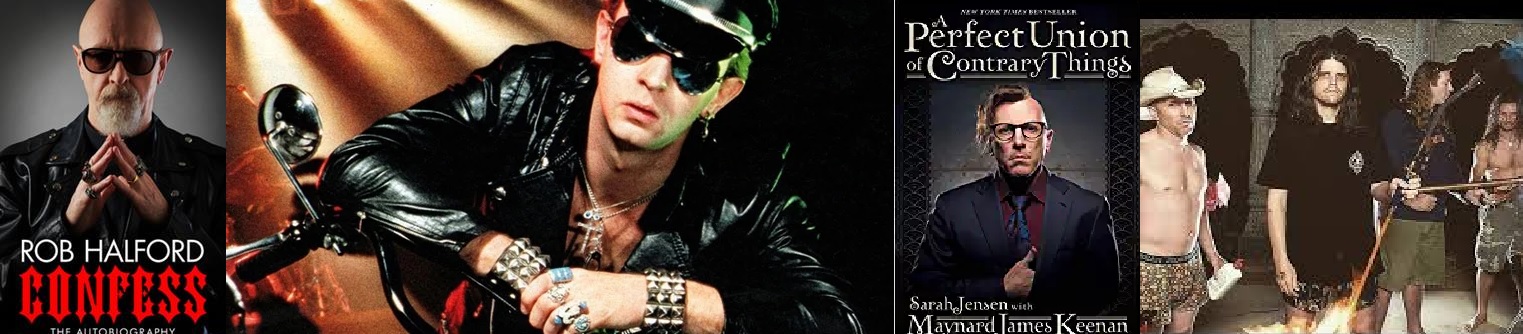
Confess, Maynard


 I put two books on my Amazon Wish List last Christmas, and my Santa-esque brother (my only one, Matt) thankfully got both for me.  The first is Confess, the autobiography of Judas Priest singer Rob Halford, and the other is A Perfect Union of Contrary Things, by Sarah Jensen with Maynard James Keenan, the enigmatic singer for TOOL, plus his side projects A Perfect Circle (APC) and Puscifer.  Confess is told in the first person by Halford himself, and covers the period all the way up to Andy Sneap’s replacement of Glenn Tipton for Firepower, the band’s latest album.  APUCT is in the third person with some direct quotes from MJK himself.

 Confess.  With the exception of original singer Alan Atkins – who left the band long before its first album, Rocka Rolla, was released in September 1974 – and brief replacement singer Ripper Owens, who only sang on Jugulator and Demolition (1995 and 1998), the singer for heavy metal band Judas Priest has been Rob Halford, from Walsall, a suburb of Birmingham, England. 

 Defenders of the Faith.  We received this album, on cassette, for free, in spring 1984 (i.e. their newest album at the time) and immediately got hooked on the band. That summer we picked up Sad Wings of Destiny on vinyl and discovered Early Priest.  When the issue of Halford’s social life came up, we took at face value his denial of homosexuality, but my friend Sean said – back in 1984 – “if he isn’t gay, why is he dressing that way?”  When Halford finally did “come out” in the early 90s, it was hardly a surprise.  Well, whatever.  We still bought Angel of Retribution, Nostradamus, Redeemer of Souls and Firepower, and still went to the concerts. 

 Having said all that, his autobiography is a bit heavy on the gay-ness, roughly 50%.  I wasn’t concerned about his “keeping in the closet”, of cruising and hooking up, of winding up with straights who have sex with men (“then you ain’t that straight!!!! Tiger Guy).  Talk about a heavy dose of TMI.  He could cut it down by half and still tell us all the stuff we care about:  how he joined Judas Priest (long before Rocka Rolla came out), the circumstances of each lineup change (particularly drummers), the background on each album and tour, and the band’s interaction with other metal bands.  Oh, and he loves “Spinal Tap”.  That’s the part I care about, and fortunately it’s here. 

 Gay Stuff.  I don’t want to devote an entire blog to this topic so I might as well address it here.   I am straight and always have been.  I have very few friends these days, and none of them are gay.  I’ve had gay acquaintances but not close relationships.   But what other people do among themselves, as consenting adults, is their business.  I have enough to worry about in my own life without getting bent out of shape about others.  Moreover, most people who bark and bray the loudest against gays usually turn out to be deep in the closet.  Again, I don’t care.

 If there is one part which does bug me, it’s this business of gays being pretentious.   I love watching “Modern Family” (though Sofia Vergara, Ariel Winter, and Sarah Hyland receive most of my attention) and the gay couple, Mitch (Jesse Tyler Ferguson) and Cam (Eric Stonestreet) seem to click all the boxes on gay stereotypes, even to the point of their friends, e.g. Pepper (Nathan Lane).  Of course, the show makes fun of Colombian drug lord culture (Gloria Pritchett, played by Sofia Vergara), goofy magic nerd realtors (Phil Dunphy, played by Ty Burrell), and stupid hot chicks (Haley Dunphy, played by Sarah Hyland), so the ridicule is evenly spread throughout. 

 In any case, Halford’s orientation was already common knowledge when he formally “came out” in the early 90s after leaving Priest, and certainly is now.  So “Confess” is somewhat of a meaningless title.  Anyhow. 

 A Perfect Union of Contrary Things.   Apparently MJK grew up in the Midwest, Ohio & Grand Rapids.  He joined the Army, but though picked to go to West Point itself from West Point Prep, actually decided to go to art school (????) in Michigan, then work in a pet store in Boston, and eventually relocated to L.A., where he worked at another pet store and met guitarist Adam Jones and drummer Danny Carey.  They formed TOOL with bassist Paul D’Amour in 1992.  After only 6 live shows, all as opening acts at microscopic clubs in L.A., somehow they got a record deal almost instantaneously. 

 After Aenima, their second album, TOOL had legal issues regarding their record contract, so MJK wound up with free, idle time, which he spent getting A Perfect Circle off the ground.  At some later point he started his second side project, Puscifer.  He also discovered jiu jitsu and set up a vineyard in Arizona.   ZZZ.

 Awhile back I read the autobiography of Brian Johnson, the singer for AC/DC (Rockers and Rollers), and blogged about it (back in 2012).   I also blogged when Axl Rose took over on the recent tour.  Brian Johnson’s voice has been accurately described as “Marge Simpson”, and of all the band members, he’s clearly the band’s weakest link.  Whether it was 1980, 1990, 2000, 2010, or 2020, Angus could find any number of singers, either professional or undiscovered in a club somewhere, who could do better than Brian Johnson. 

But to get back on topic:  Johnson’s autobiography actually made me like him LESS.  And same deal with Maynard’s.   Goes to art school instead of West Point?   Jiu jitsu and wine?  The utter pretentiousness of the book is off the chart, yet this is not a critique or expose, it’s supposed to be HIS story. 

 In fact, it does such a spectacular job at making him appear pretentious that I begin to wonder if that wasn’t the whole point all along.  Of course he’s pretentious.  He’s Maynard.  Listen to TOOL lyrics and you’ll figure that out.  The book just adds into the whole equation, a Fibonacci spiral….

 Will I stop listening to TOOL or going to their shows?  Of course not.  Same deal with seeing AC/DC live even if Marge Simpson is still their singer.  And Halford’s private life is not my concern, his music is.  These people are imperfect humans just like I am and their music is still top quality.   Sometimes, though, you find your heroes have clay feet.  And life goes on. 

Friday, February 26, 2021

Tuned Port Injection


 Back to cars again.  I joined a TPI site on Facebook and was surprised to see how many enthusiasts there still are for this GM variant of port fuel injection, which only came on Camaro Z/28s/IROCs, Firebird Formula and Trans Ams, and Corvettes, and only between 1985 and 1992 on 5.0L and 5.7L V8s.  With GM’s LS-series V8s being the current performance standard among the GM crowd, that tuned port injection still has many adherents is a remarkable surprise.  My own L98 is still languishing in a machine shop in Fairfax, Virginia, rebuilt, balanced and blueprinted with a new camshaft and aluminum cylinder heads since the donor vehicle (intense weeping) burned up in 2012. 

Carburetors.   Before any form of fuel injection, there were carburetors to mix air and fuel so an engine could make the car go.  Carburetors use a venturi inside the barrel to suck gas up and mix it with air.  They’re sized in “barrels” depending on the engine they go on.  Four and six cylinder engines typically get one barrel carburetors, six and eight cylinder engines get two barrels, and V8s usually get four barrels.  The Rochester QuadraJet is GM’s most popular and common four barrel carburetor (and what’s on my ’76 Firebird’s Olds 455 right now), the Carter AFB (Aluminum Four Barrel), now made by Edelbrock, is a popular alternative, and Holley has traditionally made aftermarket four barrels.  The ’67-69 Firebird Sprint had an overhead cam straight six with a four barrel (QJet) – Delorean was proud of that, but no one else seemed to care. 

Generally a well-tuned four barrel is all a V8 needs, but some have even more.  The Pontiac Tri-Power (1964-66 GTO) and Mopar Six-Pack set up had three two barrels.  For idle and part throttle, the engine ran off just the middle (inboard) two barrel carburetor, and at larger throttle openings up to WOT (wide open throttle, pedal all the way down to the floor) the outboard two barrels would open up, for a total of six barrels.  Some engines went even further: the ’67-69 (first generation) Camaro Z/28 had two four barrel carburetors on its fairly small 302 cubic inch V8, and the 426 Hemi had two Carter AFBs, a total of 8 barrels, aka a “dual quad” setup.   I haven’t seen a dual quad setup with QuadraJets, though.  Listen to “409” by the Beach Boys, citing the “four-speed, dual-quad, positraction 409”. 

Mechanical Fuel Injection.  Engineers weren’t satisfied with carburetors and tried mechanical fuel injection in the late 50s.  The Corvette, some Pontiac Bonnevilles and Chrysler 300s, got this deal, but mechanics were hard-pressed to work on them due to their rarity.  Mercedes insisted on putting mechanical fuel injection on all their cars from 1959 to the early 70s, at which point they switched to electronic fuel injection.   And literally all diesel engines, by design, have mechanical fuel injection.  Diesels inject the fuel directly into the cylinder on the firing stroke, which ignites immediately upon hitting the highly compressed hot air in the cylinder.  Mechanical fuel injection never managed to effectively compete with carburetors. 

Electronic Fuel Injection.   Carburetors are actually fairly complex, as they have to handle all the different fuel needs of the engine mechanically.   For cold start conditions, there’s a choke.  For idle, when the throttle is closed (e.g. at a stoplight) there’s an idle circuit.  For off-the-line boost, there’s an accelerator pump. 

But imagine if you simply had 4, 6, or 8 injectors, connected to a computer, which pulse on and off to inject fuel.  The computer could ascertain how much pulsewidth to use, and simply pulse the injectors on and off.  If the engine still doesn’t have enough fuel for its needs with the injectors continuously open, simply upgrade to larger injectors or higher fuel pressure.   Moreover, a performance makeover is as simple as replacing the EFI chip (PROM) or reprogramming the ECM (electronic control module) with a unit designed for that purpose.  And if any sensor is reporting back bizarre readings outside its normal range, the computer can shoot back a trouble code, to give the engine some self-diagnostic capability.

EFI got its start in the 1950s, but back then computers ran on vacuum tubes, not nearly as small or fast to run an engine in real time.  Bendix, which had started the whole thing, sold its rights to Bosch.  When transistors came around in the 1960s, Bosch was finally able to develop a practical ECM, and thus K-Jetronic debuted on 1968 model year VWs.  In 1972, Mercedes switched over to EFI on all its cars, and in 1976 Cadillac and Lincoln started as well.  In the early 80s, computers had gotten even better, so the Big Three could finally put EFI on more mundane cars like Chevrolets, Pontiacs, Fords, Dodges and Plymouths.

Throttle Body Injection.  Port fuel injection has an injector at each cylinder.  When I bought my 1992 Pontiac Firebird (not the Formula), it had a 5.0L V8.  On top of the engine was the familiar circular air cleaner with the snorkel.  Huh?  This 1992 car has a carburetor?  Nope – spin the wing nut off the air cleaner cover and voila – two egg-like things with wires pointing down in what looks like a carburetor but isn’t: the throttle body supplying fuel to all 8 cylinders.  TBI is a mid-range system in between carburetors and port fuel injection.

TUNED PORT INJECTION.  Finally getting to my subject.  By 1985 GM had developed a performance port fuel injection system for the Corvette, Camaro and Firebird.  Dropped onto the small block Chevy V8 in 5.0L (LB9) and 5.7L (L98) size, the system made between 205 and 230 HP on the LB9 (the higher rating on T5 manual engines) and 225 and 245 HP on the L98.  Most of those got the 700R4 automatic transmission, as GM knew only Corvette owners would be willing to pay $3000 just to get a five speed manual ZF transmission. 

The TPI setup has a baseplate, a pair of runners, a plenum, 8 injectors on a fuel rail with a fuel pressure regulator, and a throttle body.  It has a distributor, HEI, either in-cap or external coil.  Supposedly the whole setup is optimized for 5.0L V8s and is a bit restrictive on 5.7L V8s.  Naturally the aftermarket has made larger runners, a larger baseplate (apparently the plenum is not the choke point) and larger throttle body plates.   My own L98 was upgraded with SLP parts: larger, siamesed runners, plus headers, a larger throttle body, 3” exhaust, a performance PROM, etc. for a total of 50 HP over the stock rating, thus 290 HP.  On my watch I added a TPIS baseplate and upgraded the transmission and rear end (3.73 rear ratio).

Again, 1992 was the last model year any GM vehicle had this system, and the LS motors are GM’s current performance standard.  But I’m still seeing strong interest in TPI engines, often transplanted into trucks and other cars other than Camaros, Firebirds or Corvettes.  Naturally those cars are also getting LS swaps. 

C4 (1984-96) Corvettes have a clamshell hood which hinges up from the front, not only on top but around the sides, leaving the top of the front tires exposed.  In Camaros, the TPI intake flows straight forward and splits into two inlets in front of the engine.  On Firebirds, the TPI intake takes a 90 degree right turn and winds up taking its air from a box at the front right corner of the engine compartment.   Camaro TPI air filters are small and square, while the Firebird TPI air filter is a short cylinder. 

More power.  For those wanting more, there were nitrous setups for TPI engines, bolting on between the throttle body and the plenum.  Nitrous is really only practical for drag racing cars, though.  Paxton and Vortech both made supercharger setups which bolted to the front and pumped air into the throttle body.  Of course, nowadays the most often advice would be to swap in an LS motor.  Not having driven any late model GM cars (1998 or later) with those engines I can’t comment.  And I’m still trying to find an ’88-92 Firebird Formula to drop in that rebuilt L98 sitting in the machine shop….

Friday, February 19, 2021

RUSH


I recently finished listening to the more recent Rush albums, and also noticed that, aside from a brief paragraph about the band in my blog about rock trios, I haven’t done a full blog.  Drummer Neil Peart has written four books, and I blogged about him before (Neil Peart – Drummer & Author, March 15, 2007). 

Toronto, Canada.  The capital.  No, that’s Ottawa – I visited there in 1991, never been anywhere else in Canada.   Geddy and Alex are from there, Peart being from St. Catherine’s (on the southern shore of lake Ontario, due west of Buffalo), and considered it their home town. 

Geddy Lee.   Vocalist, bassist, and keyboardist.  His distinctive vocals took some time to get used to, but now I don’t mind them at all.  In some ways they remind me of Burke Shelley, bassist/vocalist for Budgie, another famous trio from the 70s.   Back in the day he favored Rickenbacker basses.  Nowadays he’s more into Fender Precisions running straight into the P.A.  He has washing machines on stage instead of amps. 

Alex Lifeson.   Guitar.  His Les Pauls and Gibson Doublenecks gave the earlier albums plenty of bite and crunch, but with the Light Meh albums was practically nonexistent.  His sense of humor is easily the strongest (“blah, blah, blah”) and he’s been on “Trailer Park Boys” three times.

Neil Peart.  Drummer and lyricist.  Generally the band’s drummer is the least intelligent and articulate, someone who “hits things with sticks” (Peart’s own words).  Peart was much more intelligent, even to the point of writing the band’s lyrics and coming up with their concept albums, most notably 2112, based on Ayn Rand’s story Anthem (albeit with a more tragic ending).  He’s written several books, mostly about his road trips.  I described these in far more detail in my prior blog, “Neil Peart – Drummer & Author”, dated 3/15/2007.  I have read them all and can heartily endorse them: Masked Rider: Cycling in West Africa; Ghost Rider: Travels Along the Healing Road; Travelling Music: The Soundtrack of My Life And Times; and Roadshow: Landscape With Drums, A Concert Tour By Motorcycle.  In fact, having enjoyed Innocents Abroad (1869) and A Tramp Abroad (1880), Mark Twain’s travel diaries, I can tell you that Peart is in some ways a modern equivalent of Twain. 

He had the immense misfortune of losing his daughter Selena and first wife Jackie in short order.  His daughter was driving to start college in August 1997, had a car accident along the way, and died.  His wife never recovered from the intense shock, and was dead herself ten months later.   To avoid taking his own life, he went travelling across the US.  Peart himself died of brain cancer in January 2020, just over a year ago.

When I reached college, I took up Peart’s obsession with Ayn Rand myself, as a government & politics major.  I eagerly devoured The Fountainhead, Atlas Shrugged, and her nonfiction, much to everyone else’s annoyance.   Certainly it’s there in “2112” (side-long title track), but also “Free Will” and other songs.  What’s funny is that Geddy actually sings these lyrics and isn’t always aware of what they mean (Tobes of Hades?  Let me get back to you on that).   

John Rutsey.  The original drummer, he’s only on the first, self-titled album.  He had health issues which prevented him from touring and quit the band early on, replaced by Peart.   Back then they were pretty much copying Led Zeppelin – so much so, that when their first single, “In The Mood”, hit the airwaves, fans called the radio station asking about the “new Led Zeppelin album”.   He died in May 2008.

Discography.   Actually, the band has, as I might describe it, four separate phases, into which I’ll divide the albums.

ROCK.  Rush (1974), Fly By Night (1975), Caress of Steel (1975).   Plus Feedback (2004) a collection of covers.    This is back when they were a classic rock band, with longer songs, blues solos, and truly kicked ass. 

PROG.  2112 (1976),  A Farewell to Kings (1977), Hemispheres (1978), Permanent Waves (1980), Moving Pictures (1980).   Now the songs get more complicated, multiple parts, somewhat more pretentious, though Moving Pictures songs are fairly short.  That album was my introduction to the band around 1982.

LIGHT MEH.   Signals (1982), Grace Under Pressure (1984), Power Windows (1985), Hold Your Fire (1987), Presto (1989), Roll The Bones (1991).  Although he’s nominally listed as a band member, Alex Lifeson’s guitar work here is practically nonexistent, buried deep in the music and his distortion pedal (or Marshall head) apparently mothballed.  To me this is one step removed from elevator music.  Mind you, my review of these albums was in the last few weeks, long after my teenage years where I thought Pink Floyd was too weird.  These days I can handle the Grateful Dead and Frank Zappa.  So even now, this material goes in one ear, out the other. 

HEAVY MEH.  Counterparts (1993), Test For Echo (1996), Vapor Trails (2002), Snakes & Arrows (2007), Clockwork Angels (2012).   Alex is back!  You can hear his guitar!  And there’s some distortion in there.  It doesn’t come backup to 70s standards, but it’s far more energetic and dynamic than last few albums.   Having said that, I have no idea how much time I have left on this planet, and I’m ill-inclined to waste any more of it listening to anything after Moving Pictures – except maybe Feedback.   

Live.  As my first ever concert was AC/DC in Paris in 1984, I obviously wasn’t able to see Rush during the 1970s, when they opened for Blue Oyster Cult or KISS.  The shows I have seen are:

1.         11/30/87 at the Capital Centre, Largo, Maryland, on the Hold Your Fire tour. 

Setlist: The Big Money; Subdivisions; Limelight; Marathon; Turn The Page; Prime Mover; Manhattan Project; Closer to the Heart; Red Sector A; Force Ten; Time Stand Still; Distant Early Warning; Lock and Key; Mission; Territories; YYZ; drum solo; Red Lenses; The Spirit of Radio; Tom Sawyer; encore: 2112: Part I: Overture; 2112 Part II: The Temples of Syrinx; La Villa Strangiato; In The Mood

2.         6/20/97 at Nissan Pavilion, Bristow, VA on the Test For Echo tour.

Setlist:  Set 1: Dreamline; Limelight; Stick It Out; Driven; Half The World; Red Barchetta; Animate; Limbo; The Trees; Virtuality; Nobody’s Hero; Closer to the Heart; 2112 Part I: Overture; 2112 Part II: The Temples of Syrinx; 2112 Part III: Discovery; 2112 Part IV: Presentation; 2112 Part V: Oracle – The Dream; 2112 Part VI: Soliloquy; 2112 Part VII: Grande Finale [full 2112 suite in its entirety]

Set 2: Test For Echo; Freewill; Red Sector A; Roll The Bones; Resist; Leave That Thing Alone; drum solo; Natural Science; Force Ten; The Spirit of Radio; Tom Sawyer; encore: YYZ

3.         8/3/04 at Nissan Pavilion on the Feedback tour.

Setlist: Set 1: Finding My Way/Anthem/Bastille Day/A Passage to Bangkok/Cygnus X-1/Cygnus X-1 Book II: Hemispheres Part I: Prelude (R30 Overture); The Spirit of Radio; Force Ten; Animate; Subdivisions; Earthshine; Red Barchetta; Roll The Bones; Bravado; YYZ; The Trees; The Seeker (The Who); One Little Victory

Set 2: Tom Sawyer; Dreamline; Secret Touch; Between the Wheels; Mystic Rhythms; Red Sector A; drum solo; Resist; Heart Full of Soul (Yardbirds cover); 2112 Part I: Overture; 2112 Part II: The Temples of Syrinx;2112 Part VII: Grande Finale; La Villa Strangiato; By-Tor & The Snow Dog; Xanadu; Working Man;

Encore: Summertime Blues (The Who cover); Crossroads (Cream cover); Limelight

4.         9/18/10 at Jiffy Lube Live (= Nissan Pavilion renamed), on the Snakes & Arrows tour.

Set 1: The Spirit of Radio; Time Stand Still; Presto; Stick It Out; Workin’ Them Angels; Leave That Thing Alone; Faithless; BU2B; Freewill; Marathon; Subdivisions

Set 2: Tom Sawyer; Red Barchetta; YYZ; Limelight; The Camera Eye; Witch Hunt; Vital Signs [= Moving Pictures in its entirety]; Caravan; drum solo; Closer to the Heart; 2112 Part I: Overture; 2112 Part II: The Temples of Syrinx; Far Cry; encore: La Villa Strangiato; Working Man

5.         5/30/15 at Jiffy Lube Live on the Clockwork Angels tour.

Set 1: The Anarchist; Clockwork Angels; Headlong Flight; Far Cry; The Main Monkey Business; One Little Victory; Animate; Roll The Bones; Distant Early Warning; Subdivisions

Set 2: Tom Sawyer; YYZ; The Spirit of Radio; Natural Science; Jacob’s Ladder; Cygnus X-1 Book II: Hemispheres Part I: Prelude; Cygnus X-1; Closer to the Heart; Xanadu; 2112 Part I: The Overture; 2112 Part II: The Temples of Syrinx; 2112 Part IV: Presentation; 2112 Part VII: Grand Finale; encore Mel’s Rock Pile Featuring Eugene Levy; Lakeside Park; Anthem; What You’re Doing; Working Man; Exit Stage Left outro video

Unlike the Grateful Dead, with different setlists every night and extended jams, Rush give you what’s on the album, note-for-note, with no improvisation at all.  Listening to All The World’s A Stage (the live album recorded on the 2112 tour) I do hear some variation, but that was before they locked everything down.  However, they do have some interesting visuals, some even humorous:  South Park doing Lil’ Rush, and Cartman adlibbing “Tom Sawyer” but describing Huckleberry Finn (“going down the river on a raft with a black guy”).  So I can say I did enjoy all 5 concerts.  

With Neil’s death in January 2020, that puts an end to Rush as we know it.  Whether Geddy and Alex will do anything else remains to be seen.  Stay tuned….

Friday, February 12, 2021

Bar Exams


Yet again, writer’s block hits me this week, as practically any subject I’d care to hit I’ve hit before.  Here goes.

I graduated from George Mason University School of Law (GMUSL) – now Antonin Scalia School of Law – in May 1993, with Ruth Bader Ginsburg, just months before joining the US Supreme Court, as our commencement speaker.  I do not recall her speech, and I’m led to understand from an unnamed classmate (also male) that the speech was directed at the half of our class who shared Ms. Ginsburg’s gender, i.e. not me.

Fortunately, I was employed by an attorney (Jerry) at the time, so my next task, Juris Doctor (law degree) in hand, was to pass the bar exam.  My comrade Greenside and I drove down to Roanoke on a Monday in July 1993, to endure two days of bar examin-ing, in suit & tie, no less.  Not sure if it’s still required, but back then, the Virginia bar required you to actually dress up to take the exam.

Virginia.  July 1993.  Tuesday was the essay portion – three hours in the morning, three in the afternoon, 10 short essay questions.  Wednesday was the Multistate portion, all multiple choice, for which on any given question you had 25% of getting it right even guessing at random.

Maryland.   July 1993.  Greenside would not be taking the Maryland exam because he lives down in Virginia Beach.  So I flew back on Wednesday night, driving up to Timonium, Maryland near the state fairgrounds, to take the Maryland essay exam on Thursday morning.  Unlike Virginia, Maryland does not require formal business attire.  Their essay portion was 2 hours and 15 minutes morning and afternoon, and very long, multi-part essay questions.  With that, I was done.   Jerry and I went on to handle a three day jury trial in US District Court in Baltimore – a drug dealer suing cops for police brutality.  Not a sympathetic client.  Anyhow. 

Results?  In October 1993, I received the news:  I had FAILED the Virginia bar exam, by mere points.  On reconsideration, the bar examiners insisted that I had still failed.  I would have to take the February 1994 exam.  D’oh!

In November 1993, I received the GOOD NEWS that I had PASSED the Maryland bar exam.  In early December 1993 I took a mandatory professionalism class in downtown Baltimore, and on December 16, 1993, in Annapolis, Maryland, I was sworn into the Maryland bar.  I was now an attorney – albeit only in Maryland.

February 1994.  The next Virginia exam was down in Norfolk.  To make matters worse, they had completely changed the format from July 1993: now it was long, detailed essay questions (75%) followed by fill-in-the-blank questions (25%), though working with Jerry I knew most of the answers from practical experience.   However, due to the new format, the bar review courses (BAR/BRI, etc) were useless, and simply advised everyone to study as much as possible and hope for the best.

On returning to the office the following Monday, I got the bad news from Jerry that he was laying me off.  D’oh!  He gave me the month of March as severance – full pay, don’t have to work – but that was it for the time being.  I now had a surplus of free time.  I bought a textbook on auto mechanics and went from being clueless about how cars worked to being able to pass ASE exams and taking classes at NOVA-Alexandria, right next door to where I live today.

In April, I came back from wherever I had been during the day, to find a small envelope in my mailbox, from the Virginia Board of Bar Examiners.  It was their ecstatic pleasure to inform me that I had somehow managed to PASS the February 1994 Virginia bar exam.  “Await further instructions”.   That meant another mandatory professionalism course – I recall Judge Bach, of the Fairfax County Circuit Court, telling us the story of an attorney who insisted her criminal client “studied at George Mason University School of Law”, only to have to admit that the defendant wasn’t actually a law student, he merely read books in the law library.  Way to go, counsel. 

On June 6, 1994, in downtown Richmond, Virginia, I swore into the Virginia Bar.  Now I was finally licensed in Virginia – albeit without a job.  That December, Jerry hired me back, and that lasted until May 1998, at which point Jerry got hired by a huge law firm that didn’t want me, and he closed the firm.

Waive-Ins.   Aside from actually taking a state’s bar exam, you can waive in, if you’ve been practicing somewhere else for some time.

DC.  I waived into DC in 2012.  That involved a brief, informal meeting with DC lawyers at the courthouse on Indiana Ave.  They were impressed enough to recommend my admission, and a few months later I was sworn into the DC Bar. 

I’ve had only a few DC cases to date.  As yet, the majority of my experience (60%) is in Virginia (plus admission to the US District Court for the Eastern District of Virginia) with the balance (38%) in Maryland, also admitted to the US District Court for the District of Maryland.  I never got around to being admitted to the US District Court for the District of Columbia.   Note that being admitted to state bar does NOT give you admission to the federal courts in that state.  You have to be sponsored by an existing member, and formally admitted.  My primary purpose in doing so is to handle bankruptcy cases, which are 100% federal law.

New York.  Avoiding that notoriously difficult NY bar exam, I waived in.  In December 2013 I failed to impress a three lawyer panel in Albany of my merit and character.  I appealed that decision, and in December 2014 I went back up to Albany for a formal hearing, which Jerry attended over the phone, testifying as to my character.  This panel, a different trio of lawyers, felt considerably better about me and recommended my admission.  In June 2015, I went back up to Albany a third time and swore into the New York Bar.  

As yet I have had NO NY clients and have yet to set foot in any courtroom in New York.  My inclination would be to sit in and listen, but with my current relationship status (no longer romantically linked to anyone in Fort Lee, New Jersey) and the COVID drama – which is pushing many court appearances online to avoid the virus – that looks extremely unlikely for the near future.

“Suits”.  While I’m on the topic, I’ll bring up this TV show.  It takes place in Manhattan, New York, and covers a major law firm in the city which exclusively hires Harvard Law School graduates.  Meghan Markle, who plays Rachel Zane, wound up marrying Prince Harry.  Yes, that guy.  The main character is Mike Ross (Patrick J. Adams), who apparently has photographic memory:  he need only read a page one time and can remember it verbatim.  For some reason, he could NOT get into law school or get a J.D., however, he took and passed the bar exams, fraudulently doing so for other applicants who presumably did have law degrees but weren’t nearly as astute at taking exams (you know, like the exams you have to take in law school).  He’s hired by the firm’s senior partner, Harvey Specter (Gabriel Macht) as an associate (employee attorney on salary, not a partner).   Again, not only is Ross not a licensed attorney in ANY jurisdiction (least of all New York) he doesn’t even have a law degree.   Of course, they have to keep this a major secret.  I’ve finished season 1, and so far I’ve seen at least one episode where he appears IN COURT, in front of a judge, representing a client as an attorney.   He also has to attend a Harvard Law School alumni function and of course, no one recognizes him.  The utter implausibility of the entire premise doesn’t completely undermine its entertainment value, so I suppose I may continue watching….

Friday, February 5, 2021

Hawkwind


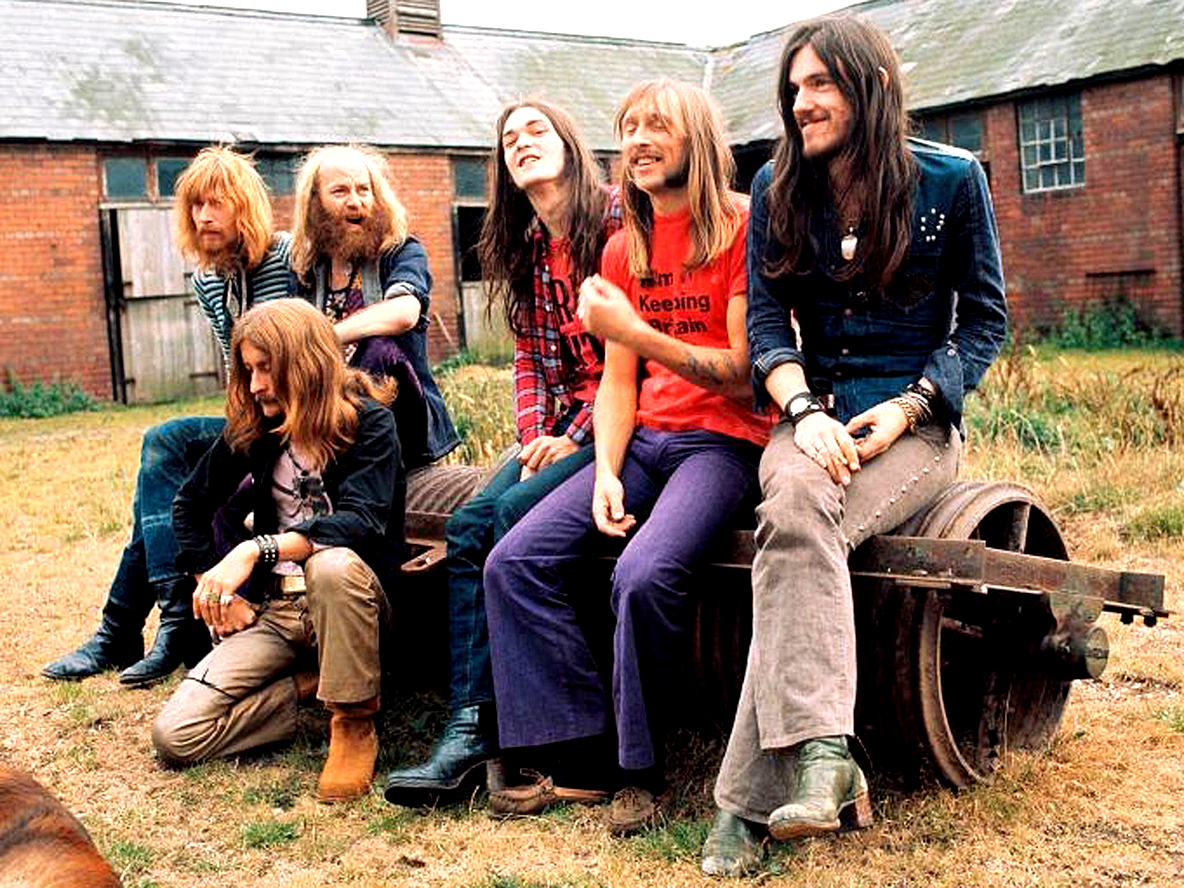
Neil (Nigel Planer): "Why don't they ever play Hawkwind or Marillion??"

 I had reviewed this band in the past, but mostly in passing.  I felt a more comprehensive discussion was appropriate.

Band.  They started out in London in 1969 and are in still in existence, though with only one consistent member, Dave Brock.  The “classic era” was in the 1970s, but despite declining popularity and publicity Brock has maintained the band.  Of course, there have been numerous lineup changes over the years.

At this time my recollection is that I got into Hawkwind from two sources.  First, in August 1985 my brother started taking guitar lessons from a very cool guy, Joel, and I began doing so the week after.  I almost immediately caught the fever to buy a Fender Stratocaster, but at this stage, neither my talent nor budget merited a full US-made ($$$) version, so I took a temporary job at the US Embassy, Office of American Services, making tourist passports.  The French guy running things was Bernard, who turned me on to Hawkwind.  About this time the band came out with Chronicle of the Black Sword, their Elric of Melnibone concept album, and the two together induced me to start listening. 

DiscographyHawkwind (1970); In Search of Space (1971); Doremi Fasol Latido (1972); Hall of the Mountain Grill (1974); Warrior at the Edge of Time (1975); Astounding Sounds, Amazing Music (1976); Quark, Strangeness & Charm (1977); 25 Years On aka Hawklords (1978); PXR5 (1979); Levitation (1980); Sonic Attack (1981); Church of Hawkwind (1982); Choose Your Masques (1982); The Chronicle of the Black Sword (1985); The Xenon Codex (1988); Space Bandits (1990); Electric Tepee (1992); It Is The Business of the Future to Be Dangerous (1993) White Zone (1995); Alien 4 (1995); Distant Horizons (1997); In Your Area (1999); Spacebrock (2000); Take Me To Your Leader (2005); Take Me To Your Future (2006); Blood of the Earth (2010); Onward (2012); Stellar Variations (2012); The Machine Stops (2016); Into the Woods (2017); Road to Utopia (2018); All Aboard the Skylark (2019); Carnivorous (2020).    As you can see, they’ve been continuously releasing material for 50 years, and will probably continue to do so until Dave Brock retires or passes away.

Plus their VERY famous, Lemmy-era live album (recorded on the Doremi Fasol Latido tour), Space Ritual

Stacia.  Back in the 70s they had this tall, well-proportioned stage dancer on tour with them, sometimes even nude.  It certainly made the experience more fun, though I can’t say I’ve had the pleasure of seeing any shows with her on stage. 

Nik Turner.  Right up there with Dave Brock in contribution in the 70s, mostly playing flute.  Jimi Hendrix made a reference to him at Isle of Wight.  Although long since gone from the band, he still puts out albums and tours periodically, and his live sets are far more focused – as you might imagine – on the 70s material.  In that regard his shows were better for someone like me who was more familiar with that material.

Bob Calvert.  Another eccentric contribution to the band, and like Turner, only in the 70s.  He has a solo album, Captain Lockheed and the Starfighters, about the ill-fated jet plane which had a bad reputation for disintegrating in midair. 

Lemmy.  By far their most famous member, on Doremi, Hall, and Warrior, kicked out of the band on that tour after being arrested by Canadian authorities.  In his autobiography, he says he was very happy in the band and would not have left had he not been fired.  Thereafter he formed Motorhead.  “Motorhead”, “Lost Johnny”, and “The Watcher”, plus “Silver Machine”, were Lemmy’s contributions, and Motorhead fans could occasionally hear his band play them.  My understanding is that they reconciled fairly soon.  Sadly, he was never in the band with HLL (see below) except for a handful of one-off appearances. 

Huw Lloyd Langton.  Their excellent guitarist, appearing on the first, self-titled album, then on Levitation through The Xenon Codex – i.e. throughout the 1980s.  He gave the band a good dose of blues-oriented solos, and remains by far my favorite Hawkwind guitarist.

I get Del Dettmar and Dik Mik mixed up, plus Simon House and Simon KingAlan Davey and Harvey Bainbridge were more recent band members.  Ginger Baker, the drummer for Cream, was on Levitation.

Michael Moorcock.  The sci-fi author had a close relationship with the band, not merely inspiring the Chronicle album but actually writing a few songs.

Concerts.  Sadly, they don’t seem to the tour the US very often, and the only concert I was able to see in London – I believe we visited in 1981, 1983, and 1985, the odd-numbered years when we didn’t go back to the US – was Donington in 1985.  My two shows are December 1990 and April 1995, both in the Washington, DC area, plus a show by Nik Turner. 

Drugs.  With the opening track on Electric Tepee named “LSD”, it’s no secret or surprise what the band’s drug of choice is.  Put the band up with Pink Floyd and the Grateful Dead in terms of being “drug-orientated band, you can trust us…”  Having said that, I can still enjoy much of their material even without any chemical enhancement. 

Influences.  Monster Magnet have covered “Brainstorm” and “The Right Stuff”, and I saw a recent pic of Mikael Akerfeldt – the charismatic frontman for Swedish prog-metallers, Opeth – wearing an In Search of Space t-shirt.  Maybe they deserve more credit, relative to Black Sabbath, for the stoner rock genre.  

Friday, January 29, 2021

TV 2021


 I have a 40+” screen at home, hooked up to a DVD player and an XBOX One.  The latter serves 95% of the time for streaming and 5% for those green boxes with game DVDs in them.  It’s reached the point where I have to keep track of which streaming service the show I want to keep watching is on…

I’m old enough to remember television:  three major VHF channels:  Channel 4 was NBC, Channel 7 was ABC, and Channel 9 was CBS (Washington DC area).  There were some UHF channels with PBS and other odd channels.  We moved to Paris in 1979 and did not care much for French TV, even if some of that was US shows dubbed into French.   When we went up to SHAPE we could watch AFN (Armed Forces Network) TV at the Raymond Hotel in Mons, Belgium – that was older US TV shows with public service announcements where advertising would normally be.  The primary purpose of the big 26” TV in a wooden box was to put the humungous VCR on top to watch VHS tapes: first ones being the 1976 “King Kong” with Jeff Bridges, Jessica Lange, and Charles Grodin, and first recorded movie being “The Odessa File” (1974 with Jon Voigt).  Our friends had relatives back in the Boston area taping US TV shows for us, but their tastes were along the lines of Lawrence Welk and “Murder, She Wrote”.  You know, old people stuff.  But we’re talking about the early 1980s, well before FOX and more provocative programming. 

Eventually DVDs came around, plus the flat screen TVs far larger than 26”.  Now we’ve got streaming.

Netflix.  Remarkably, I STILL borrow DVDs from Netflix.  However, the days when a red envelope wound up back with them the day after, and I received my next movie the day after that, seem to be long gone.  However, a note “DVD ONLY” for a movie does not discourage me at all:  send it to me and I’ll watch it.  You’ve spared me the need to find it on YouTube or buy it used. 

Shows I’ve been watching:  The Crown (still season 1), Schitt$ Creek (finished season 1), Disenchantment (previously finished S2, but rewatching S1 again now that S3 is available), Umbrella Academy (finished S1), The Politician (finished S1).  I was watching the Original Twilight Zone (finished S4), Peaky Blinders (finished S1), Riverdale (finished S2), and as noted in the last blog, Babylon Berlin.  Their original programming is competitive and watchable.

Amazon Prime.  The $12.99 membership gives some excellent viewing – plus free shipping and far quicker delivery times than USPS these days.  Shows:  Goliath (finished S2), Suits (finished S1), 30 Rock (finished S1), Roadkill (still plowing through S1, brings me back to my earlier days working on my cars and subscribing to Car Craft), The Boys (finished S2, glad to hear S3 is on its way), Tin Star (finished S2), and of course, High in the Man Castle.  

Hulu.  I had to get Hulu to continue with season 4 of Burn Notice – that Miami-based show about the CIA operative, Michael Weston (Jeffrey Donovan) who was inexplicably fired from the CIA while in the middle of an operation in Lagos, Nigeria and is trying to figure out what happened, while he takes miscellaneous jobs – narrated by him in the first person – which take advantage of his unusual skill set.  Sharon Gless of “Cagney & Lacey” plays his mom (Tyne Daley guest stars in one episode) and Bruce “Army of Darkness” Campbell is his FBI buddy, Sam Axe, who helps out.  There’s also a hot skinny chick, Gabrielle Anwar, as his “no, I am NOT gay, Sam and I are just friends” GF and close associate.  I can’t help calling this “BURN!!” (KELSO!) Notice.  Hulu also has Black Jesus – Aaron “Boondocks” McGruder’s most recent thing – and Archer, including the most recent season 11.  

Disney+.  This has ALL of “The Simpsons” (just finished Season 16) and all the “Star Wars” stuff, including our beloved Man Delorean. 

CBS All Access.   This has all the Star Trek stuff:  the movies, the Original Series, plus Next Generation, Deep Space Nine, Voyager, Enterprise, Discovery, Picard, and Lower Decks, plus the movies. 

Binge Watching.  I think we’ve reached a critical mass where they are coming out with new TV shows faster than anyone can watch them.  As for watching a show from start to finish nonstop, even if it’s only one season, I don’t have the patience for that.  I prefer to mix things up.  Recently I was alternating “M*A*S*H” (Season 4, we’ve got BJ Hunnicutt and Colonel Potter, but still Major Frank Burns) and “Modern Family” (Season 10, Alex graduates from CalTech, Dylan and Haley have twins).   Both of those, however, I was watching on DVD, not streaming.

Friday, January 22, 2021

Destination Berlin


I’ve been fortunate in my life to have lived in Paris from 1979 to 1990, and visited other places, such as Rio de Janeiro, Brazil, Bucharest, Romania, and several different places in Europe.  But one place in particular has eluded me thus far, and I do want to go there before I die (after, if that’s possible):  BERLIN.

[I actually covered this topic on March 2, 2012 with a blog titled simply "Berlin".  However, that mostly covers a fiction novel, The Garden of Beasts, by Erik Larson, and a nonfiction book, Berlin At War, by Roger Moorhouse.  Fortunately most of the current blog does not repeat the prior one.]

Initially the capital of Prussia, and then the capital of unified, Imperial Germany (1871-1918), the Weimar Republic (1918-1933 – though my high school history professor, Mr. Mimmack, noted that since Adolf Hitler took power by legitimate means in January 1933, technically Nazi Germany qualifies as an extension of the Weimar Republic itself), and Nazi Germany (1933-45).  

After World War II, both Germany itself and Berlin were separated into East and West.  East Berlin was the capital of East Germany, more officially known as the German Democratic Republic (GDR in English, DDR in German), whereas the West German capital, of the Federal Republic of Germany (Bundesrepublic Deutschland, in German) was Bonn, best known as the birthplace of Ludwig von Beethoven, though he moved to Vienna at 21.    

In 1961 the East Germans, fed up with their own people escaping from boring, oppressive East Berlin into West Berlin, built a WALL (no thanks to Roger Waters, though he did play a concert there) – eventually torn down in 1989 when the Soviet Union collapsed, bringing the East Bloc down with it as well.  Berlin finally became one city again.

Germany vs. Prussia vs. Brandenburg.   Brandenburg is a province of Prussia.  Up until 1871, Prussia was a sovereign state, a kingdom run by a king (konig).  Of the various different entities which collectively made up what became Germany in 1871, Prussia was the most important.  Bismarck, the architect of Prussia’s success against Denmark (1864), Austria (1866), and France (1870) orchestrated Prussia’s takeover of the rest of Germany to become the empire, and the King of Prussia, of the Hohenzollern dynasty, became the Emperor (Kaiser) of Germany.  Was Germany truly unified, or did Prussia simply take over the rest?  During WWI, the various different kingdoms and principalities supplied their own armies to the cause, with varying degrees of independence, Bavaria being the second-strongest after Prussia.  In any case, Brandenburg was a sub-part of Prussia, which itself was a sub-part of Germany. 

The fervent Germanophile I have been, I was obviously fascinated by Berlin, but so long as it was divided into West and East, with that pesky, inconvenient WALL, my interest was attenuated.  I wanted to experience the Berlin of the Kaiser, Weimar Republic, and Nazi-Town.  Since time travel still doesn’t exist, that’s not a realistic option, but maybe one day I can visit the current city, which has enjoyed reunification for the past 30 years. 

Unknown.  A recent film with Liam Neeson, January Jones, and Diane Kruger, taking place in modern Berlin.  Neeson plays a guy who winds up with amnesia after his cab plunges into the river.  He has to figure what is going on, while other considerably less polite people try to kill him.  The TV Tower and Brandenburg Gate feature prominently – and one character is a former Stasi (East Germany secret police) agent. 

Babylon Berlin.  I reviewed this series after its second season and watched the third when it came out.  Oddly, I don’t see much in the way of panoramic views of the city in this show.  For that matter, I don’t recall seeing Brandenburg Gate at any point in the series.  Although set in Berlin, I don’t see nearly enough of it to make a difference.  Likewise with “Gentlemen Comrades” taking place in Moscow in 1918.  My guess is that too much has changed in Berlin and Moscow to allow those cities, at the present time, to effectively portray their older selves.  I recall reading about “The Last Samurai”, that Tom Cruise movie from way back, taking place in Yokohama in the late nineteenth century but filmed on a soundstage somewhere because present day Yokohama is full of neon and skyscrapers and looks nothing like its late nineteenth century self.

That being the case, I’m on notice that if “Babylon Berlin” cannot show me old-timey Berlin, there’s a limit to how much I can enjoy.  However, the following appear to be the most famous Berlin landmarks: Brandenburg Gate (1788); the rebuilt Reichtag (no longer on fire); the TV Tower; Charlottenburg Palace, the Gendarmenmarkt; the Tiergarten & the Victory Column; the Kurfurstendam (commercial avenue, Berlin’s Champs Elysees), and Unter den Linden (fancy tree-lined avenue).  Needless to say, if I did visit, I would appreciate a tour.